AQA · A-Level · History
Course version: 7042 · Version from Sept 2017
Opposition of individuals and groups: faction and curbing internal…
Full specification wording
1B Spain in the Age of Discovery, 1469–1598 (A-level only) – The 'Golden Age', 1556–1598 (A-level only): Opposition of individuals and groups: faction and curbing internal rebellions
Philip II faced significant opposition from both individuals and groups, challenging his centralising policies.
Checked against the AQA 7042 specification (opens in a new tab) on .
- Point 2 of 6
- 2 key terms
Study notes
From the checked teaching notes for this specification point.
The idea
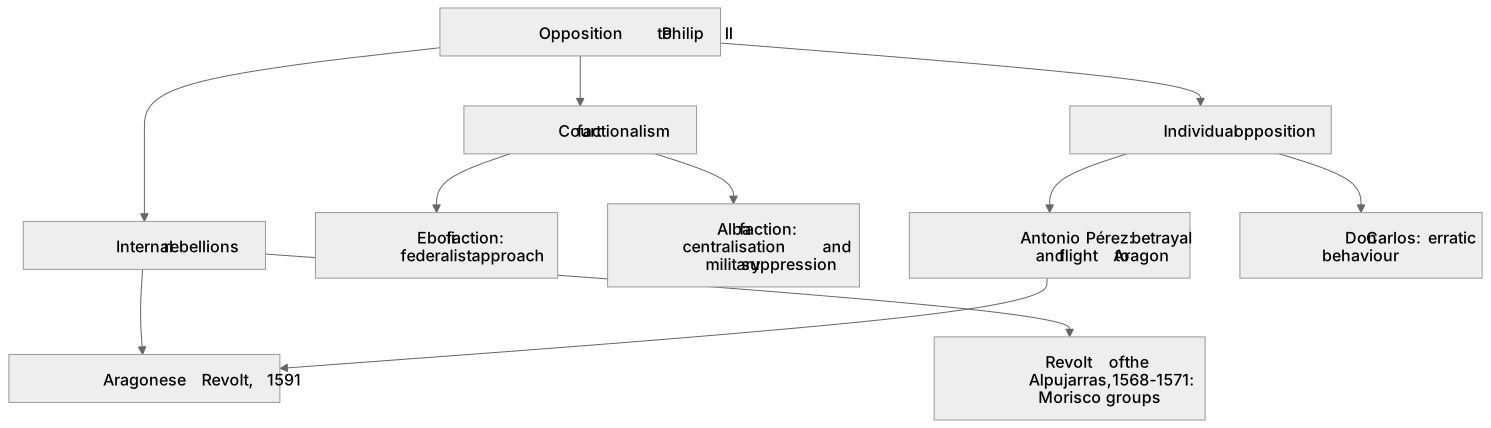
Philip II faced significant opposition from both individuals and groups, challenging his centralising policies. At court, intense factionalism emerged between the Eboli faction, favouring a federalist approach, and the Alba faction, advocating for centralisation and military suppression. Individual opposition included the betrayal by his secretary Antonio Pérez and the erratic behaviour of his heir, Don Carlos. Philip ruthlessly curbed internal rebellions to maintain authority. The Revolt of the Alpujarras (1568–1571) saw Morisco groups rebel against cultural repression, suppressed brutally by Don John of Austria. Later, the Aragonese Revolt (1591), sparked by Pérez fleeing to Zaragoza, forced Philip to use military force to curb regional privileges.
What earns the marks
- Analyse the ideological and political differences between the Alba and Eboli factions and how Philip manipulated them to maintain control.
- Evaluate the threat posed by individual opposition, specifically the political crisis triggered by Antonio Pérez's defection and flight to Aragon.
- Assess the causes and consequences of the Morisco Revolt in the Alpujarras, focusing on religious assimilation policies and the subsequent dispersal of Moriscos.
- Examine the Aragonese Revolt of 1591 as a clash between Philip's centralising administration and traditional regional fueros (privileges).
Common mistakes and how to put them right
Confusing the Morisco Revolt of the Alpujarras with the later expulsion of the Moriscos.
Put it right: Philip II dispersed the Moriscos across Castile after the 1568-1571 revolt; the final expulsion occurred later under Philip III in 1609.
Viewing court factions merely as personal rivalries.
Put it right: Factions like Alba and Eboli represented distinct political ideologies regarding how to govern the empire and handle the Netherlands.
Stating Philip abolished Aragonese fueros after the 1591 revolt.
Put it right: While he executed the Justicia Mayor and altered some laws, Philip largely respected the traditional fueros to restore peace.
Exam tips
- Link the Antonio Pérez affair directly to the Aragonese Revolt to demonstrate how individual opposition could ignite broader regional group rebellion.
- Use the Revolt of the Alpujarras to illustrate the intersection of religious policy, internal security, and the fear of Ottoman intervention.
- Discuss Philip's management of court factions as a deliberate strategy of divide and rule, rather than a sign of administrative weakness.
Try the lesson
The start of the 1B Spain in the Age of Discovery, 1469–1598 (A-level only) – The 'Golden Age', 1556–1598 (A-level only): Opposition of individuals and groups: faction and curbing internal rebellions lesson, made from checked teaching notes for this specification point.
Have a go first
Which internal rebellion did Philip II face in 1568, primarily caused by his policies of cultural assimilation and religious suppression?
Listen
Philip II faced significant opposition from both individuals and groups, challenging his centralising policies. At court, intense factionalism emerged between the Eboli faction, favouring a federalist approach, and the Alba faction, advocating for centralisation and military suppression. Individual opposition included the betrayal by his secretary Antonio Pérez and the erratic behaviour of his heir, Don Carlos. Philip ruthlessly curbed internal rebellions to maintain authority. The Revolt of the Alpujarras (1568–1571) saw Morisco groups rebel against cultural repression, suppressed brutally by Don John of Austria. Later, the Aragonese Revolt (1591), sparked by Pérez fleeing to Zaragoza, forced Philip to use military force to curb regional privileges. A strong answer earns marks for these points. Analyse the ideological and political differences between the Alba and Eboli factions and how Philip manipulated them to maintain control. Evaluate the threat posed by individual opposition, specifically the political crisis triggered by Antonio Pérez's defection and flight to Aragon. Assess the causes and consequences of the Morisco Revolt in the Alpujarras, focusing on religious assimilation policies and the subsequent dispersal of Moriscos. Examine the Aragonese Revolt of 1591 as a clash between Philip's centralising administration and traditional regional fueros (privileges). A common slip: Confusing the Morisco Revolt of the Alpujarras with the later expulsion of the Moriscos. Instead, Philip II dispersed the Moriscos across Castile after the 1568-1571 revolt; the final expulsion occurred later under Philip III in 1609. Exam tip: Link the Antonio Pérez affair directly to the Aragonese Revolt to demonstrate how individual opposition could ignite broader regional group rebellion.
See it
Key words
Say what each word means before you turn the card.
Factionalism
Try answering aloud or in your head before turning the card.
Regionalism vs Centralisation
Try answering aloud or in your head before turning the card.
See every definition
- Factionalism
- Intense rivalry at court between groups such as the Eboli faction, favouring a federalist approach, and the Alba faction, advocating centralisation and military suppression.
- Regionalism vs Centralisation
- A clash between Philip's centralising administration and traditional regional fueros, as seen in the Aragonese Revolt of 1591.
Label the diagram
Some boxes have lost their names. Pick the right name for each number.
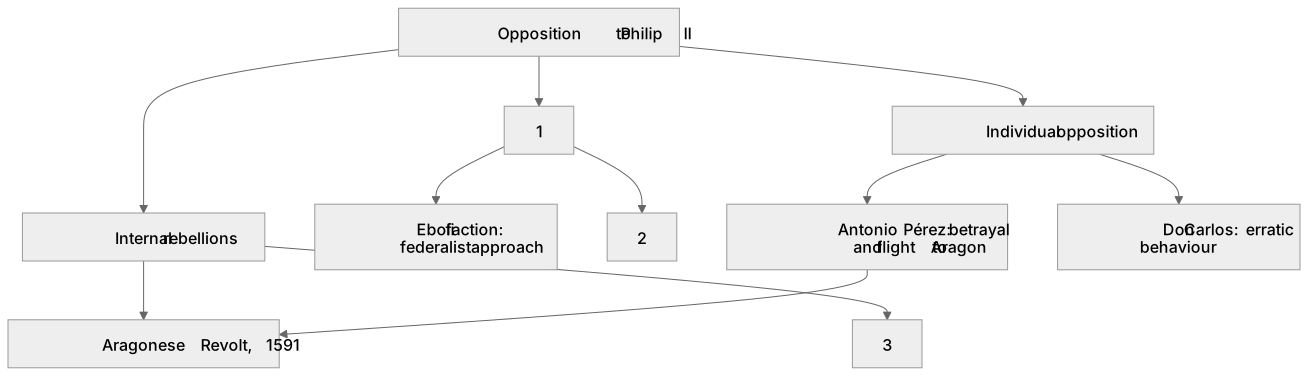
1Box 1
2Box 2
3Box 3
There is more to this lesson
The full lesson goes on to check your understanding and help you earn the marks. Create a free account to carry on, with your progress saved.
A week of Premium from your first lesson · Then the free plan continues · No card, no charge
Test your understanding of 1B Spain in the Age of Discovery, 1469–1598 (A-level only) – The 'Golden Age', 1556–1598 (A-level only): Opposition of individuals and groups: faction and curbing internal rebellions
Active recall beats re-reading. Take an instant quiz now to test what you’ve learned and lock it into long-term memory.
A week of Premium from your first lesson · Then the free plan continues · No card, no charge