AQA · A-Level · History
Course version: 7042 · Version from Sept 2017
The condition of Spain in 1598: political, economic and social strengths…
Full specification wording
1B Spain in the Age of Discovery, 1469–1598 (A-level only) – The 'Golden Age', 1556–1598 (A-level only): The condition of Spain in 1598: political, economic and social strengths and weaknesses
By Philip II's death in 1598, Spain presented a paradox of imperial power masking deep vulnerabilities.
Checked against the AQA 7042 specification (opens in a new tab) on .
- Point 6 of 6
- 3 key terms
Study notes
From the checked teaching notes for this specification point.
The idea
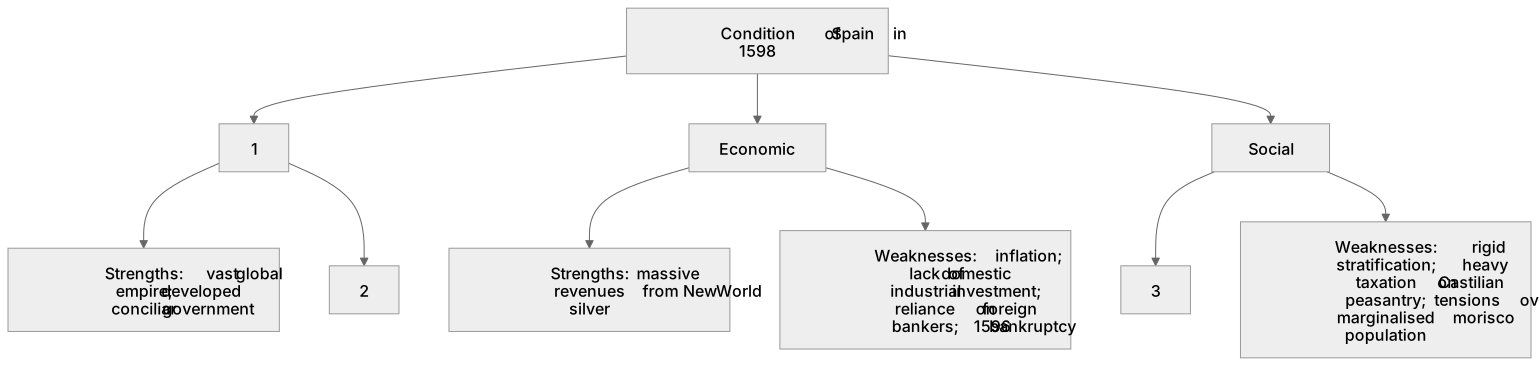
By Philip II's death in 1598, Spain presented a paradox of imperial power masking deep vulnerabilities. Politically, Spain boasted a vast global empire and a developed conciliar government, yet this bureaucracy was notoriously slow and overly dependent on the monarch's micromanagement. Economically, New World silver provided massive revenues, but this strength was undermined by severe inflation, lack of domestic industrial investment, and reliance on foreign bankers, culminating in the 1596 bankruptcy. Socially, Spain benefited from a unifying Catholic identity, but suffered from rigid stratification, heavy taxation falling disproportionately on the Castilian peasantry, and lingering tensions surrounding the marginalised morisco population.
What earns the marks
- Evaluate political strengths, such as the extent of the overseas empire and the sophisticated conciliar system, against the weakness of administrative bottlenecks.
- Analyse economic weaknesses, specifically the impact of the price revolution, the cost of foreign wars, and the crown's repeated bankruptcies.
- Assess the social strengths of religious unity and a shared imperial identity against the weaknesses of a heavily taxed peasantry and an unproductive nobility.
- Weigh the disproportionate burden placed on Castile compared to the relative autonomy and lower taxation of the Crown of Aragon.
Common mistakes and how to put them right
Stating that Spain was completely ruined by 1598.
Put it right: Balance the narrative of economic decline with the reality that Spain remained the pre-eminent global military and imperial power.
Blaming inflation solely on New World silver.
Put it right: Explain that while bullion imports exacerbated inflation, population growth and stagnant agricultural output were also fundamental causes.
Treating Spain as a fully unified nation-state.
Put it right: Emphasise that Spain remained a composite monarchy with distinct laws, economies, and tax systems in Castile and Aragon.
Exam tips
- Structure your answer thematically (political, economic, social) to ensure comprehensive coverage of Spain's condition in 1598.
- Use the 1596 bankruptcy as a concrete piece of evidence to illustrate the structural weaknesses of the Spanish economy despite silver imports.
- Always provide a balanced judgement: for every weakness identified, consider whether there was a corresponding strength that sustained the empire.
Try the lesson
The start of the 1B Spain in the Age of Discovery, 1469–1598 (A-level only) – The 'Golden Age', 1556–1598 (A-level only): The condition of Spain in 1598: political, economic and social strengths and weaknesses lesson, made from checked teaching notes for this specification point.
Have a go first
What was a major economic weakness of Spain at the time of Philip II's death in 1598?
Listen
By Philip II's death in 1598, Spain presented a paradox of imperial power masking deep vulnerabilities. Politically, Spain boasted a vast global empire and a developed conciliar government, yet this bureaucracy was notoriously slow and overly dependent on the monarch's micromanagement. Economically, New World silver provided massive revenues, but this strength was undermined by severe inflation, lack of domestic industrial investment, and reliance on foreign bankers, culminating in the 1596 bankruptcy. Socially, Spain benefited from a unifying Catholic identity, but suffered from rigid stratification, heavy taxation falling disproportionately on the Castilian peasantry, and lingering tensions surrounding the marginalised morisco population. A strong answer earns marks for these points. Evaluate political strengths, such as the extent of the overseas empire and the sophisticated conciliar system, against the weakness of administrative bottlenecks. Analyse economic weaknesses, specifically the impact of the price revolution, the cost of foreign wars, and the crown's repeated bankruptcies. Assess the social strengths of religious unity and a shared imperial identity against the weaknesses of a heavily taxed peasantry and an unproductive nobility. Weigh the disproportionate burden placed on Castile compared to the relative autonomy and lower taxation of the Crown of Aragon. A common slip: Stating that Spain was completely ruined by 1598. Instead, balance the narrative of economic decline with the reality that Spain remained the pre-eminent global military and imperial power. Exam tip: Structure your answer thematically (political, economic, social) to ensure comprehensive coverage of Spain's condition in 1598.
See it

Key words
Say what each word means before you turn the card.
Composite monarchy
Try answering aloud or in your head before turning the card.
Economic instability
Try answering aloud or in your head before turning the card.
Social inequality
Try answering aloud or in your head before turning the card.
See every definition
- Composite monarchy
- A system in which Spain remained a composite monarchy with distinct laws, economies, and tax systems in Castile and Aragon.
- Economic instability
- A condition in which severe inflation, lack of domestic industrial investment, and reliance on foreign bankers undermined the massive revenues from New World silver.
- Social inequality
- A condition of rigid stratification in which heavy taxation fell disproportionately on the Castilian peasantry, alongside lingering tensions surrounding the marginalised morisco population.
Label the diagram
Some boxes have lost their names. Pick the right name for each number.
1Box 1
2Box 2
3Box 3
There is more to this lesson
The full lesson goes on to check your understanding and help you earn the marks. Create a free account to carry on, with your progress saved.
A week of Premium from your first lesson · Then the free plan continues · No card, no charge
Test your understanding of 1B Spain in the Age of Discovery, 1469–1598 (A-level only) – The 'Golden Age', 1556–1598 (A-level only): The condition of Spain in 1598: political, economic and social strengths and weaknesses
Active recall beats re-reading. Take an instant quiz now to test what you’ve learned and lock it into long-term memory.
A week of Premium from your first lesson · Then the free plan continues · No card, no charge