AQA · A-Level · History
Course version: 7042 · Version from Sept 2017
Social and cultural developments of the ‘Golden Age’; impact of new ideas…
Full specification wording
1B Spain in the Age of Discovery, 1469–1598 (A-level only) – The 'Golden Age', 1556–1598 (A-level only): Social and cultural developments of the ‘Golden Age’; impact of new ideas and intellectual movements
The Spanish 'Golden Age' (Siglo de Oro) under Philip II witnessed profound cultural and social transformations, despite strict religious orthodoxy.
Checked against the AQA 7042 specification (opens in a new tab) on .
- Point 5 of 6
Study notes
From the checked teaching notes for this specification point.
The idea
The Spanish 'Golden Age' (Siglo de Oro) under Philip II witnessed profound cultural and social transformations, despite strict religious orthodoxy. Culturally, literature and art flourished, exemplified by El Greco's Mannerist paintings and the early works of Cervantes, reflecting a uniquely Spanish synthesis of Renaissance humanism and intense Catholic piety. Socially, the period saw the entrenchment of the limpieza de sangre (purity of blood) doctrine, which stratified society and marginalised conversos and moriscos. Intellectual movements were heavily shaped by the Counter-Reformation; while Erasmian humanism declined due to Inquisition censorship, new intellectual currents emerged through Catholic mysticism, led by figures like Teresa of Ávila and John of the Cross, profoundly impacting Spanish religious and social life.
What earns the marks
- Identify key cultural figures of the Golden Age, such as El Greco in art and Cervantes or Lope de Vega in literature, explaining their contribution to Spanish identity.
- Analyse the social impact of the limpieza de sangre statutes on social mobility and the marginalisation of minority groups.
- Evaluate the role of the Inquisition and the Index of Prohibited Books in suppressing Erasmian humanism and Protestant ideas.
- Assess the influence of Catholic mysticism and the Carmelite reforms by Teresa of Ávila on Spanish intellectual and religious culture.
Common mistakes and how to put them right
Assuming the Golden Age was purely a period of economic prosperity.
Put it right: Recognise that the 'Golden Age' primarily refers to a cultural and artistic flourishing that occurred alongside significant economic difficulties.
Claiming the Inquisition completely stifled all intellectual thought.
Put it right: Acknowledge that while heterodox ideas were suppressed, orthodox Catholic intellectual movements, such as mysticism and neo-scholasticism, thrived.
Confusing the timeline of the Golden Age.
Put it right: Ensure cultural developments are accurately placed within Philip II's reign (1556–1598), rather than earlier under Ferdinand and Isabella.
Exam tips
- Use specific examples of art, literature, or architecture (like the El Escorial palace) to substantiate claims about cultural developments.
- Link social developments, such as the obsession with honour and blood purity, to broader political and religious policies of Philip II.
- When discussing intellectual movements, contrast the suppression of Renaissance humanism with the promotion of Counter-Reformation theology.
Try the lesson
The start of the 1B Spain in the Age of Discovery, 1469–1598 (A-level only) – The 'Golden Age', 1556–1598 (A-level only): Social and cultural developments of the ‘Golden Age’; impact of new ideas and intellectual movements lesson, made from checked teaching notes for this specification point.
Have a go first
Which of the following best describes the primary architectural and cultural significance of El Escorial, commissioned by Philip II?
Listen
The Spanish 'Golden Age' (Siglo de Oro) under Philip II witnessed profound cultural and social transformations, despite strict religious orthodoxy. Culturally, literature and art flourished, exemplified by El Greco's Mannerist paintings and the early works of Cervantes, reflecting a uniquely Spanish synthesis of Renaissance humanism and intense Catholic piety. Socially, the period saw the entrenchment of the limpieza de sangre (purity of blood) doctrine, which stratified society and marginalised conversos and moriscos. Intellectual movements were heavily shaped by the Counter-Reformation; while Erasmian humanism declined due to Inquisition censorship, new intellectual currents emerged through Catholic mysticism, led by figures like Teresa of Ávila and John of the Cross, profoundly impacting Spanish religious and social life. A strong answer earns marks for these points. Identify key cultural figures of the Golden Age, such as El Greco in art and Cervantes or Lope de Vega in literature, explaining their contribution to Spanish identity. Analyse the social impact of the limpieza de sangre statutes on social mobility and the marginalisation of minority groups. Evaluate the role of the Inquisition and the Index of Prohibited Books in suppressing Erasmian humanism and Protestant ideas. Assess the influence of Catholic mysticism and the Carmelite reforms by Teresa of Ávila on Spanish intellectual and religious culture. A common slip: Assuming the Golden Age was purely a period of economic prosperity. Instead, recognise that the 'Golden Age' primarily refers to a cultural and artistic flourishing that occurred alongside significant economic difficulties. Exam tip: Use specific examples of art, literature, or architecture (like the El Escorial palace) to substantiate claims about cultural developments.
See it
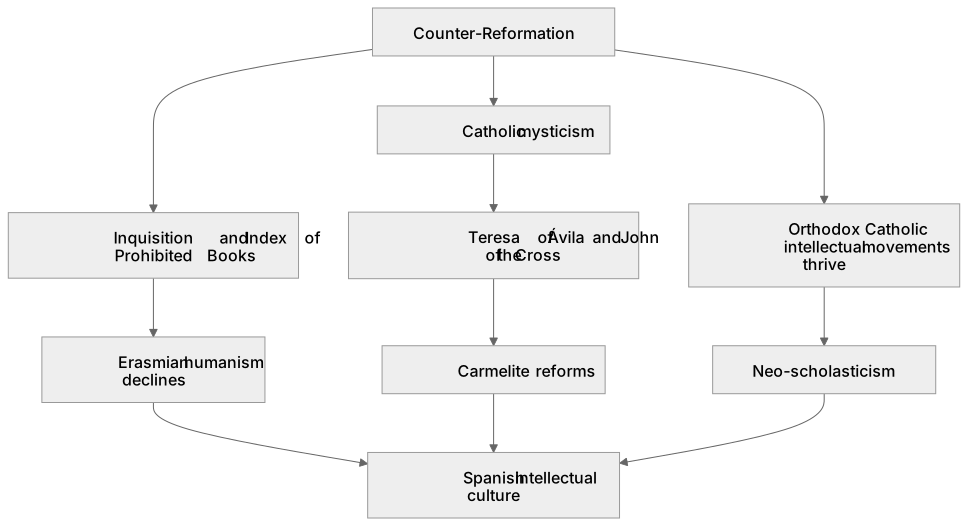
Label the diagram
Some boxes have lost their names. Pick the right name for each number.
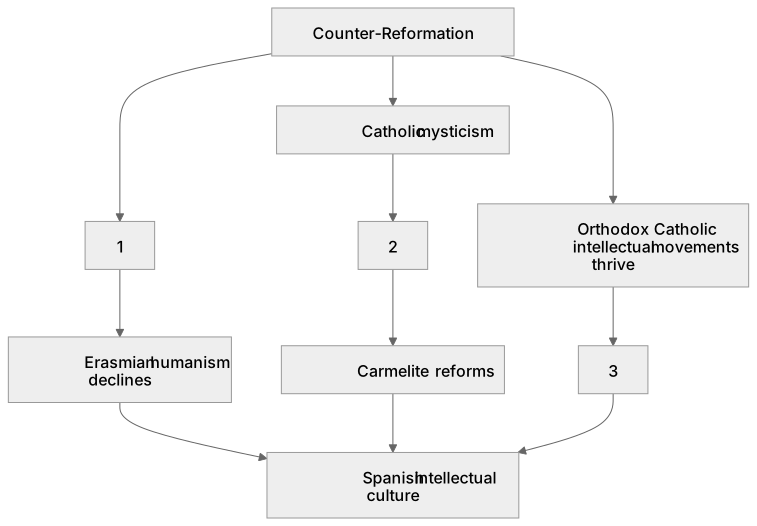
1Box 1
2Box 2
3Box 3
There is more to this lesson
The full lesson goes on to check your understanding and help you earn the marks. Create a free account to carry on, with your progress saved.
A week of Premium from your first lesson · Then the free plan continues · No card, no charge
Test your understanding of 1B Spain in the Age of Discovery, 1469–1598 (A-level only) – The 'Golden Age', 1556–1598 (A-level only): Social and cultural developments of the ‘Golden Age’; impact of new ideas and intellectual movements
Active recall beats re-reading. Take an instant quiz now to test what you’ve learned and lock it into long-term memory.
A week of Premium from your first lesson · Then the free plan continues · No card, no charge