AQA · A-Level · History
Course version: 7042 · Version from Sept 2017
England, 1485–1603 – consequence in this period through the following key…
Full specification wording
1C The Tudors: England, 1485–1603 – consequence in this period through the following key questions:: How effectively did the Tudors restore and develop the powers of the monarchy?
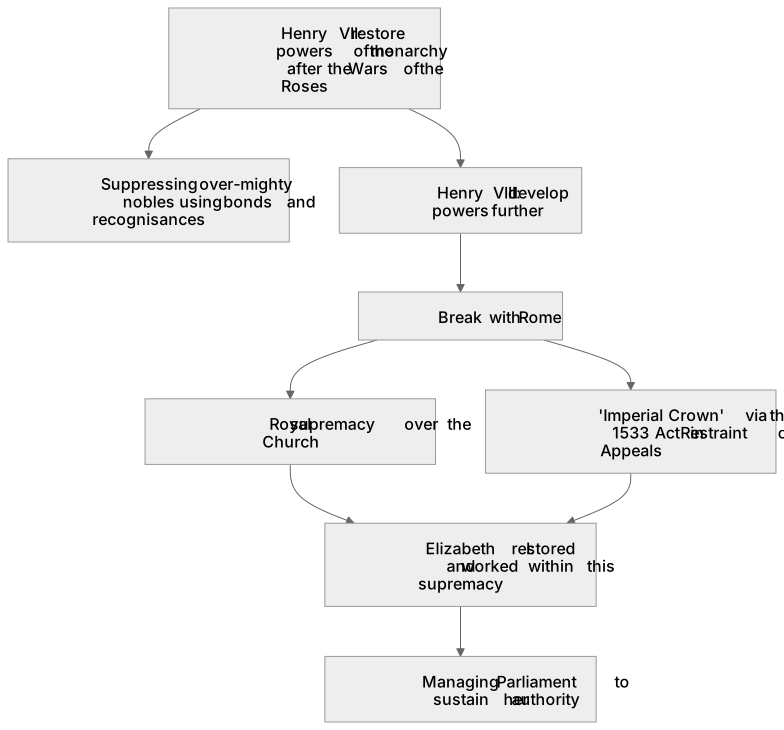
The Tudor era saw a profound transformation in royal authority, starting with Henry VII's urgent need to restore the powers of the monarchy after the Wars of the Roses.
Checked against the AQA 7042 specification (opens in a new tab) on .
- Point 1 of 6
- 4 key terms
Study notes
From the checked teaching notes for this specification point.
The idea
The Tudor era saw a profound transformation in royal authority, starting with Henry VII's urgent need to restore the powers of the monarchy after the Wars of the Roses. He achieved this by suppressing over-mighty nobles using bonds and recognisances. Subsequent monarchs developed these powers further. Henry VIII's break with Rome established royal supremacy over the Church, expanding monarchical power into spiritual domains and establishing the concept of the 'Imperial Crown' via the 1533 Act in Restraint of Appeals. Elizabeth I later restored and worked within this supremacy, managing Parliament to sustain her authority.
What earns the marks
- Assess the methods used by Henry VII to restore royal authority, such as financial controls and the limitation of noble power.
- Evaluate the development of monarchical power under Henry VIII, specifically the impact of the Act of Supremacy, the break with Rome, and the 'Imperial Crown' concept.
- Analyse the challenges to royal power during the mid-Tudor crisis and how effectively the monarchy maintained its authority.
- Examine Elizabeth I's restoration of royal supremacy and her management of Parliament and the Privy Council to sustain monarchical power.
Common mistakes and how to put them right
Treating 'restore' and 'develop' as synonyms.
Put it right: Explicitly distinguish between Henry VII returning the Crown to its former strength (restoring) and Henry VIII creating new forms of authority like Royal Supremacy (developing).
Ignoring the mid-Tudor period.
Put it right: Include the reigns of Edward VI and Mary I to provide a complete assessment of how effectively monarchical power was maintained across the whole period.
Focusing solely on the monarch's personality.
Put it right: Analyse institutional and legal changes, such as the role of Parliament and the Privy Council, in developing royal power.
Exam tips
- Structure your essay to explicitly address both 'restore' and 'develop' to ensure full coverage of the question's demands.
- Use specific legislative examples, such as the 1533 Act in Restraint of Appeals, to demonstrate the development of monarchical power.
- Weigh the effectiveness of the monarchy's power against the limitations they faced, such as financial constraints or rebellions.
Try the lesson
The start of the 1C The Tudors: England, 1485–1603 – consequence in this period through the following key questions:: How effectively did the Tudors restore and develop the powers of the monarchy? lesson, made from checked teaching notes for this specification point.
Have a go first
Which of the following methods was most prominently used by Henry VII to restore the power of the monarchy over the nobility?
Listen
The Tudor era saw a profound transformation in royal authority, starting with Henry VII's urgent need to restore the powers of the monarchy after the Wars of the Roses. He achieved this by suppressing over-mighty nobles using bonds and recognisances. Subsequent monarchs developed these powers further. Henry VIII's break with Rome established royal supremacy over the Church, expanding monarchical power into spiritual domains and establishing the concept of the 'Imperial Crown' via the 1533 Act in Restraint of Appeals. Elizabeth I later restored and worked within this supremacy, managing Parliament to sustain her authority. A strong answer earns marks for these points. Assess the methods used by Henry VII to restore royal authority, such as financial controls and the limitation of noble power. Evaluate the development of monarchical power under Henry VIII, specifically the impact of the Act of Supremacy, the break with Rome, and the 'Imperial Crown' concept. Analyse the challenges to royal power during the mid-Tudor crisis and how effectively the monarchy maintained its authority. Examine Elizabeth I's restoration of royal supremacy and her management of Parliament and the Privy Council to sustain monarchical power. A common slip: Treating 'restore' and 'develop' as synonyms. Instead, explicitly distinguish between Henry VII returning the Crown to its former strength (restoring) and Henry VIII creating new forms of authority like Royal Supremacy (developing). Exam tip: Structure your essay to explicitly address both 'restore' and 'develop' to ensure full coverage of the question's demands.
See it
Put the events in order
Put these events in the order they happened, earliest first.
- 1. Henry VII needed to restore the powers of the monarchy
- 2. End of the Tudor period
- 3. Act in Restraint of Appeals established the 'Imperial Crown'
Key words
Say what each word means before you turn the card.
Royal prerogative and authority
Try answering aloud or in your head before turning the card.
Church-State relations
Try answering aloud or in your head before turning the card.
Crown and Parliament
Try answering aloud or in your head before turning the card.
Control of the nobility
Try answering aloud or in your head before turning the card.
See every definition
- Royal prerogative and authority
- The powers of the monarchy that Henry VII urgently needed to restore after the Wars of the Roses, and which later monarchs developed further.
- Church-State relations
- Henry VIII's break with Rome established royal supremacy over the Church, expanding monarchical power into spiritual domains.
- Crown and Parliament
- Elizabeth I managed Parliament to sustain her authority, working within the royal supremacy she had restored.
- Control of the nobility
- Henry VII suppressed over-mighty nobles using bonds and recognisances as a method of restoring royal authority.
Label the diagram
Some boxes have lost their names. Pick the right name for each number.
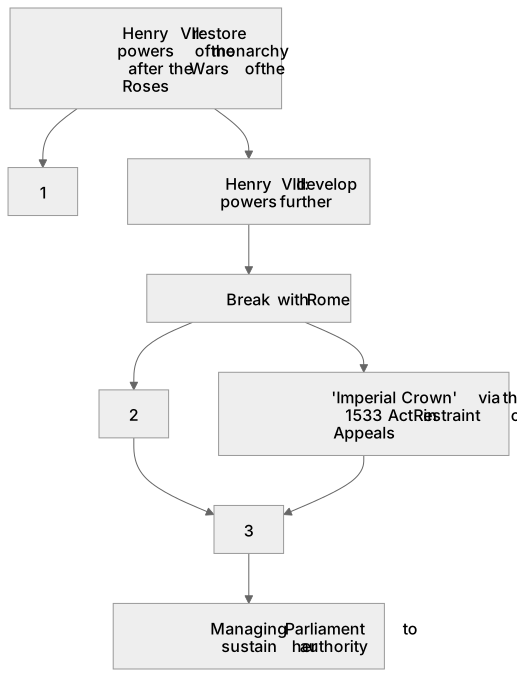
1Box 1
2Box 2
3Box 3
There is more to this lesson
The full lesson goes on to check your understanding and help you earn the marks. Create a free account to carry on, with your progress saved.
A week of Premium from your first lesson · Then the free plan continues · No card, no charge
Test your understanding of 1C The Tudors: England, 1485–1603 – consequence in this period through the following key questions:: How effectively did the Tudors restore and develop the powers of the monarchy?
Active recall beats re-reading. Take an instant quiz now to test what you’ve learned and lock it into long-term memory.
A week of Premium from your first lesson · Then the free plan continues · No card, no charge