AQA · A-Level · History
Course version: 7042 · Version from Sept 2017
England, 1485–1603 – consequence in this period through the following key…
Full specification wording
1C The Tudors: England, 1485–1603 – consequence in this period through the following key questions:: In what ways and how effectively was England governed during this period?
This topic requires an analysis of Tudor government mechanisms and an evaluation of their effectiveness.
Checked against the AQA 7042 specification (opens in a new tab) on .
- Point 2 of 6
Study notes
From the checked teaching notes for this specification point.
The idea
This topic requires an analysis of Tudor government mechanisms and an evaluation of their effectiveness. Local government is equally crucial; the reliance on unpaid Justices of the Peace (JPs) demonstrates how the Crown enforced its will without a standing army. A strong evaluation will contrast periods of stable governance, such as under Henry VII, with the administrative challenges of the mid-Tudor crisis.
What earns the marks
- Identify and explain the different ways England was governed, including central institutions like the Privy Council and Parliament.
- Assess the role and effectiveness of local government officials, particularly Justices of the Peace, in enforcing Crown policies.
- Evaluate the effectiveness of regional councils, such as the Council of the North and the Council of Wales, in maintaining control over peripheral areas.
- Analyse the effectiveness of the government in responding to crises, such as rebellions, economic difficulties, and religious transitions.
Common mistakes and how to put them right
Focusing exclusively on central government.
Put it right: Ensure local government, particularly the role of JPs and regional councils, is analysed to show how policies were actually implemented.
Describing government institutions without evaluating their success.
Put it right: Explicitly judge 'how effectively' these institutions maintained order, collected taxes, or enforced laws.
Assuming government effectiveness was static.
Put it right: Trace how the effectiveness of governance fluctuated, noting periods of innovation (e.g., under Cromwell) and periods of crisis.
Exam tips
- Always link the 'ways' of governing (the institutions) to 'how effectively' they functioned in practice.
- Use the handling of specific rebellions (e.g., the Pilgrimage of Grace or the Northern Rebellion) as evidence to judge the effectiveness of government control.
- Consider the limitations of Tudor government, such as the lack of a standing army and reliance on the unpaid cooperation of the gentry.
Try the lesson
The start of the 1C The Tudors: England, 1485–1603 – consequence in this period through the following key questions:: In what ways and how effectively was England governed during this period? lesson, made from checked teaching notes for this specification point.
Have a go first
Which group was primarily responsible for the day-to-day administration of local government and the maintenance of law and order in Tudor England?
Listen
This topic requires an analysis of Tudor government mechanisms and an evaluation of their effectiveness. Local government is equally crucial; the reliance on unpaid Justices of the Peace (JPs) demonstrates how the Crown enforced its will without a standing army. A strong evaluation will contrast periods of stable governance, such as under Henry VII, with the administrative challenges of the mid-Tudor crisis. A strong answer earns marks for these points. Identify and explain the different ways England was governed, including central institutions like the Privy Council and Parliament. Assess the role and effectiveness of local government officials, particularly Justices of the Peace, in enforcing Crown policies. Evaluate the effectiveness of regional councils, such as the Council of the North and the Council of Wales, in maintaining control over peripheral areas. Analyse the effectiveness of the government in responding to crises, such as rebellions, economic difficulties, and religious transitions. A common slip: Focusing exclusively on central government. Instead, ensure local government, particularly the role of JPs and regional councils, is analysed to show how policies were actually implemented. Exam tip: Always link the 'ways' of governing (the institutions) to 'how effectively' they functioned in practice.
See it
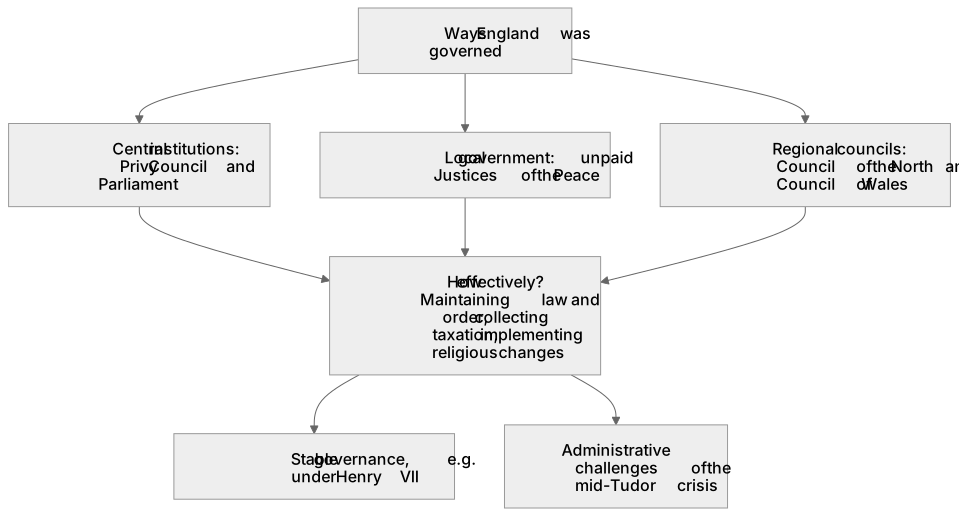
Label the diagram
Some boxes have lost their names. Pick the right name for each number.
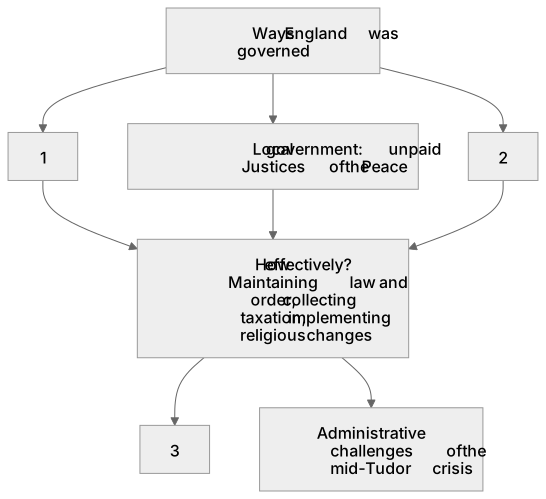
1Box 1
2Box 2
3Box 3
There is more to this lesson
The full lesson goes on to check your understanding and help you earn the marks. Create a free account to carry on, with your progress saved.
A week of Premium from your first lesson · Then the free plan continues · No card, no charge
Test your understanding of 1C The Tudors: England, 1485–1603 – consequence in this period through the following key questions:: In what ways and how effectively was England governed during this period?
Active recall beats re-reading. Take an instant quiz now to test what you’ve learned and lock it into long-term memory.
A week of Premium from your first lesson · Then the free plan continues · No card, no charge