AQA · A-Level · History
Course version: 7042 · Version from Sept 2017
England, 1485–1603 – consequence in this period through the following key…
Full specification wording
1C The Tudors: England, 1485–1603 – consequence in this period through the following key questions:: How important was the role of key individuals and groups and how were they affected by developments?
Evaluating the Tudor period requires analysing the importance of key individuals—such as monarchs, ministers like Wolsey and Cromwell, and religious figures—alongside influential groups including…
Checked against the AQA 7042 specification (opens in a new tab) on .
- Point 6 of 6
- 4 key terms
Study notes
From the checked teaching notes for this specification point.
The idea
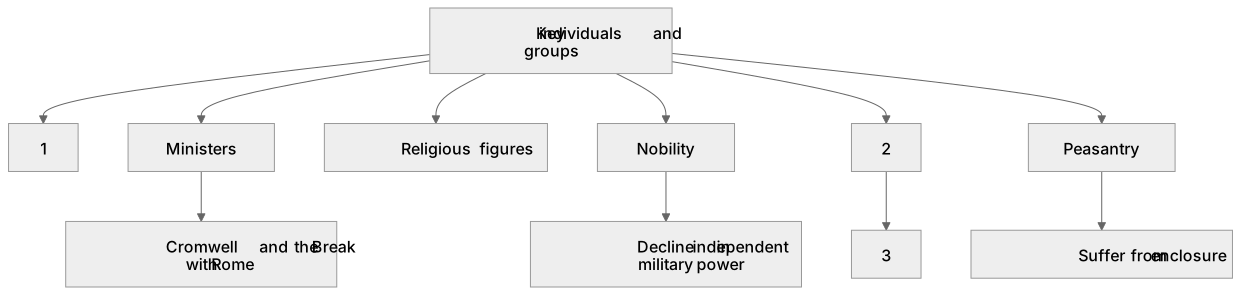
Evaluating the Tudor period requires analysing the importance of key individuals—such as monarchs, ministers like Wolsey and Cromwell, and religious figures—alongside influential groups including the nobility, gentry, and peasantry. Furthermore, the specification demands an understanding of how these individuals and groups were affected by ongoing developments.
For example: The nobility faced a decline in independent military power due to centralisation, the gentry benefited from monastic land sales, and the peasantry suffered from economic developments like enclosure.
What earns the marks
- Evaluate the importance of key ministers (e.g., Wolsey, Cromwell, Cecil) in shaping domestic and foreign policy compared to the monarch's own agency.
- Assess the changing role and power of the nobility, noting their transition from regional warlords to courtiers dependent on royal patronage.
- Analyse the rise of the gentry and merchant classes, linking their growing influence to economic developments and the acquisition of former Church lands.
- Examine how lower-class groups were affected by socio-economic developments, such as population growth, inflation, and changes to poor relief.
Common mistakes and how to put them right
Focusing solely on monarchs and ignoring the crucial role of ministers and advisors.
Put it right: Ensure answers evaluate the specific contributions of figures like Thomas Cromwell or William Cecil in executing and sometimes driving royal policy.
Treating 'the nobility' or 'the peasantry' as monolithic groups with identical experiences.
Put it right: Acknowledge regional and individual variations, noting that while some nobles lost power, others thrived through loyal service to the Crown.
Describing what individuals did without explaining how they were affected by broader changes.
Put it right: Explicitly address the second part of the statement by analysing how events like the Reformation or economic inflation impacted the wealth and status of specific groups.
Exam tips
- When assessing 'how important', establish criteria for importance, such as the individual's impact on legislation, religious settlement, or economic stability.
- Contrast the fortunes of different social groups to build a nuanced argument about the social consequences of Tudor policies.
- Use specific examples of individuals rising or falling from power (e.g., the execution of the Duke of Buckingham) to illustrate broader trends affecting the nobility.
Try the lesson
The start of the 1C The Tudors: England, 1485–1603 – consequence in this period through the following key questions:: How important was the role of key individuals and groups and how were they affected by developments? lesson, made from checked teaching notes for this specification point.
Have a go first
What was the primary role of Thomas Cromwell in the developments of the 1530s during the reign of Henry VIII?
Listen
Evaluating the Tudor period requires analysing the importance of key individuals—such as monarchs, ministers like Wolsey and Cromwell, and religious figures—alongside influential groups including the nobility, gentry, and peasantry. Furthermore, the specification demands an understanding of how these individuals and groups were affected by ongoing developments. For example, the nobility faced a decline in independent military power due to centralisation, the gentry benefited from monastic land sales, and the peasantry suffered from economic developments like enclosure. A strong answer earns marks for these points. Evaluate the importance of key ministers (e.g., Wolsey, Cromwell, Cecil) in shaping domestic and foreign policy compared to the monarch's own agency. Assess the changing role and power of the nobility, noting their transition from regional warlords to courtiers dependent on royal patronage. Analyse the rise of the gentry and merchant classes, linking their growing influence to economic developments and the acquisition of former Church lands. Examine how lower-class groups were affected by socio-economic developments, such as population growth, inflation, and changes to poor relief. A common slip: Focusing solely on monarchs and ignoring the crucial role of ministers and advisors. Instead, Ensure answers evaluate the specific contributions of figures like Thomas Cromwell or William Cecil in executing and sometimes driving royal policy. Exam tip: When assessing 'how important', establish criteria for importance, such as the individual's impact on legislation, religious settlement, or economic stability.
See it

Key words
Say what each word means before you turn the card.
Power, patronage and the court
Try answering aloud or in your head before turning the card.
Social mobility and class structure
Try answering aloud or in your head before turning the card.
Ministerial influence versus royal authority
Try answering aloud or in your head before turning the card.
Socio-economic transformation
Try answering aloud or in your head before turning the card.
See every definition
- Power, patronage and the court
- The nobility moved from regional warlords to courtiers dependent on royal patronage.
- Social mobility and class structure
- The gentry and merchant classes rose through economic developments and the acquisition of former Church lands.
- Ministerial influence versus royal authority
- Key ministers such as Wolsey and Cromwell shaped domestic and foreign policy, and their importance must be weighed against the monarch's own agency.
- Socio-economic transformation
- Lower-class groups were affected by population growth, inflation and changes to poor relief, while the peasantry suffered from enclosure.
Label the diagram
Some boxes have lost their names. Pick the right name for each number.
1Box 1
2Box 2
3Box 3
There is more to this lesson
The full lesson goes on to check your understanding and help you earn the marks. Create a free account to carry on, with your progress saved.
A week of Premium from your first lesson · Then the free plan continues · No card, no charge
Test your understanding of 1C The Tudors: England, 1485–1603 – consequence in this period through the following key questions:: How important was the role of key individuals and groups and how were they affected by developments?
Active recall beats re-reading. Take an instant quiz now to test what you’ve learned and lock it into long-term memory.
A week of Premium from your first lesson · Then the free plan continues · No card, no charge