AQA · A-Level · History
Course version: 7042 · Version from Sept 2017
England, 1485–1603 – consequence in this period through the following key…
Full specification wording
1C The Tudors: England, 1485–1603 – consequence in this period through the following key questions:: How far did intellectual and religious ideas change and develop and with what effects?
The Tudor period witnessed profound transformations in intellectual and religious ideas, fundamentally altering English society.
Checked against the AQA 7042 specification (opens in a new tab) on .
- Point 5 of 6
- 4 key terms
Study notes
From the checked teaching notes for this specification point.
The idea
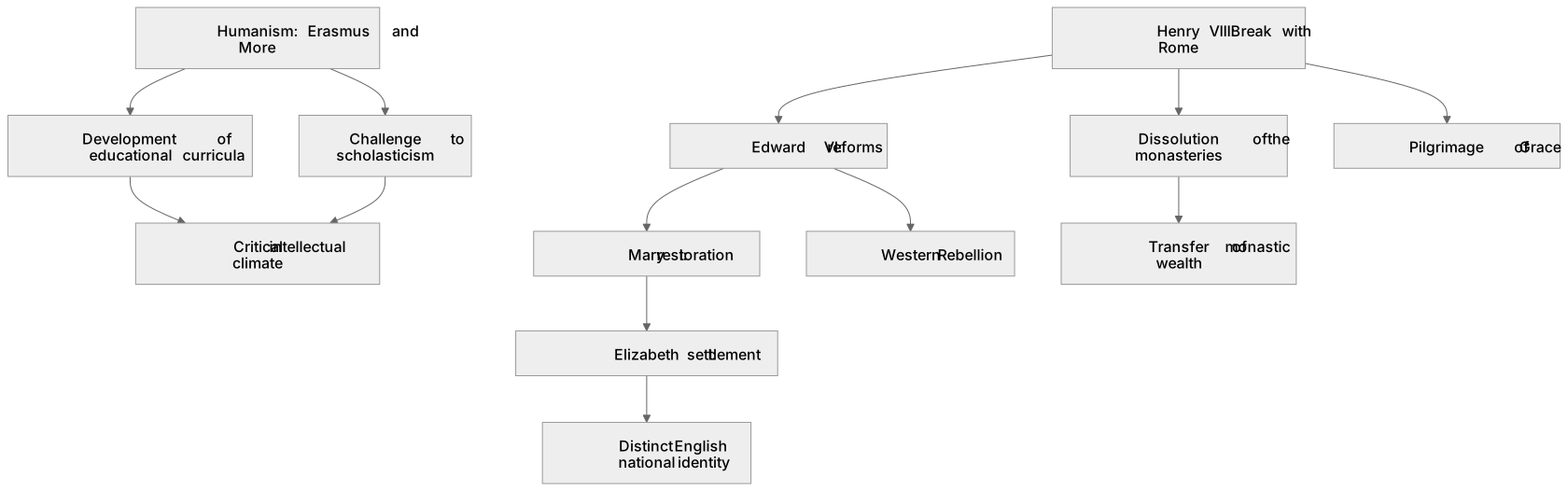
The Tudor period witnessed profound transformations in intellectual and religious ideas, fundamentally altering English society. Humanism, championed by Erasmus and More, developed educational curricula and challenged scholasticism, fostering a critical intellectual climate. Religiously, the shift from Catholicism to Protestantism evolved through Henry VIII's Break with Rome, Edward VI's reforms, Mary I's restoration, and Elizabeth I's settlement.
What earns the marks
- Assess the extent of change in intellectual ideas, focusing on the rise of humanism and the Renaissance impact on education and government.
- Evaluate the development of religious ideas across different reigns, contrasting official doctrinal shifts with the slower pace of change in popular belief.
- Analyse the social and economic effects of religious change, such as the transfer of monastic wealth and the provision of poor relief.
- Examine the political effects of intellectual and religious developments, including challenges to royal authority and the justification of the Royal Supremacy.
Common mistakes and how to put them right
Assuming the Break with Rome immediately made England a Protestant country.
Put it right: Distinguish between Henry VIII's political break from papal authority and the later doctrinal shifts towards Protestantism under Edward VI.
Treating humanism as a purely secular movement opposed to religion.
Put it right: Recognise that early Tudor humanists like Colet and More were devout Catholics seeking to reform and purify the Church from within.
Ignoring the resistance to religious change and assuming smooth transitions.
Put it right: Highlight the significant opposition to religious developments, evidenced by uprisings such as the Pilgrimage of Grace and the Western Rebellion.
Exam tips
- Use specific examples of legislation, such as the Act of Supremacy or the Act of Uniformity, to demonstrate the exact nature of religious changes.
- When evaluating 'how far', always balance evidence of radical change with evidence of continuity, particularly regarding the religious practices of the ordinary laity.
- Link intellectual developments directly to their practical effects, such as how humanist education prepared a new generation of administrators for Tudor government.
Try the lesson
The start of the 1C The Tudors: England, 1485–1603 – consequence in this period through the following key questions:: How far did intellectual and religious ideas change and develop and with what effects? lesson, made from checked teaching notes for this specification point.
Have a go first
Which of the following best describes the primary focus of Christian Humanism in England during the early sixteenth century?
Listen
The Tudor period witnessed profound transformations in intellectual and religious ideas, fundamentally altering English society. Humanism, championed by Erasmus and More, developed educational curricula and challenged scholasticism, fostering a critical intellectual climate. Religiously, the shift from Catholicism to Protestantism evolved through Henry VIII's Break with Rome, Edward VI's reforms, Mary I's restoration, and Elizabeth I's settlement. A strong answer earns marks for these points. Assess the extent of change in intellectual ideas, focusing on the rise of humanism and the Renaissance impact on education and government. Evaluate the development of religious ideas across different reigns, contrasting official doctrinal shifts with the slower pace of change in popular belief. Analyse the social and economic effects of religious change, such as the transfer of monastic wealth and the provision of poor relief. Examine the political effects of intellectual and religious developments, including challenges to royal authority and the justification of the Royal Supremacy. A common slip: Assuming the Break with Rome immediately made England a Protestant country. Instead, Distinguish between Henry VIII's political break from papal authority and the later doctrinal shifts towards Protestantism under Edward VI. Exam tip: Use specific examples of legislation, such as the Act of Supremacy or the Act of Uniformity, to demonstrate the exact nature of religious changes.
See it
Key words
Say what each word means before you turn the card.
Religious transformation and the Reformation
Try answering aloud or in your head before turning the card.
Renaissance and Humanism
Try answering aloud or in your head before turning the card.
State power and the Royal Supremacy
Try answering aloud or in your head before turning the card.
Social rebellion and conformity
Try answering aloud or in your head before turning the card.
See every definition
- Religious transformation and the Reformation
- The shift from Catholicism to Protestantism, evolving through Henry VIII's Break with Rome, Edward VI's reforms, Mary I's restoration and Elizabeth I's settlement.
- Renaissance and Humanism
- An intellectual movement championed by Erasmus and More, which developed educational curricula and challenged scholasticism, fostering a critical intellectual climate.
- State power and the Royal Supremacy
- Political effects of intellectual and religious developments, including challenges to royal authority and the justification of the Royal Supremacy.
- Social rebellion and conformity
- Opposition to religious developments, evidenced by uprisings such as the Pilgrimage of Grace and the Western Rebellion, alongside continuities in popular belief.
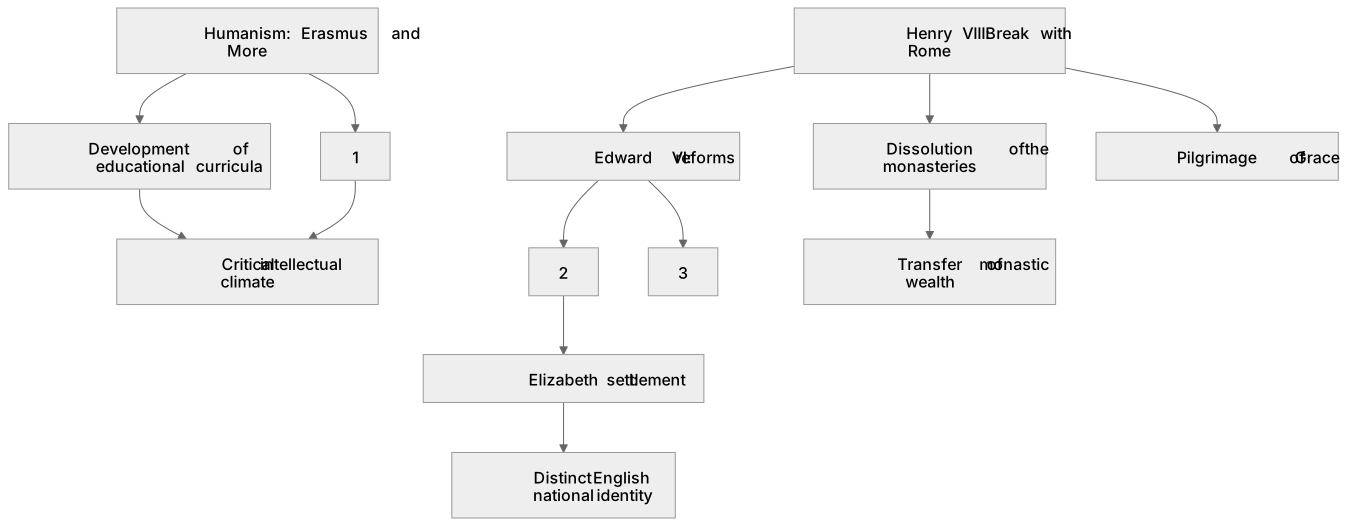
Label the diagram
Some boxes have lost their names. Pick the right name for each number.
1Box 1
2Box 2
3Box 3
There is more to this lesson
The full lesson goes on to check your understanding and help you earn the marks. Create a free account to carry on, with your progress saved.
A week of Premium from your first lesson · Then the free plan continues · No card, no charge
Test your understanding of 1C The Tudors: England, 1485–1603 – consequence in this period through the following key questions:: How far did intellectual and religious ideas change and develop and with what effects?
Active recall beats re-reading. Take an instant quiz now to test what you’ve learned and lock it into long-term memory.
A week of Premium from your first lesson · Then the free plan continues · No card, no charge