AQA · A-Level · History
Course version: 7042 · Version from Sept 2017
England, 1485–1603 – Henry VIII, 1509–1547: Economic development: trade,…
Full specification wording
1C The Tudors: England, 1485–1603 – Henry VIII, 1509–1547: Economic development: trade, exploration, prosperity and depression
Under Henry VIII, economic development was uneven, marked by both prosperity and depression.
Checked against the AQA 7042 specification (opens in a new tab) on .
- Point 5 of 6
- 4 key terms
Study notes
From the checked teaching notes for this specification point.
The idea
Under Henry VIII, economic development was uneven, marked by both prosperity and depression. Trade expanded significantly, especially broadcloth exports to Antwerp, enriching merchants but increasing reliance on one market. Exploration remained limited, though William Hawkins began voyages to Guinea and Brazil, laying foundations for future expansion. Prosperity was evident in the growing wealth of the gentry and the booming cloth industry, stimulating urban growth in London. Conversely, depression afflicted the lower classes. This hardship was driven by population growth, inflation exacerbated by the Great Debasement of the coinage from 1544, and the enclosure of common lands, causing rural unemployment and widespread poverty.
What earns the marks
- Assess the impact of the cloth trade on the English economy, noting the dominance of the London-Antwerp route.
- Evaluate the limited extent of English exploration under Henry VIII, referencing individual ventures like those of William Hawkins.
- Analyse the causes of economic prosperity for the gentry and merchant classes, including the acquisition of monastic lands.
- Explain the causes of economic depression for the lower classes, focusing on population growth, enclosure, and inflation.
- Examine the impact of government policies on the economy, particularly the Great Debasement of 1544 and its inflationary consequences.
Common mistakes and how to put them right
Claiming Henry VIII sponsored major voyages of discovery.
Put it right: State that exploration was largely left to private individuals like Hawkins, with Henry focusing on European politics.
Assuming the entire country experienced economic depression.
Put it right: Differentiate between the prosperity of the gentry and merchants and the poverty of the wage-earning lower classes.
Attributing inflation solely to the Great Debasement.
Put it right: Acknowledge that underlying population growth and agricultural changes were already driving prices up before 1544.
Exam tips
- Use the Great Debasement of 1544 as a key turning point when discussing the worsening of economic depression and inflation.
- Contrast the regional prosperity of cloth-producing areas with the economic struggles of enclosed rural communities.
- Link economic changes to social consequences, such as how enclosure and inflation contributed to the grievances behind the Pilgrimage of Grace.
Try the lesson
The start of the 1C The Tudors: England, 1485–1603 – Henry VIII, 1509–1547: Economic development: trade, exploration, prosperity and depression lesson, made from checked teaching notes for this specification point.
Have a go first
Which commodity dominated English export trade during the reign of Henry VIII?
Listen
Under Henry VIII, economic development was uneven, marked by both prosperity and depression. Trade expanded significantly, especially broadcloth exports to Antwerp, enriching merchants but increasing reliance on one market. Exploration remained limited, though William Hawkins began voyages to Guinea and Brazil, laying foundations for future expansion. Prosperity was evident in the growing wealth of the gentry and the booming cloth industry, stimulating urban growth in London. Conversely, depression afflicted the lower classes. This hardship was driven by population growth, inflation exacerbated by the Great Debasement of the coinage from 1544, and the enclosure of common lands, causing rural unemployment and widespread poverty. A strong answer earns marks for these points. Assess the impact of the cloth trade on the English economy, noting the dominance of the London-Antwerp route. Evaluate the limited extent of English exploration under Henry VIII, referencing individual ventures like those of William Hawkins. Analyse the causes of economic prosperity for the gentry and merchant classes, including the acquisition of monastic lands. Explain the causes of economic depression for the lower classes, focusing on population growth, enclosure, and inflation. A common slip: Claiming Henry VIII sponsored major voyages of discovery. Instead, state that exploration was largely left to private individuals like Hawkins, with Henry focusing on European politics. Exam tip: Use the Great Debasement of 1544 as a key turning point when discussing the worsening of economic depression and inflation.
See it

Key words
Say what each word means before you turn the card.
Commercial expansion
Try answering aloud or in your head before turning the card.
Inflation and monetary policy
Try answering aloud or in your head before turning the card.
Agrarian change
Try answering aloud or in your head before turning the card.
Economic inequality
Try answering aloud or in your head before turning the card.
See every definition
- Commercial expansion
- Trade expanded significantly, especially broadcloth exports to Antwerp, enriching merchants but increasing reliance on one market.
- Inflation and monetary policy
- Hardship was driven by inflation exacerbated by the Great Debasement of the coinage from 1544.
- Agrarian change
- The enclosure of common lands caused rural unemployment and widespread poverty.
- Economic inequality
- Prosperity was evident in the growing wealth of the gentry and the booming cloth industry, while depression afflicted the lower classes.
Label the diagram
Some boxes have lost their names. Pick the right name for each number.
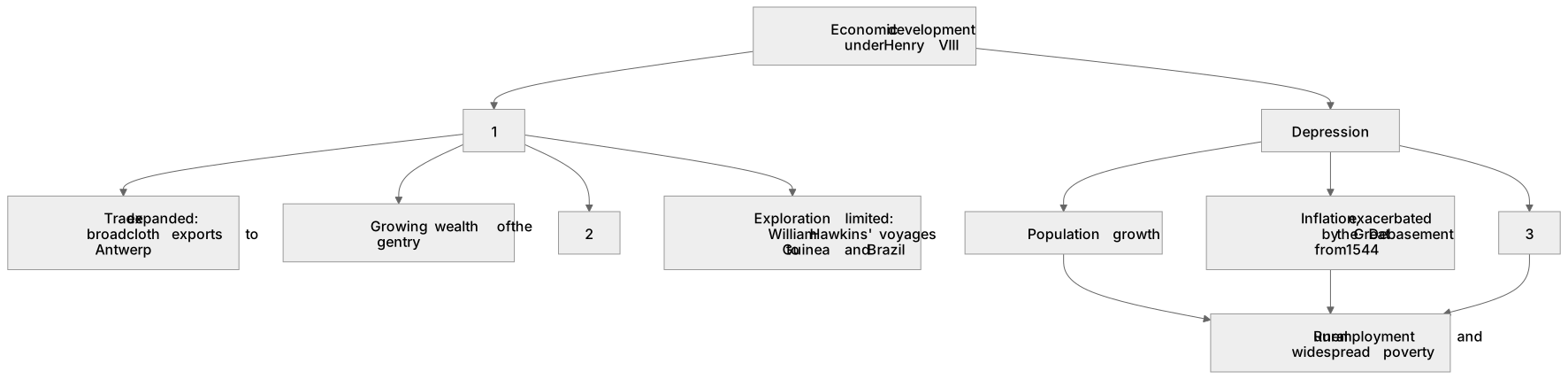
1Box 1
2Box 2
3Box 3
There is more to this lesson
The full lesson goes on to check your understanding and help you earn the marks. Create a free account to carry on, with your progress saved.
A week of Premium from your first lesson · Then the free plan continues · No card, no charge
Test your understanding of 1C The Tudors: England, 1485–1603 – Henry VIII, 1509–1547: Economic development: trade, exploration, prosperity and depression
Active recall beats re-reading. Take an instant quiz now to test what you’ve learned and lock it into long-term memory.
A week of Premium from your first lesson · Then the free plan continues · No card, no charge