AQA · A-Level · History
Course version: 7042 · Version from Sept 2017
England, 1485–1603 – Henry VIII, 1509–1547: Society: elites and commoners;…
Full specification wording
1C The Tudors: England, 1485–1603 – Henry VIII, 1509–1547: Society: elites and commoners; regional issues and the social impact of religious upheaval; rebellion
Tudor society under Henry VIII was strictly hierarchical, divided between a powerful elite of nobles and gentry, and commoners facing inflation and enclosure.
Checked against the AQA 7042 specification (opens in a new tab) on .
- Point 4 of 6
- 3 key terms
Study notes
From the checked teaching notes for this specification point.
The idea
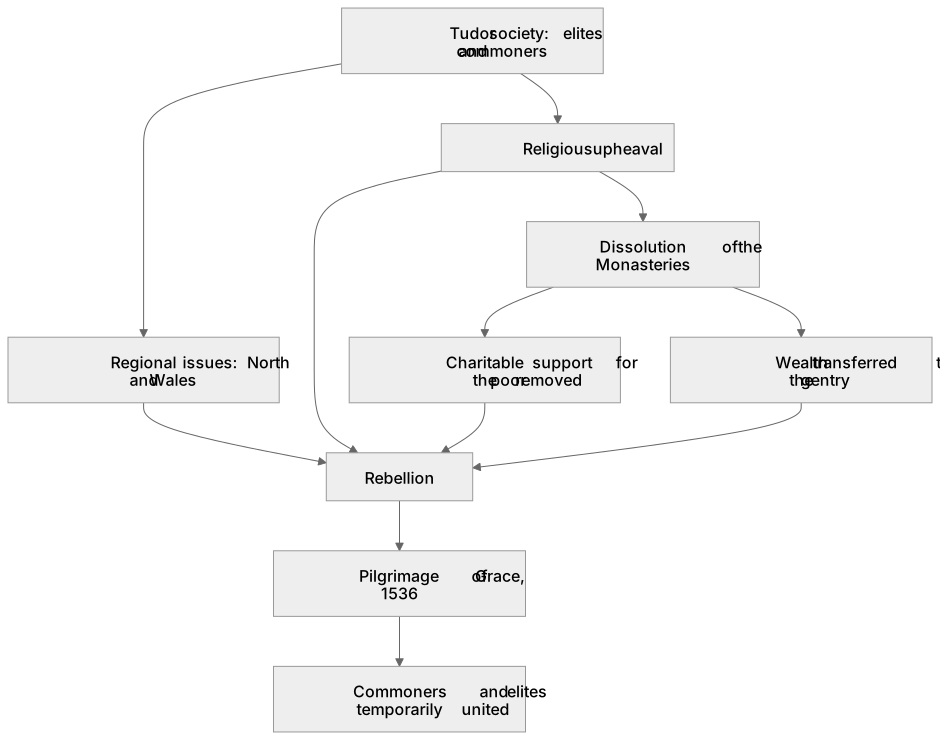
Tudor society under Henry VIII was strictly hierarchical, divided between a powerful elite of nobles and gentry, and commoners facing inflation and enclosure. Regional issues persisted, with the North and Wales retaining distinct identities, prompting reforms like the Laws in Wales Acts. The social impact of religious upheaval was profound; the Dissolution of the Monasteries removed vital charitable support networks for the poor while transferring vast wealth to the gentry. This religious and economic turmoil culminated in significant rebellion, most notably the Pilgrimage of Grace in 1536, where commoners and elites temporarily united to protest religious changes and regional grievances.
What earns the marks
- Analyze the rigid social hierarchy of Henrician England and the growing economic pressures on commoners, such as enclosure and inflation.
- Evaluate the methods used by the Crown to assert control over regional anomalies, including the Council of the North and the integration of Wales.
- Assess the social consequences of the Break with Rome, particularly how the Dissolution of the Monasteries affected poverty relief and land ownership.
- Examine the multifaceted causes of the Pilgrimage of Grace, distinguishing between religious, economic, and political motivations among different social classes.
Common mistakes and how to put them right
Treating the Pilgrimage of Grace as a purely religious rebellion.
Put it right: Identify and explain the intertwined economic (taxation, enclosure) and political (factionalism) grievances alongside the religious motives.
Assuming the Dissolution of the Monasteries only affected the clergy.
Put it right: Explain the severe social impact on commoners who lost monastic charity, employment, and medical care.
Viewing the elites and commoners as entirely separate in their grievances.
Put it right: Note that during the Pilgrimage of Grace, members of the gentry and nobility often shared or co-opted the grievances of the commoners.
Exam tips
- Always link social changes to government policy, demonstrating how religious reforms directly impacted the daily lives of commoners.
- Use the Pilgrimage of Grace as a primary case study to evaluate the extent of opposition to Henry VIII's religious and social policies.
- Differentiate between the experiences of the nobility, the rising gentry, and the peasantry when discussing the social impact of the Reformation.
Try the lesson
The start of the 1C The Tudors: England, 1485–1603 – Henry VIII, 1509–1547: Society: elites and commoners; regional issues and the social impact of religious upheaval; rebellion lesson, made from checked teaching notes for this specification point.
Have a go first
Which of the following rebellions in 1536 was primarily triggered by the social and economic impact of the dissolution of the smaller monasteries?
Listen
Tudor society under Henry VIII was strictly hierarchical, divided between a powerful elite of nobles and gentry, and commoners facing inflation and enclosure. Regional issues persisted, with the North and Wales retaining distinct identities, prompting reforms like the Laws in Wales Acts. The social impact of religious upheaval was profound; the Dissolution of the Monasteries removed vital charitable support networks for the poor while transferring vast wealth to the gentry. This religious and economic turmoil culminated in significant rebellion, most notably the Pilgrimage of Grace in 1536, where commoners and elites temporarily united to protest religious changes and regional grievances. A strong answer earns marks for these points. Analyze the rigid social hierarchy of Henrician England and the growing economic pressures on commoners, such as enclosure and inflation. Evaluate the methods used by the Crown to assert control over regional anomalies, including the Council of the North and the integration of Wales. Assess the social consequences of the Break with Rome, particularly how the Dissolution of the Monasteries affected poverty relief and land ownership. Examine the multifaceted causes of the Pilgrimage of Grace, distinguishing between religious, economic, and political motivations among different social classes. A common slip: Treating the Pilgrimage of Grace as a purely religious rebellion. Instead, Identify and explain the intertwined economic (taxation, enclosure) and political (factionalism) grievances alongside the religious motives. Exam tip: Always link social changes to government policy, demonstrating how religious reforms directly impacted the daily lives of commoners.
See it
Key words
Say what each word means before you turn the card.
Social hierarchy
Try answering aloud or in your head before turning the card.
Religious transformation
Try answering aloud or in your head before turning the card.
Popular resistance
Try answering aloud or in your head before turning the card.
See every definition
- Social hierarchy
- A strictly hierarchical division between a powerful elite of nobles and gentry and commoners facing inflation and enclosure.
- Religious transformation
- Religious upheaval whose social impact was profound, removing vital charitable support networks for the poor while transferring vast wealth to the gentry.
- Popular resistance
- Significant rebellion, most notably the Pilgrimage of Grace in 1536, where commoners and elites temporarily united to protest religious changes and regional grievances.
Label the diagram
Some boxes have lost their names. Pick the right name for each number.
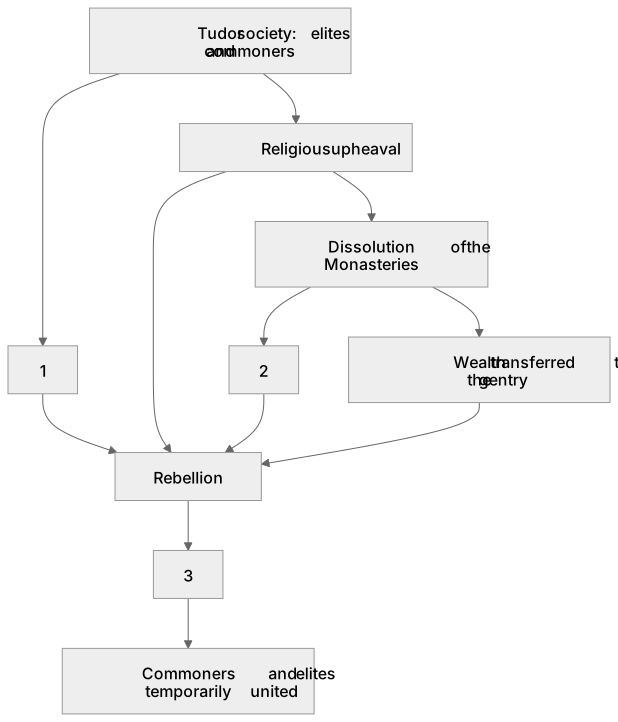
1Box 1
2Box 2
3Box 3
There is more to this lesson
The full lesson goes on to check your understanding and help you earn the marks. Create a free account to carry on, with your progress saved.
A week of Premium from your first lesson · Then the free plan continues · No card, no charge
Test your understanding of 1C The Tudors: England, 1485–1603 – Henry VIII, 1509–1547: Society: elites and commoners; regional issues and the social impact of religious upheaval; rebellion
Active recall beats re-reading. Take an instant quiz now to test what you’ve learned and lock it into long-term memory.
A week of Premium from your first lesson · Then the free plan continues · No card, no charge