AQA · A-Level · History
Course version: 7042 · Version from Sept 2017
England, 1485–1603 – Henry VIII, 1509–1547: Government: Crown and…
Full specification wording
1C The Tudors: England, 1485–1603 – Henry VIII, 1509–1547: Government: Crown and Parliament, ministers, domestic policies including the establishment of Royal Supremacy
Henry VIII’s government evolved significantly, driven by his ministers and the quest for an annulment.
Checked against the AQA 7042 specification (opens in a new tab) on .
- Point 2 of 6
- 3 key terms
Study notes
From the checked teaching notes for this specification point.
The idea
Henry VIII’s government evolved significantly, driven by his ministers and the quest for an annulment. Initially, Thomas Wolsey dominated domestic policies, centralising justice through the Star Chamber and managing finances via the Tudor subsidy. Following Wolsey’s fall, Thomas Cromwell revolutionised government by elevating the role of Parliament. The Crown and Parliament worked collaboratively to pass the Reformation Parliament statutes, culminating in the 1534 Act of Supremacy. This established the Royal Supremacy, making Henry the Supreme Head of the Church of England. This shift transformed Parliament from a sporadic tax-granting body into a vital legislative partner, fundamentally altering the constitutional balance and enabling sweeping domestic reforms like the dissolution of the monasteries.
What earns the marks
- Analyse the role of chief ministers, contrasting Wolsey's use of the Star Chamber with Cromwell's reliance on statute law.
- Evaluate the changing relationship between the Crown and Parliament, noting Parliament's enhanced legislative authority during the 1530s.
- Explain the domestic policies implemented by Wolsey, such as the Amicable Grant and the Eltham Ordinances.
- Assess the legislative process and impact of the establishment of the Royal Supremacy, including the Act in Restraint of Appeals and the Act of Supremacy.
- Examine the administrative revolution thesis regarding Cromwell's creation of specialised bureaucratic courts like the Court of Augmentations.
Common mistakes and how to put them right
Assuming Parliament had the power to dictate policy to Henry VIII.
Put it right: Clarify that Parliament was a tool used by the Crown to give legal force to the Royal Supremacy, not an independent policy-maker.
Treating Wolsey and Cromwell's governing styles as identical.
Put it right: Distinguish between Wolsey's reliance on the royal prerogative and conciliar courts, and Cromwell's use of parliamentary statute.
Stating the Royal Supremacy immediately changed Protestant doctrine.
Put it right: Emphasise that the Royal Supremacy was initially a political and jurisdictional break from Rome, while Henry maintained largely Catholic doctrine.
Exam tips
- Use the concept of 'King-in-Parliament' to explain how the Crown's authority was magnified when acting in conjunction with Parliament.
- When discussing domestic policies, explicitly link Wolsey's financial measures, like the Tudor subsidy, to Henry's foreign policy demands.
- Deploy specific legislation, such as the 1533 Act in Restraint of Appeals, to demonstrate exactly how the Royal Supremacy was legally constructed.
Try the lesson
The start of the 1C The Tudors: England, 1485–1603 – Henry VIII, 1509–1547: Government: Crown and Parliament, ministers, domestic policies including the establishment of Royal Supremacy lesson, made from checked teaching notes for this specification point.
Have a go first
Which of Henry VIII's chief ministers was primarily responsible for drafting the legislation that established the Royal Supremacy in the 1530s?
Listen
Henry VIII’s government evolved significantly, driven by his ministers and the quest for an annulment. Initially, Thomas Wolsey dominated domestic policies, centralising justice through the Star Chamber and managing finances via the Tudor subsidy. Following Wolsey’s fall, Thomas Cromwell revolutionised government by elevating the role of Parliament. The Crown and Parliament worked collaboratively to pass the Reformation Parliament statutes, culminating in the 1534 Act of Supremacy. This established the Royal Supremacy, making Henry the Supreme Head of the Church of England. This shift transformed Parliament from a sporadic tax-granting body into a vital legislative partner, fundamentally altering the constitutional balance and enabling sweeping domestic reforms like the dissolution of the monasteries. A strong answer earns marks for these points. Analyse the role of chief ministers, contrasting Wolsey's use of the Star Chamber with Cromwell's reliance on statute law. Evaluate the changing relationship between the Crown and Parliament, noting Parliament's enhanced legislative authority during the 1530s. Explain the domestic policies implemented by Wolsey, such as the Amicable Grant and the Eltham Ordinances. Assess the legislative process and impact of the establishment of the Royal Supremacy, including the Act in Restraint of Appeals and the Act of Supremacy. A common slip: Assuming Parliament had the power to dictate policy to Henry VIII. Instead, Clarify that Parliament was a tool used by the Crown to give legal force to the Royal Supremacy, not an independent policy-maker. Exam tip: Use the concept of 'King-in-Parliament' to explain how the Crown's authority was magnified when acting in conjunction with Parliament.
See it
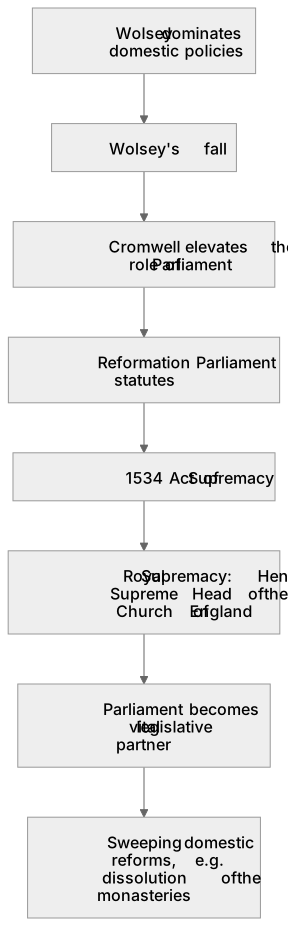
Put it in order
Put these steps in the order they happen.
- 1. 1534 Act of Supremacy
- 2. Sweeping domestic reforms, e.g. dissolution of the monasteries
- 3. Royal Supremacy: Henry Supreme Head of the Church of England
- 4. Wolsey dominates domestic policies
- 5. Wolsey's fall
- 6. Parliament becomes a vital legislative partner
- 7. Cromwell elevates the role of Parliament
- 8. Reformation Parliament statutes
Key words
Say what each word means before you turn the card.
Royal Supremacy
Try answering aloud or in your head before turning the card.
Reformation Parliament
Try answering aloud or in your head before turning the card.
Crown and Parliament
Try answering aloud or in your head before turning the card.
See every definition
- Royal Supremacy
- Established by the 1534 Act of Supremacy, it made Henry the Supreme Head of the Church of England.
- Reformation Parliament
- Passed statutes collaboratively with the Crown, culminating in the 1534 Act of Supremacy.
- Crown and Parliament
- Worked collaboratively to pass the Reformation Parliament statutes, with Parliament becoming a vital legislative partner.
Label the diagram
Some boxes have lost their names. Pick the right name for each number.
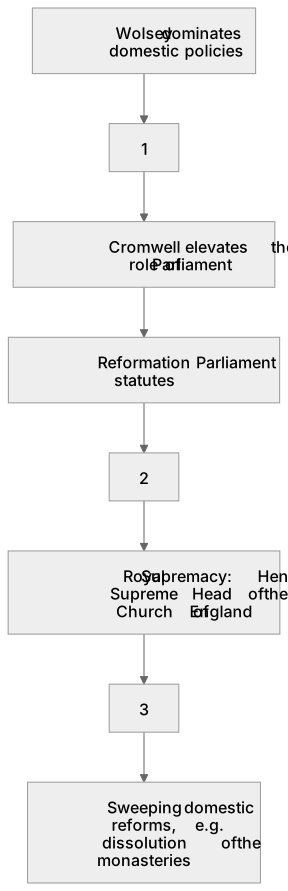
1Box 1
2Box 2
3Box 3
There is more to this lesson
The full lesson goes on to check your understanding and help you earn the marks. Create a free account to carry on, with your progress saved.
A week of Premium from your first lesson · Then the free plan continues · No card, no charge
Test your understanding of 1C The Tudors: England, 1485–1603 – Henry VIII, 1509–1547: Government: Crown and Parliament, ministers, domestic policies including the establishment of Royal Supremacy
Active recall beats re-reading. Take an instant quiz now to test what you’ve learned and lock it into long-term memory.
A week of Premium from your first lesson · Then the free plan continues · No card, no charge