AQA · A-Level · History
Course version: 7042 · Version from Sept 2017
England, 1485–1603 – Henry VIII, 1509–1547: Henry VIII: character and…
Full specification wording
1C The Tudors: England, 1485–1603 – Henry VIII, 1509–1547: Henry VIII: character and aims; addressing Henry VII’s legacy
Henry VIII ascended the throne in 1509 with a character starkly contrasting his father’s; he was charismatic, athletic, and sought martial glory, viewing himself as a Renaissance prince.
Checked against the AQA 7042 specification (opens in a new tab) on .
- Point 1 of 6
- 4 key terms
Study notes
From the checked teaching notes for this specification point.
The idea
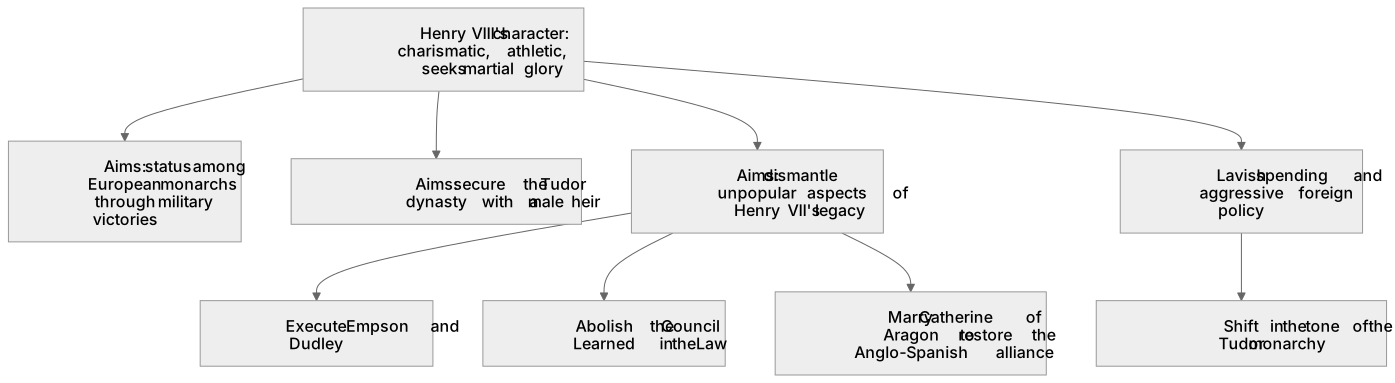
Henry VIII ascended the throne in 1509 with a character starkly contrasting his father’s; he was charismatic, athletic, and sought martial glory, viewing himself as a Renaissance prince. His primary aims included establishing his status among European monarchs through military victories, securing the Tudor dynasty with a male heir, and dismantling unpopular aspects of Henry VII’s legacy. He addressed this legacy immediately by executing his father’s despised financial enforcers, Empson and Dudley, abolishing the Council Learned in the Law, and marrying Catherine of Aragon to restore the Anglo-Spanish alliance. Unlike his cautious father, Henry VIII embraced lavish spending and aggressive foreign policy, fundamentally shifting the tone of the Tudor monarchy.
What earns the marks
- Identify Henry VIII's early aims, such as achieving military glory in France and securing the succession.
- Explain how Henry's character, which was extroverted, aggressive and chivalric, influenced his departure from his father's cautious policies.
- Evaluate the methods used to dismantle Henry VII's legacy, specifically the execution of Empson and Dudley and the abolition of the Council Learned.
- Assess the significance of his marriage to Catherine of Aragon in fulfilling diplomatic aims and distancing himself from his father's later isolation.
Common mistakes and how to put them right
Claiming Henry VIII continued his father's financial prudence.
Put it right: Emphasise that Henry VIII rapidly depleted the inherited treasury through lavish court spending and expensive foreign wars.
Stating Henry VIII had a clear, long-term administrative plan upon accession.
Put it right: Recognise that his early aims were largely focused on immediate glory and dismantling unpopular policies rather than structural reform.
Confusing the Council Learned in the Law with the Star Chamber.
Put it right: Specify that Henry VIII abolished the Council Learned to appease the nobility, while the Star Chamber was later expanded by Wolsey.
Exam tips
- Contrast Henry VIII's early reliance on his father's councillors with his later promotion of Thomas Wolsey to highlight shifts in his governing style.
- Use the executions of Empson and Dudley as a concrete example of Henry VIII securing popularity with the nobility.
- Link Henry's desire for martial glory directly to his character as a Renaissance prince when evaluating his early foreign policy decisions.
Try the lesson
The start of the 1C The Tudors: England, 1485–1603 – Henry VIII, 1509–1547: Henry VIII: character and aims; addressing Henry VII’s legacy lesson, made from checked teaching notes for this specification point.
Have a go first
Which immediate action did Henry VIII take upon his accession in 1509 to distance himself from the unpopular financial legacy of Henry VII?
Listen
Henry VIII ascended the throne in 1509 with a character starkly contrasting his father’s; he was charismatic, athletic, and sought martial glory, viewing himself as a Renaissance prince. His primary aims included establishing his status among European monarchs through military victories, securing the Tudor dynasty with a male heir, and dismantling unpopular aspects of Henry VII’s legacy. He addressed this legacy immediately by executing his father’s despised financial enforcers, Empson and Dudley, abolishing the Council Learned in the Law, and marrying Catherine of Aragon to restore the Anglo-Spanish alliance. Unlike his cautious father, Henry VIII embraced lavish spending and aggressive foreign policy, fundamentally shifting the tone of the Tudor monarchy. A strong answer earns marks for these points. Identify Henry VIII's early aims, such as achieving military glory in France and securing the succession. Explain how Henry's character, which was extroverted, aggressive and chivalric, influenced his departure from his father's cautious policies. Evaluate the methods used to dismantle Henry VII's legacy, specifically the execution of Empson and Dudley and the abolition of the Council Learned. Assess the significance of his marriage to Catherine of Aragon in fulfilling diplomatic aims and distancing himself from his father's later isolation. A common slip: Claiming Henry VIII continued his father's financial prudence. Instead, Emphasise that Henry VIII rapidly depleted the inherited treasury through lavish court spending and expensive foreign wars. Exam tip: Contrast Henry VIII's early reliance on his father's councillors with his later promotion of Thomas Wolsey to highlight shifts in his governing style.
See it
Key words
Say what each word means before you turn the card.
Monarchical authority
Try answering aloud or in your head before turning the card.
Nobility and crown relations
Try answering aloud or in your head before turning the card.
Foreign policy and diplomacy
Try answering aloud or in your head before turning the card.
Continuity and change
Try answering aloud or in your head before turning the card.
See every definition
- Monarchical authority
- Henry VIII viewed himself as a Renaissance prince and sought to establish his status among European monarchs through military victories.
- Nobility and crown relations
- He addressed his father's legacy by executing the despised financial enforcers Empson and Dudley and abolishing the Council Learned in the Law.
- Foreign policy and diplomacy
- Unlike his cautious father, he embraced aggressive foreign policy, and his marriage to Catherine of Aragon restored the Anglo-Spanish alliance.
- Continuity and change
- His character starkly contrasted his father's, and he fundamentally shifted the tone of the Tudor monarchy through lavish spending and aggressive foreign policy.
Label the diagram
Some boxes have lost their names. Pick the right name for each number.
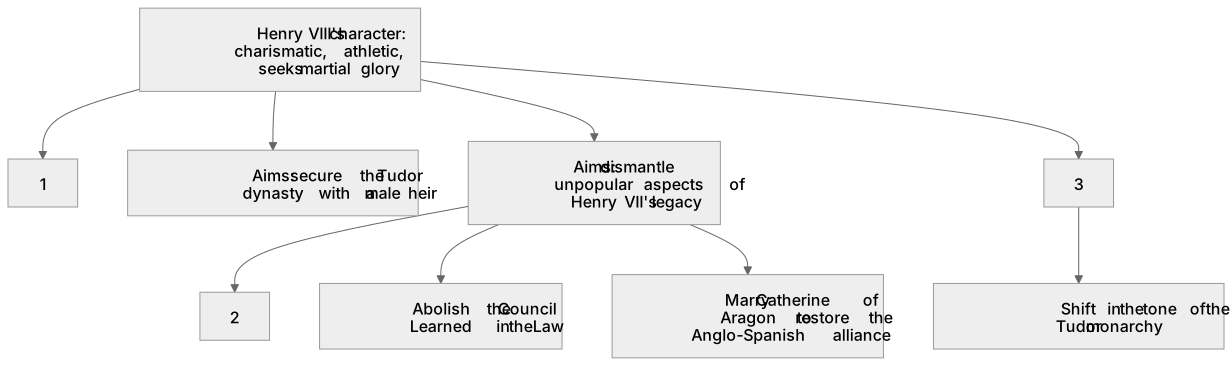
1Box 1
2Box 2
3Box 3
There is more to this lesson
The full lesson goes on to check your understanding and help you earn the marks. Create a free account to carry on, with your progress saved.
A week of Premium from your first lesson · Then the free plan continues · No card, no charge
Test your understanding of 1C The Tudors: England, 1485–1603 – Henry VIII, 1509–1547: Henry VIII: character and aims; addressing Henry VII’s legacy
Active recall beats re-reading. Take an instant quiz now to test what you’ve learned and lock it into long-term memory.
A week of Premium from your first lesson · Then the free plan continues · No card, no charge