AQA · A-Level · History
Course version: 7042 · Version from Sept 2017
England, 1485–1603 – Instability and consolidation: 'the Mid-Tudor…
Full specification wording
1C The Tudors: England, 1485–1603 – Instability and consolidation: 'the Mid-Tudor Crisis', 1547–1563 (A-level only): The impact of economic, social and religious developments in the early years of Elizabeth's rule
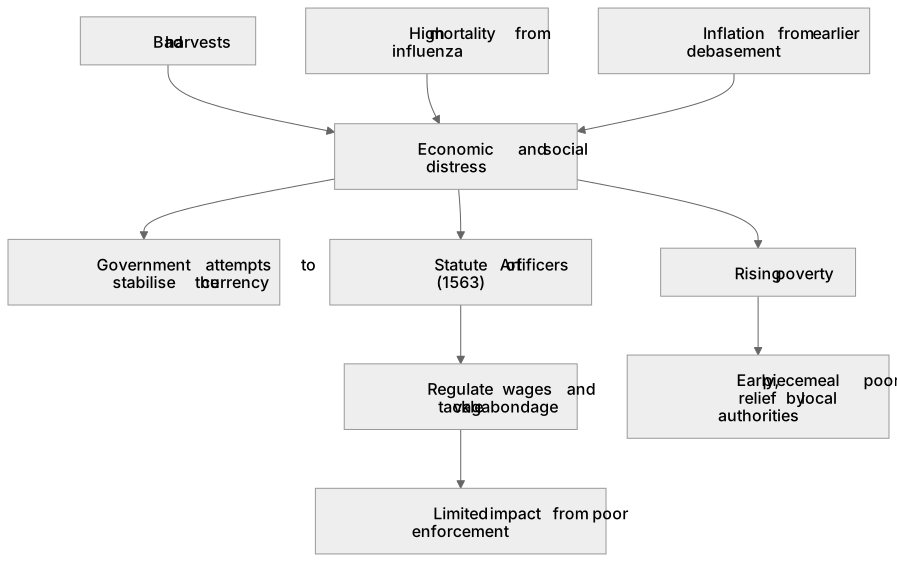
The early years of Elizabeth’s reign faced severe economic and social distress, exacerbated by bad harvests, high mortality from influenza, and rampant inflation caused by earlier debasement.
Checked against the AQA 7042 specification (opens in a new tab) on .
- Point 6 of 6
- 4 key terms
Study notes
From the checked teaching notes for this specification point.
The idea
The early years of Elizabeth’s reign faced severe economic and social distress, exacerbated by bad harvests, high mortality from influenza, and rampant inflation caused by earlier debasement. Economically, the government attempted to stabilise the currency and introduced the Statute of Artificers (1563) to regulate wages and tackle vagabondage, though its impact was limited by poor enforcement. Socially, local authorities struggled with rising poverty, leading to early, piecemeal poor relief measures. Religiously, the implementation of the 1559 Settlement caused local friction; Marian bishops were deprived of their sees for refusing the Oath of Supremacy, and the Crown faced the challenge of enforcing Protestant conformity across a largely conservative populace.
What earns the marks
- Analyse the economic challenges of the late 1550s, including inflation, debased coinage, and the impact of the influenza epidemic on the labour market.
- Evaluate the effectiveness of early Elizabethan social legislation, particularly the 1563 Statute of Artificers, in addressing wage demands and vagrancy.
- Assess the social impact of population changes, harvest failures, and the growing problem of poverty in urban and rural communities.
- Examine the religious impact of enforcing the 1559 Settlement at the parish level, including the deprivation of Marian clergy and the slow pace of Protestantisation.
Common mistakes and how to put them right
Confusing the 1563 Statute of Artificers with the later 1598 or 1601 Poor Laws.
Put it right: Specify that the 1563 Statute focused on wage regulation, apprenticeships, and tying men to the land, rather than comprehensive national poor relief.
Assuming the 1559 Religious Settlement instantly transformed England into a Protestant nation.
Put it right: Highlight that early religious developments were slow, with widespread survival of Catholic sympathies and practices at the local level.
Blaming Elizabeth entirely for the economic crisis of her early reign.
Put it right: Contextualise the economic turmoil as a legacy of the 'Mid-Tudor Crisis', including Henry VIII and Edward VI's debasement of the coinage and the Marian influenza epidemic.
Exam tips
- Use the 1563 Statute of Artificers as a primary example of the government's attempt to enforce social hierarchy and economic stability.
- Connect economic hardship, such as inflation and harvest failures, to the broader theme of the 'Mid-Tudor Crisis' to evaluate whether 1558 marked a turning point.
- When discussing religious developments, differentiate between the official legislation passed in Westminster and the practical reality of enforcement in the parishes.
Try the lesson
The start of the 1C The Tudors: England, 1485–1603 – Instability and consolidation: 'the Mid-Tudor Crisis', 1547–1563 (A-level only): The impact of economic, social and religious developments in the early years of Elizabeth's rule lesson, made from checked teaching notes for this specification point.
Have a go first
What was the primary aim of the Statute of Artificers passed by Elizabeth's government in 1563?
Listen
The early years of Elizabeth’s reign faced severe economic and social distress, exacerbated by bad harvests, high mortality from influenza, and rampant inflation caused by earlier debasement. Economically, the government attempted to stabilise the currency and introduced the Statute of Artificers (1563) to regulate wages and tackle vagabondage, though its impact was limited by poor enforcement. Socially, local authorities struggled with rising poverty, leading to early, piecemeal poor relief measures. Religiously, the implementation of the 1559 Settlement caused local friction; Marian bishops were deprived of their sees for refusing the Oath of Supremacy, and the Crown faced the challenge of enforcing Protestant conformity across a largely conservative populace. A strong answer earns marks for these points. Analyse the economic challenges of the late 1550s, including inflation, debased coinage, and the impact of the influenza epidemic on the labour market. Evaluate the effectiveness of early Elizabethan social legislation, particularly the 1563 Statute of Artificers, in addressing wage demands and vagrancy. Assess the social impact of population changes, harvest failures, and the growing problem of poverty in urban and rural communities. Examine the religious impact of enforcing the 1559 Settlement at the parish level, including the deprivation of Marian clergy and the slow pace of Protestantisation. A common slip: Confusing the 1563 Statute of Artificers with the later 1598 or 1601 Poor Laws. Instead, Specify that the 1563 Statute focused on wage regulation, apprenticeships, and tying men to the land, rather than comprehensive national poor relief. Exam tip: Use the 1563 Statute of Artificers as a primary example of the government's attempt to enforce social hierarchy and economic stability.
See it
Key words
Say what each word means before you turn the card.
Economic instability and inflation
Try answering aloud or in your head before turning the card.
Social hierarchy and poverty
Try answering aloud or in your head before turning the card.
Religious transition and conformity
Try answering aloud or in your head before turning the card.
Continuity versus change in the Mid-Tudor period
Try answering aloud or in your head before turning the card.
See every definition
- Economic instability and inflation
- Severe economic and social distress, exacerbated by bad harvests, high mortality from influenza, and rampant inflation caused by earlier debasement.
- Social hierarchy and poverty
- Local authorities struggled with rising poverty, leading to early, piecemeal poor relief measures.
- Religious transition and conformity
- The implementation of the 1559 Settlement caused local friction, with Marian bishops deprived of their sees and the Crown facing the challenge of enforcing Protestant conformity across a largely conservative populace.
- Continuity versus change in the Mid-Tudor period
- The economic turmoil was a legacy of the 'Mid-Tudor Crisis', including debasement of the coinage and the Marian influenza epidemic.
Label the diagram
Some boxes have lost their names. Pick the right name for each number.
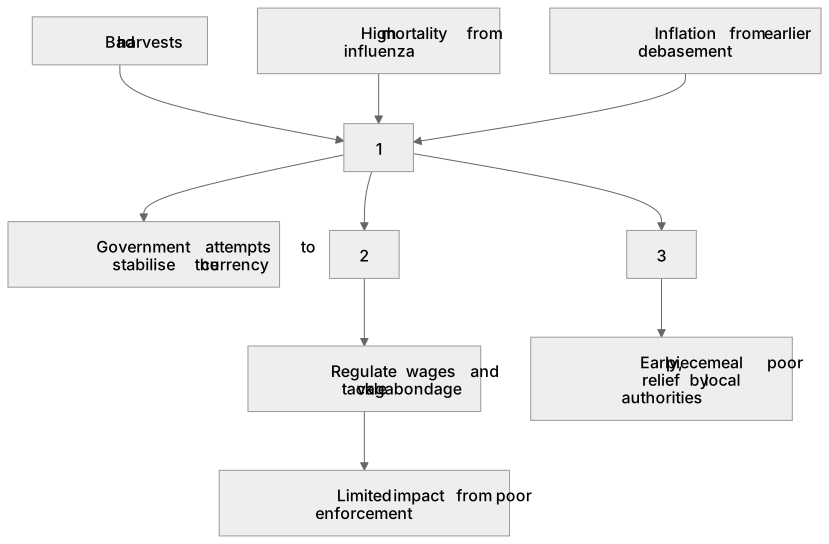
1Box 1
2Box 2
3Box 3
There is more to this lesson
The full lesson goes on to check your understanding and help you earn the marks. Create a free account to carry on, with your progress saved.
A week of Premium from your first lesson · Then the free plan continues · No card, no charge
Test your understanding of 1C The Tudors: England, 1485–1603 – Instability and consolidation: 'the Mid-Tudor Crisis', 1547–1563 (A-level only): The impact of economic, social and religious developments in the early years of Elizabeth's rule
Active recall beats re-reading. Take an instant quiz now to test what you’ve learned and lock it into long-term memory.
A week of Premium from your first lesson · Then the free plan continues · No card, no charge