AQA · A-Level · History
Course version: 7042 · Version from Sept 2017
England, 1485–1603 – Instability and consolidation: 'the Mid-Tudor…
Full specification wording
1C The Tudors: England, 1485–1603 – Instability and consolidation: 'the Mid-Tudor Crisis', 1547–1563 (A-level only): Elizabeth I: character and aims; consolidation of power, including the Elizabethan Settlement and relations with foreign powers
Elizabeth I’s accession in 1558 required immediate consolidation of power due to her gender, questionable legitimacy, and the religious divisions left by Mary I. Her character—highly educated,…
Checked against the AQA 7042 specification (opens in a new tab) on .
- Point 5 of 6
- 4 key terms
Study notes
From the checked teaching notes for this specification point.
The idea
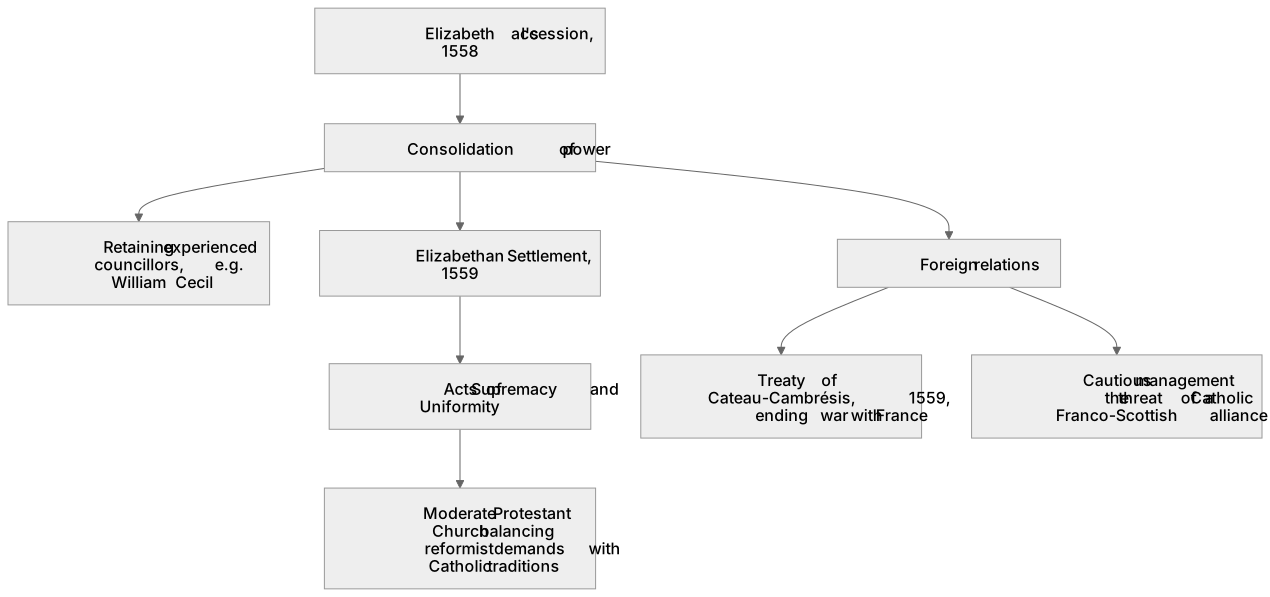
Elizabeth I’s accession in 1558 required immediate consolidation of power due to her gender, questionable legitimacy, and the religious divisions left by Mary I. Her character—highly educated, cautious, and politically astute—shaped her primary aims: securing her throne, achieving religious stability, and avoiding ruinous foreign wars. She consolidated power by retaining experienced councillors like William Cecil. The 1559 Elizabethan Settlement (Acts of Supremacy and Uniformity) established a moderate Protestant Church, balancing reformist demands with Catholic traditions to minimise rebellion. In foreign relations, she navigated the Treaty of Cateau-Cambrésis (1559) to end war with France and cautiously managed the threat of a Catholic Franco-Scottish alliance, demonstrating her pragmatic approach to diplomacy.
What earns the marks
- Evaluate how Elizabeth's cautious character and humanist education influenced her political decision-making and choice of Privy Councillors.
- Assess the methods used to consolidate her authority in 1558, including her coronation, management of Parliament, and appointment of William Cecil.
- Analyse the components of the 1559 Religious Settlement (Acts of Supremacy and Uniformity, Royal Injunctions) as a tool for political and religious consolidation.
- Examine early foreign policy aims, specifically the resolution of the French war via the Treaty of Cateau-Cambrésis and the handling of the French threat in Scotland.
Common mistakes and how to put them right
Claiming the Elizabethan Settlement was entirely Protestant and satisfied all reformers.
Put it right: Acknowledge that the Settlement was a compromise ('via media') that retained Catholic vestments and ambiguous communion phrasing, which frustrated radical Puritans.
Stating Elizabeth wanted aggressive expansionist foreign wars.
Put it right: Emphasise that her primary foreign policy aim was national security and financial preservation, leading to defensive and cautious diplomacy.
Assuming Elizabeth's gender made her entirely dependent on male advisors.
Put it right: Recognise that while she relied on figures like Cecil, she actively manipulated her court, used her gender to her diplomatic advantage, and retained ultimate decision-making power.
Exam tips
- Link Elizabeth's personal character traits, such as her pragmatism and caution, directly to the specific terms of the 1559 Religious Settlement.
- When discussing consolidation of power, contrast her smooth accession and immediate political appointments with the instability of the preceding 'Mid-Tudor Crisis'.
- Use the Treaty of Cateau-Cambrésis as concrete evidence of her prioritising financial recovery and national security over dynastic glory.
Try the lesson
The start of the 1C The Tudors: England, 1485–1603 – Instability and consolidation: 'the Mid-Tudor Crisis', 1547–1563 (A-level only): Elizabeth I: character and aims; consolidation of power, including the Elizabethan Settlement and relations with foreign powers lesson, made from checked teaching notes for this specification point.
Have a go first
Which of the following was a key provision of the 1559 Act of Supremacy?
Listen
Elizabeth I’s accession in 1558 required immediate consolidation of power due to her gender, questionable legitimacy, and the religious divisions left by Mary I. Her character—highly educated, cautious, and politically astute—shaped her primary aims: securing her throne, achieving religious stability, and avoiding ruinous foreign wars. She consolidated power by retaining experienced councillors like William Cecil. The 1559 Elizabethan Settlement (Acts of Supremacy and Uniformity) established a moderate Protestant Church, balancing reformist demands with Catholic traditions to minimise rebellion. In foreign relations, she navigated the Treaty of Cateau-Cambrésis (1559) to end war with France and cautiously managed the threat of a Catholic Franco-Scottish alliance, demonstrating her pragmatic approach to diplomacy. A strong answer earns marks for these points. Evaluate how Elizabeth's cautious character and humanist education influenced her political decision-making and choice of Privy Councillors. Assess the methods used to consolidate her authority in 1558, including her coronation, management of Parliament, and appointment of William Cecil. Analyse the components of the 1559 Religious Settlement (Acts of Supremacy and Uniformity, Royal Injunctions) as a tool for political and religious consolidation. Examine early foreign policy aims, specifically the resolution of the French war via the Treaty of Cateau-Cambrésis and the handling of the French threat in Scotland. A common slip: Claiming the Elizabethan Settlement was entirely Protestant and satisfied all reformers. Instead, Acknowledge that the Settlement was a compromise ('via media') that retained Catholic vestments and ambiguous communion phrasing, which frustrated radical Puritans. Exam tip: Link Elizabeth's personal character traits, such as her pragmatism and caution, directly to the specific terms of the 1559 Religious Settlement.
See it
Key words
Say what each word means before you turn the card.
Monarchical authority and consolidation
Try answering aloud or in your head before turning the card.
Religious compromise and the 'via media'
Try answering aloud or in your head before turning the card.
Diplomatic pragmatism and national security
Try answering aloud or in your head before turning the card.
The role of the Privy Council
Try answering aloud or in your head before turning the card.
See every definition
- Monarchical authority and consolidation
- Securing the throne and achieving religious stability were primary aims, pursued by retaining experienced councillors like William Cecil.
- Religious compromise and the 'via media'
- The 1559 Elizabethan Settlement established a moderate Protestant Church, balancing reformist demands with Catholic traditions to minimise rebellion.
- Diplomatic pragmatism and national security
- A pragmatic approach to diplomacy was shown by navigating the Treaty of Cateau-Cambrésis to end war with France and cautiously managing a Catholic Franco-Scottish alliance.
- The role of the Privy Council
- Power was consolidated by appointing experienced councillors such as William Cecil to the Privy Council.
Label the diagram
Some boxes have lost their names. Pick the right name for each number.
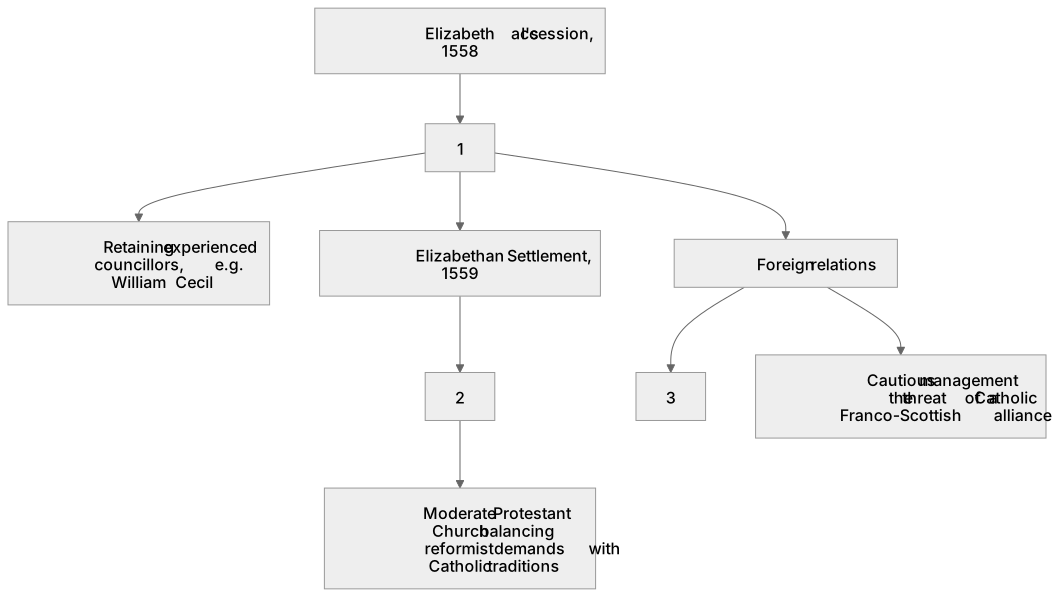
1Box 1
2Box 2
3Box 3
There is more to this lesson
The full lesson goes on to check your understanding and help you earn the marks. Create a free account to carry on, with your progress saved.
A week of Premium from your first lesson · Then the free plan continues · No card, no charge
Test your understanding of 1C The Tudors: England, 1485–1603 – Instability and consolidation: 'the Mid-Tudor Crisis', 1547–1563 (A-level only): Elizabeth I: character and aims; consolidation of power, including the Elizabethan Settlement and relations with foreign powers
Active recall beats re-reading. Take an instant quiz now to test what you’ve learned and lock it into long-term memory.
A week of Premium from your first lesson · Then the free plan continues · No card, no charge