AQA · A-Level · History
Course version: 7042 · Version from Sept 2017
England, 1485–1603 – Instability and consolidation: 'the Mid-Tudor…
Full specification wording
1C The Tudors: England, 1485–1603 – Instability and consolidation: 'the Mid-Tudor Crisis', 1547–1563 (A-level only): The social impact of religious and economic changes under Edward VI; rebellion; intellectual developments; humanist and religious thought
Edward VI’s reign saw profound social upheaval driven by radical religious reforms and economic pressures.
Checked against the AQA 7042 specification (opens in a new tab) on .
- Point 2 of 6
- 4 key terms
Study notes
From the checked teaching notes for this specification point.
The idea
Edward VI’s reign saw profound social upheaval driven by radical religious reforms and economic pressures. The 1549 Book of Common Prayer and the dissolution of chantries removed traditional community support networks, deeply affecting the peasantry. Economically, rampant inflation, debasement of the coinage, and enclosure exacerbated poverty. These tensions culminated in the 1549 rebellions: the Western Rebellion, a conservative religious reaction, and Kett’s Rebellion, driven by anti-enclosure grievances. Concurrently, intellectual developments flourished as evangelical humanism gained traction. Figures like Thomas Cranmer and Martin Bucer shaped religious thought, promoting Protestant theology and education, which fundamentally altered England's intellectual landscape amidst the unrest.
What earns the marks
- Analyse the social consequences of religious changes, such as the dissolution of chantries and the introduction of the 1549 and 1552 Prayer Books.
- Evaluate the economic factors contributing to social distress, including population growth, inflation, debasement, and enclosure.
- Compare the causes, nature, and threat levels of the Western Rebellion and Kett's Rebellion in 1549.
- Assess the influence of humanist thinkers and radical reformers, such as Cranmer, Hooper, and Bucer, on Edwardian religious policy and intellectual life.
Common mistakes and how to put them right
Treating the 1549 rebellions as having identical causes.
Put it right: Distinguish between the primarily religious motives of the Western Rebellion and the socio-economic (anti-enclosure) focus of Kett's Rebellion.
Assuming humanism under Edward VI was identical to Henrician humanism.
Put it right: Specify that Edwardian humanism was distinctly evangelical and Protestant, contrasting with the Catholic humanism of More or Erasmus.
Ignoring the economic context of religious changes.
Put it right: Link the confiscation of church wealth (like chantries) directly to the crown's financial needs and the resulting loss of charitable support for the poor.
Exam tips
- Link economic grievances directly to the outbreak of rebellion, using specific examples like the resentment towards the sheep tax in 1549.
- When discussing intellectual developments, name specific reformers (e.g., Peter Martyr, Martin Bucer) who influenced Cranmer and the Edwardian church.
- Evaluate whether the events of 1549 genuinely constituted a 'crisis' by assessing the government's ability to suppress the rebellions.
Try the lesson
The start of the 1C The Tudors: England, 1485–1603 – Instability and consolidation: 'the Mid-Tudor Crisis', 1547–1563 (A-level only): The social impact of religious and economic changes under Edward VI; rebellion; intellectual developments; humanist and religious thought lesson, made from checked teaching notes for this specification point.
Have a go first
What was the primary catalyst for the outbreak of the Western Rebellion in 1549?
Listen
Edward VI’s reign saw profound social upheaval driven by radical religious reforms and economic pressures. The 1549 Book of Common Prayer and the dissolution of chantries removed traditional community support networks, deeply affecting the peasantry. Economically, rampant inflation, debasement of the coinage, and enclosure exacerbated poverty. These tensions culminated in the 1549 rebellions: the Western Rebellion, a conservative religious reaction, and Kett’s Rebellion, driven by anti-enclosure grievances. Concurrently, intellectual developments flourished as evangelical humanism gained traction. Figures like Thomas Cranmer and Martin Bucer shaped religious thought, promoting Protestant theology and education, which fundamentally altered England's intellectual landscape amidst the unrest. A strong answer earns marks for these points. Analyse the social consequences of religious changes, such as the dissolution of chantries and the introduction of the 1549 and 1552 Prayer Books. Evaluate the economic factors contributing to social distress, including population growth, inflation, debasement, and enclosure. Compare the causes, nature, and threat levels of the Western Rebellion and Kett's Rebellion in 1549. Assess the influence of humanist thinkers and radical reformers, such as Cranmer, Hooper, and Bucer, on Edwardian religious policy and intellectual life. A common slip: Treating the 1549 rebellions as having identical causes. Instead, distinguish between the primarily religious motives of the Western Rebellion and the socio-economic (anti-enclosure) focus of Kett's Rebellion. Exam tip: Link economic grievances directly to the outbreak of rebellion, using specific examples like the resentment towards the sheep tax in 1549.
See it
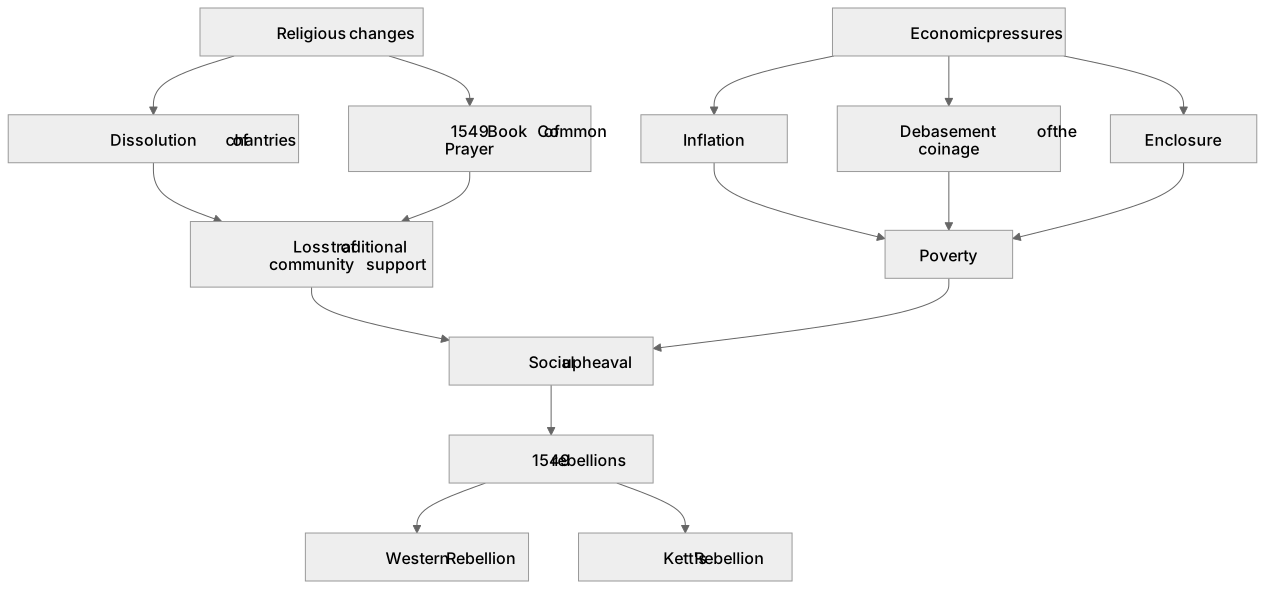
Key words
Say what each word means before you turn the card.
Social discontent and rebellion
Try answering aloud or in your head before turning the card.
Economic pressures and policy
Try answering aloud or in your head before turning the card.
Religious reform and radicalism
Try answering aloud or in your head before turning the card.
Intellectual and humanist thought
Try answering aloud or in your head before turning the card.
See every definition
- Social discontent and rebellion
- Profound social upheaval driven by radical religious reforms and economic pressures, culminating in the 1549 rebellions, the Western Rebellion and Kett's Rebellion.
- Economic pressures and policy
- Rampant inflation, debasement of the coinage and enclosure exacerbated poverty, while the confiscation of church wealth was linked to the crown's financial needs.
- Religious reform and radicalism
- The 1549 Book of Common Prayer and the dissolution of chantries removed traditional community support networks, deeply affecting the peasantry.
- Intellectual and humanist thought
- Evangelical humanism gained traction, with figures like Thomas Cranmer and Martin Bucer promoting Protestant theology and education.
Label the diagram
Some boxes have lost their names. Pick the right name for each number.
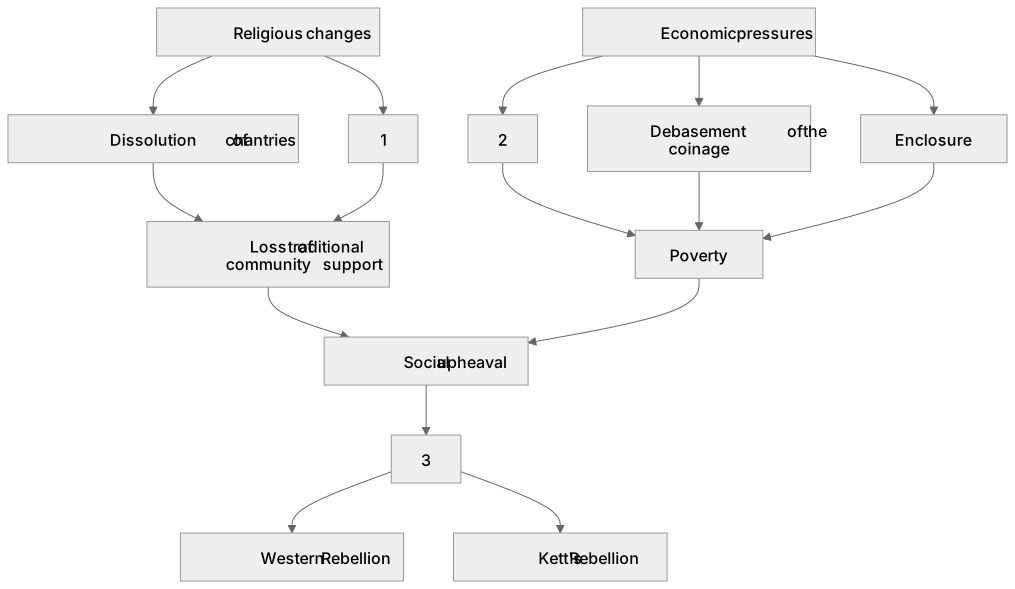
1Box 1
2Box 2
3Box 3
There is more to this lesson
The full lesson goes on to check your understanding and help you earn the marks. Create a free account to carry on, with your progress saved.
A week of Premium from your first lesson · Then the free plan continues · No card, no charge
Test your understanding of 1C The Tudors: England, 1485–1603 – Instability and consolidation: 'the Mid-Tudor Crisis', 1547–1563 (A-level only): The social impact of religious and economic changes under Edward VI; rebellion; intellectual developments; humanist and religious thought
Active recall beats re-reading. Take an instant quiz now to test what you’ve learned and lock it into long-term memory.
A week of Premium from your first lesson · Then the free plan continues · No card, no charge