AQA · A-Level · History
Course version: 7042 · Version from Sept 2017
England, 1485–1603 – Instability and consolidation: 'the Mid-Tudor…
Full specification wording
1C The Tudors: England, 1485–1603 – Instability and consolidation: 'the Mid-Tudor Crisis', 1547–1563 (A-level only): Mary I and her ministers; royal authority; problems of succession; relations with foreign powers
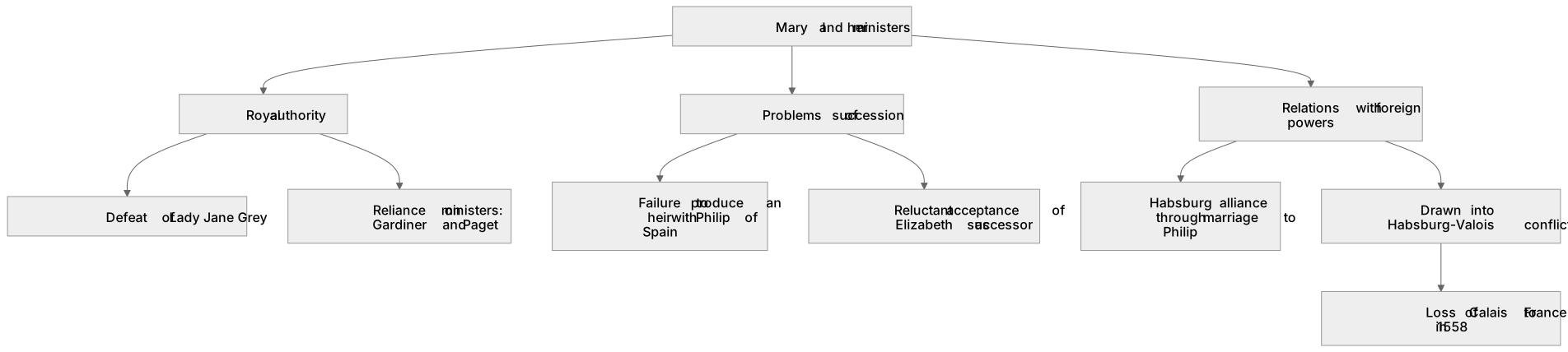
Mary I’s reign tested royal authority, beginning with her defeat of Lady Jane Grey, demonstrating support for the legitimate succession.
Checked against the AQA 7042 specification (opens in a new tab) on .
- Point 3 of 6
- 4 key terms
Study notes
From the checked teaching notes for this specification point.
The idea
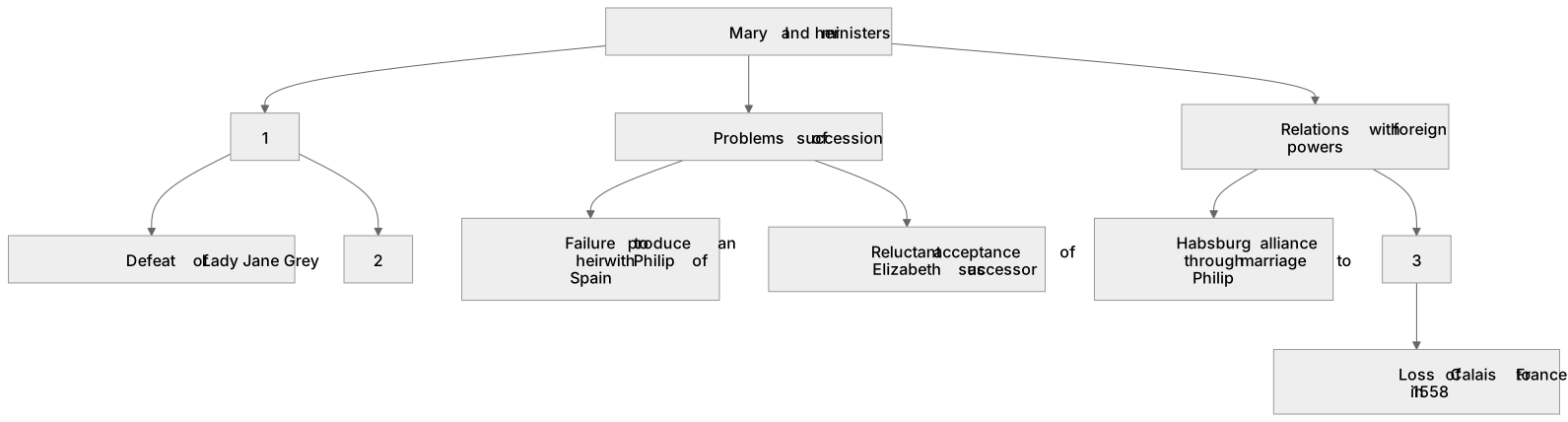
Mary I’s reign tested royal authority, beginning with her defeat of Lady Jane Grey, demonstrating support for the legitimate succession. However, her reliance on ministers like Stephen Gardiner and William Paget highlighted tensions in governance. The succession remained a persistent problem; Mary’s failure to produce an heir with Philip of Spain meant she reluctantly accepted Elizabeth as her successor. Relations with foreign powers were dominated by the Habsburg alliance through her marriage to Philip, drawing England into the Habsburg-Valois conflict. This culminated in the disastrous loss of Calais to France in 1558, severely damaging Mary's prestige and highlighting the subordination of English interests to Spanish foreign policy.
What earns the marks
- Evaluate the effectiveness of Mary's working relationship with her Privy Council, noting the factionalism between Gardiner and Paget.
- Assess the extent of royal authority, particularly how Mary asserted her legitimate claim to the throne against the Devise for the Succession.
- Analyse the succession crisis, focusing on the implications of Mary's phantom pregnancies and the eventual necessity of recognising Elizabeth.
- Examine the impact of the Spanish marriage on foreign relations, specifically how it dragged England into war with France and led to the loss of Calais.
Common mistakes and how to put them right
Claiming Mary had no control over her ministers.
Put it right: Acknowledge that while her council was large and factional, Mary often made independent decisions, such as her marriage to Philip.
Stating the loss of Calais was purely a military failure.
Put it right: Explain that the loss was deeply tied to the unpopular Spanish marriage and the resulting diplomatic alignment with the Habsburgs.
Assuming Mary easily accepted Elizabeth as her heir.
Put it right: Recognise that Mary deeply resented Elizabeth's Protestantism and only formally acknowledged her succession days before her own death.
Exam tips
- When discussing royal authority, contrast Mary's initial triumph in 1553 with the later decline in her prestige following the loss of Calais.
- Use the marriage treaty of 1554 as concrete evidence when evaluating how Mary attempted to protect English interests from foreign domination.
- Link the problems of succession directly to foreign policy, showing how the lack of a Catholic heir doomed the Marian restoration.
Try the lesson
The start of the 1C The Tudors: England, 1485–1603 – Instability and consolidation: 'the Mid-Tudor Crisis', 1547–1563 (A-level only): Mary I and her ministers; royal authority; problems of succession; relations with foreign powers lesson, made from checked teaching notes for this specification point.
Have a go first
Which of the following individuals served as Mary I's Lord Chancellor and was a key minister in her government?
Listen
Mary I’s reign tested royal authority, beginning with her defeat of Lady Jane Grey, demonstrating support for the legitimate succession. However, her reliance on ministers like Stephen Gardiner and William Paget highlighted tensions in governance. The succession remained a persistent problem; Mary’s failure to produce an heir with Philip of Spain meant she reluctantly accepted Elizabeth as her successor. Relations with foreign powers were dominated by the Habsburg alliance through her marriage to Philip, drawing England into the Habsburg-Valois conflict. This culminated in the disastrous loss of Calais to France in 1558, severely damaging Mary's prestige and highlighting the subordination of English interests to Spanish foreign policy. A strong answer earns marks for these points. Evaluate the effectiveness of Mary's working relationship with her Privy Council, noting the factionalism between Gardiner and Paget. Assess the extent of royal authority, particularly how Mary asserted her legitimate claim to the throne against the Devise for the Succession. Analyse the succession crisis, focusing on the implications of Mary's phantom pregnancies and the eventual necessity of recognising Elizabeth. Examine the impact of the Spanish marriage on foreign relations, specifically how it dragged England into war with France and led to the loss of Calais. A common slip: Claiming Mary had no control over her ministers. Instead, Acknowledge that while her council was large and factional, Mary often made independent decisions, such as her marriage to Philip. Exam tip: When discussing royal authority, contrast Mary's initial triumph in 1553 with the later decline in her prestige following the loss of Calais.
See it
Key words
Say what each word means before you turn the card.
Royal authority and governance
Try answering aloud or in your head before turning the card.
Dynastic security and succession
Try answering aloud or in your head before turning the card.
Diplomacy and foreign alliances
Try answering aloud or in your head before turning the card.
Factionalism in the Privy Council
Try answering aloud or in your head before turning the card.
See every definition
- Royal authority and governance
- Mary I's reign tested royal authority, and her reliance on ministers like Stephen Gardiner and William Paget highlighted tensions in governance.
- Dynastic security and succession
- The succession remained a persistent problem, and Mary's failure to produce an heir meant she reluctantly accepted Elizabeth as her successor.
- Diplomacy and foreign alliances
- Relations with foreign powers were dominated by the Habsburg alliance through her marriage to Philip, drawing England into the Habsburg-Valois conflict.
- Factionalism in the Privy Council
- Factionalism between Gardiner and Paget is noted in evaluating the effectiveness of Mary's working relationship with her Privy Council.
Label the diagram
Some boxes have lost their names. Pick the right name for each number.
1Box 1
2Box 2
3Box 3
There is more to this lesson
The full lesson goes on to check your understanding and help you earn the marks. Create a free account to carry on, with your progress saved.
A week of Premium from your first lesson · Then the free plan continues · No card, no charge
Test your understanding of 1C The Tudors: England, 1485–1603 – Instability and consolidation: 'the Mid-Tudor Crisis', 1547–1563 (A-level only): Mary I and her ministers; royal authority; problems of succession; relations with foreign powers
Active recall beats re-reading. Take an instant quiz now to test what you’ve learned and lock it into long-term memory.
A week of Premium from your first lesson · Then the free plan continues · No card, no charge