AQA · A-Level · History
Course version: 7042 · Version from Sept 2017
England, 1485–1603 – The triumph of Elizabeth, 1563–1603 (A-level only):…
Full specification wording
1C The Tudors: England, 1485–1603 – The triumph of Elizabeth, 1563–1603 (A-level only): Elizabethan government: court, ministers and parliament; factional rivalries
Elizabeth I’s government balanced the royal court, trusted ministers, and Parliament.
Checked against the AQA 7042 specification (opens in a new tab) on .
- Point 1 of 6
- 4 key terms
Study notes
From the checked teaching notes for this specification point.
The idea
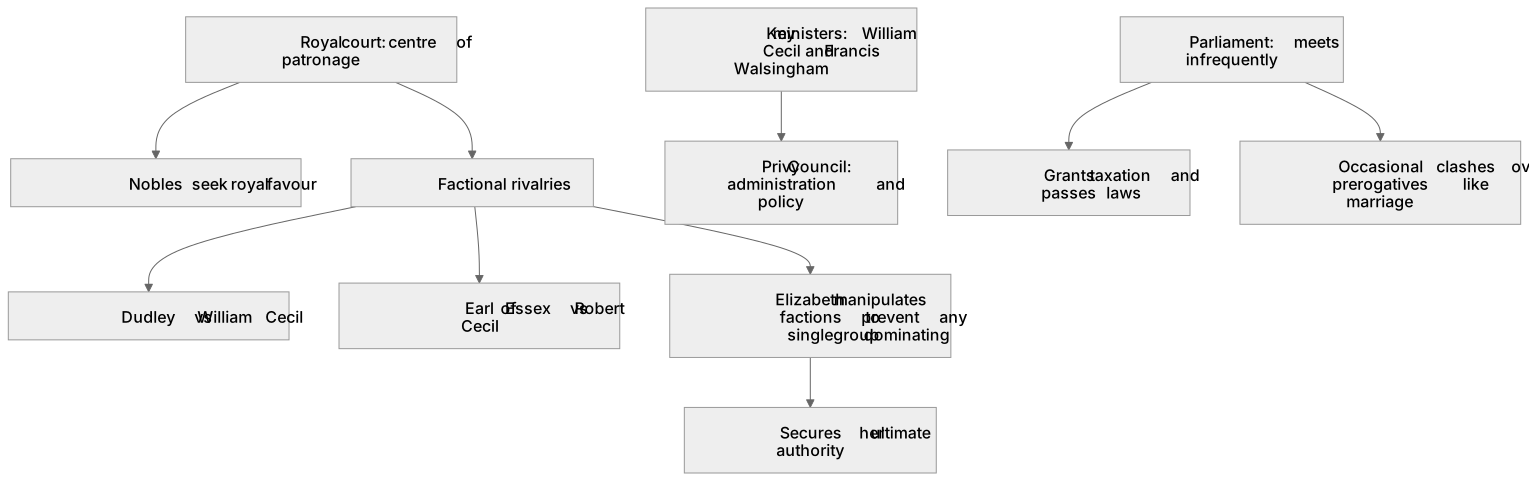
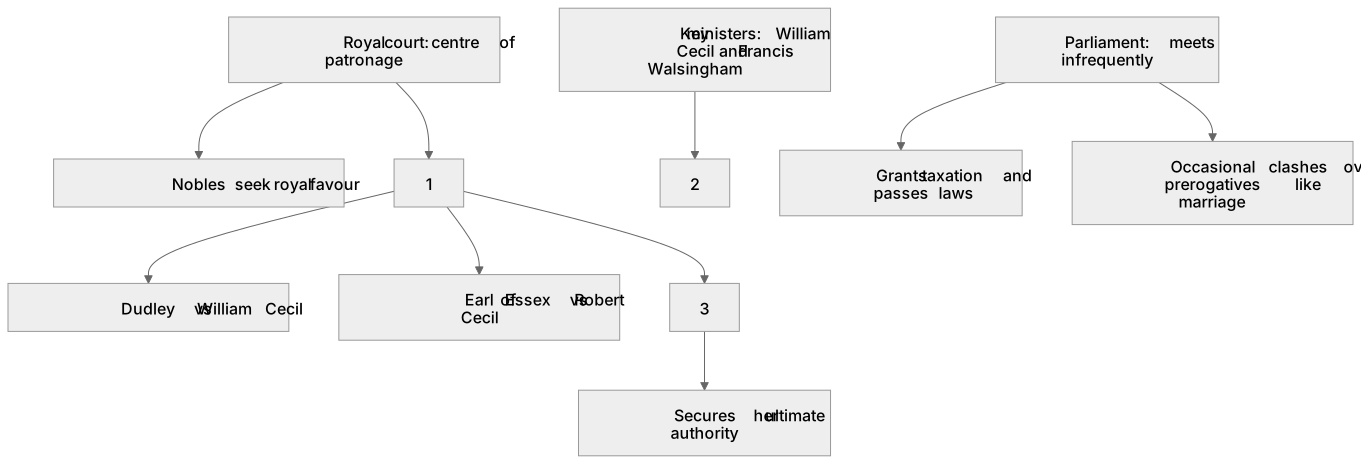
Elizabeth I’s government balanced the royal court, trusted ministers, and Parliament. The court was the centre of patronage, where nobles sought royal favour. Key ministers, notably William Cecil and Francis Walsingham, managed administration and policy via the Privy Council. Parliament met infrequently, primarily to grant taxation and pass laws, though it occasionally clashed with Elizabeth over prerogatives like marriage. Factional rivalries, such as the competition between Robert Dudley and William Cecil, or later between the Earl of Essex and Robert Cecil, dominated court politics. Elizabeth deliberately manipulated these factions to prevent any single group from dominating, thereby securing her ultimate authority.
What earns the marks
- Assess the role of the Privy Council in advising the Queen and managing the daily administration of the realm.
- Evaluate the extent of parliamentary opposition, noting that Parliament was primarily a legislative and tax-granting body rather than a regular governing institution.
- Analyse how Elizabeth used patronage at court to maintain loyalty and control ambitious nobles.
- Examine the impact of factional rivalries, contrasting the manageable Cecil-Dudley rivalry with the destabilising Essex-Cecil conflict in the 1590s.
Common mistakes and how to put them right
Assuming Parliament had equal power to the monarch.
Put it right: Emphasise that Parliament was called at the Queen's pleasure, mainly for taxation, and she retained the royal veto.
Viewing factionalism purely as a weakness of Elizabethan government.
Put it right: Argue that Elizabeth actively used factionalism as a political tool to divide and rule her courtiers.
Confusing the roles of William Cecil and Robert Cecil.
Put it right: Distinguish between William Cecil (Lord Burghley), her long-serving chief minister, and his son Robert, who dominated the 1590s.
Exam tips
- Use specific examples of parliamentary clashes, such as the 1601 Golden Speech over monopolies, to evaluate Elizabeth's management of MPs.
- Contrast the stability of the Privy Council in the 1570s with the factional instability of the 1590s to show change over time.
- When discussing ministers, explicitly link their actions to the Queen's ultimate decision-making authority to demonstrate understanding of royal prerogative.
Try the lesson
The start of the 1C The Tudors: England, 1485–1603 – The triumph of Elizabeth, 1563–1603 (A-level only): Elizabethan government: court, ministers and parliament; factional rivalries lesson, made from checked teaching notes for this specification point.
Have a go first
Which two figures were the principal rivals in the most prominent factional conflict at the Elizabethan court during the 1590s?
Listen
Elizabeth I’s government balanced the royal court, trusted ministers, and Parliament. The court was the centre of patronage, where nobles sought royal favour. Key ministers, notably William Cecil and Francis Walsingham, managed administration and policy via the Privy Council. Parliament met infrequently, primarily to grant taxation and pass laws, though it occasionally clashed with Elizabeth over prerogatives like marriage. Factional rivalries, such as the competition between Robert Dudley and William Cecil, or later between the Earl of Essex and Robert Cecil, dominated court politics. Elizabeth deliberately manipulated these factions to prevent any single group from dominating, thereby securing her ultimate authority. A strong answer earns marks for these points. Assess the role of the Privy Council in advising the Queen and managing the daily administration of the realm. Evaluate the extent of parliamentary opposition, noting that Parliament was primarily a legislative and tax-granting body rather than a regular governing institution. Analyse how Elizabeth used patronage at court to maintain loyalty and control ambitious nobles. Examine the impact of factional rivalries, contrasting the manageable Cecil-Dudley rivalry with the destabilising Essex-Cecil conflict in the 1590s. A common slip: Assuming Parliament had equal power to the monarch. Instead, Emphasise that Parliament was called at the Queen's pleasure, mainly for taxation, and she retained the royal veto. Exam tip: Use specific examples of parliamentary clashes, such as the 1601 Golden Speech over monopolies, to evaluate Elizabeth's management of MPs.
See it
Key words
Say what each word means before you turn the card.
Royal prerogative versus parliamentary privilege
Try answering aloud or in your head before turning the card.
Patronage and court politics
Try answering aloud or in your head before turning the card.
Factionalism and political stability
Try answering aloud or in your head before turning the card.
The role of the Privy Council
Try answering aloud or in your head before turning the card.
See every definition
- Royal prerogative versus parliamentary privilege
- Elizabeth occasionally clashed with Parliament over prerogatives like marriage, while Parliament met infrequently, primarily to grant taxation and pass laws.
- Patronage and court politics
- The court was the centre of patronage, where nobles sought royal favour, and Elizabeth used patronage at court to maintain loyalty and control ambitious nobles.
- Factionalism and political stability
- Factional rivalries dominated court politics, and Elizabeth deliberately manipulated these factions to prevent any single group from dominating, thereby securing her ultimate authority.
- The role of the Privy Council
- Key ministers, notably William Cecil and Francis Walsingham, managed administration and policy via the Privy Council, which advised the Queen and managed the daily administration of the realm.
Label the diagram
Some boxes have lost their names. Pick the right name for each number.
1Box 1
2Box 2
3Box 3
There is more to this lesson
The full lesson goes on to check your understanding and help you earn the marks. Create a free account to carry on, with your progress saved.
A week of Premium from your first lesson · Then the free plan continues · No card, no charge
Test your understanding of 1C The Tudors: England, 1485–1603 – The triumph of Elizabeth, 1563–1603 (A-level only): Elizabethan government: court, ministers and parliament; factional rivalries
Active recall beats re-reading. Take an instant quiz now to test what you’ve learned and lock it into long-term memory.
A week of Premium from your first lesson · Then the free plan continues · No card, no charge