AQA · A-Level · History
Course version: 7042 · Version from Sept 2017
How important was the role of key individuals and groups and how were they…
Full specification wording
1D Stuart Britain and the Crisis of Monarchy, 1603–1702 – consequence in this period through the following key questions:: How important was the role of key individuals and groups and how were they affected by developments?
The Stuart crises were profoundly shaped by key individuals and groups, whose roles and fortunes fluctuated alongside political developments.
Checked against the AQA 7042 specification (opens in a new tab) on .
- Point 6 of 6
- 4 key terms
Study notes
From the checked teaching notes for this specification point.
The idea
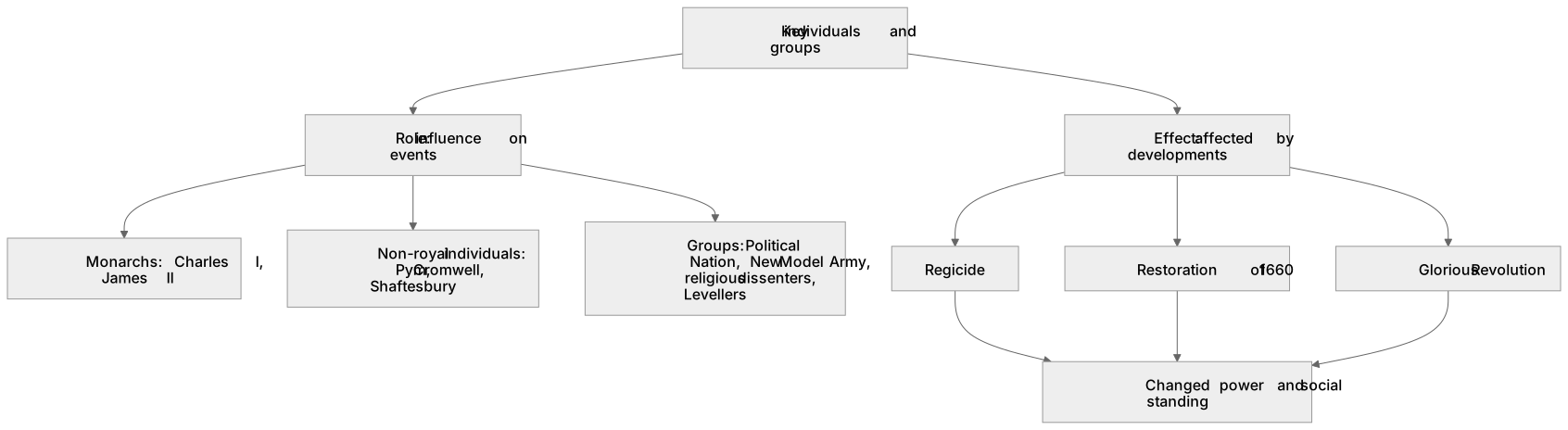
The Stuart crises were profoundly shaped by key individuals and groups, whose roles and fortunes fluctuated alongside political developments. Monarchs like Charles I drove constitutional breakdowns through inflexible leadership, while Oliver Cromwell steered the nation through civil war. Crucial groups, including the Political Nation, the New Model Army, and religious dissenters, acted as catalysts for change.
What earns the marks
- Assess the extent to which the personal characteristics and decisions of monarchs (e.g., Charles I, James II) precipitated political crises.
- Evaluate the influence of key non-royal individuals, such as Pym, Cromwell, or Shaftesbury, in directing opposition and shaping government.
- Analyse the role of specific groups, such as the New Model Army or the Levellers, in driving radical political and social changes.
- Examine how major developments, like the Restoration of 1660, affected the status and influence of religious dissenters and republicans.
Common mistakes and how to put them right
Focusing solely on the actions of individuals without addressing the second part of the question.
Put it right: Explicitly analyse how these individuals and groups were subsequently affected by the events they helped create.
Treating 'groups' as monolithic entities.
Put it right: Acknowledge internal divisions within groups, such as the split between Presbyterians and Independents in Parliament.
Overstating the power of individuals.
Put it right: Balance the agency of key figures like Cromwell against the structural, financial, and ideological constraints they faced.
Exam tips
- Structure essays to explicitly address both the 'role' (impact on events) and the 'effect of developments' (how events impacted them) for high-level analysis.
- Contrast the fortunes of different groups across periods, such as how the political influence of the army peaked in the 1650s but was dismantled after 1660.
- Use specific examples of how the Political Nation's relationship with the Crown evolved in response to the financial and religious policies of the monarchs.
Try the lesson
The start of the 1D Stuart Britain and the Crisis of Monarchy, 1603–1702 – consequence in this period through the following key questions:: How important was the role of key individuals and groups and how were they affected by developments? lesson, made from checked teaching notes for this specification point.
Have a go first
What was the primary role of Oliver Cromwell in the political developments of the 1650s?
Listen
The Stuart crises were profoundly shaped by key individuals and groups, whose roles and fortunes fluctuated alongside political developments. Monarchs like Charles I drove constitutional breakdowns through inflexible leadership, while Oliver Cromwell steered the nation through civil war. Crucial groups, including the Political Nation, the New Model Army, and religious dissenters, acted as catalysts for change. A strong answer earns marks for these points. Assess the extent to which the personal characteristics and decisions of monarchs (e.g., Charles I, James II) precipitated political crises. Evaluate the influence of key non-royal individuals, such as Pym, Cromwell, or Shaftesbury, in directing opposition and shaping government. Analyse the role of specific groups, such as the New Model Army or the Levellers, in driving radical political and social changes. Examine how major developments, like the Restoration of 1660, affected the status and influence of religious dissenters and republicans. A common slip: Focusing solely on the actions of individuals without addressing the second part of the question. Instead, explicitly analyse how these individuals and groups were subsequently affected by the events they helped create. Exam tip: Structure essays to explicitly address both the 'role' (impact on events) and the 'effect of developments' (how events impacted them) for high-level analysis.
See it
Key words
Say what each word means before you turn the card.
Leadership and Personality
Try answering aloud or in your head before turning the card.
The Political Nation
Try answering aloud or in your head before turning the card.
Radical and Conservative Groups
Try answering aloud or in your head before turning the card.
Social and Political Mobility
Try answering aloud or in your head before turning the card.
See every definition
- Leadership and Personality
- Monarchs like Charles I drove constitutional breakdowns through inflexible leadership, and personal characteristics and decisions precipitated political crises.
- The Political Nation
- A crucial group acting as a catalyst for change, whose relationship with the Crown evolved in response to financial and religious policies.
- Radical and Conservative Groups
- Crucial groups including religious dissenters acted as catalysts for change, while developments often transformed former radicals into outcasts.
- Social and Political Mobility
- Developments affected the power and social standing of actors, often elevating parliamentary elites to permanent constitutional prominence.
Label the diagram
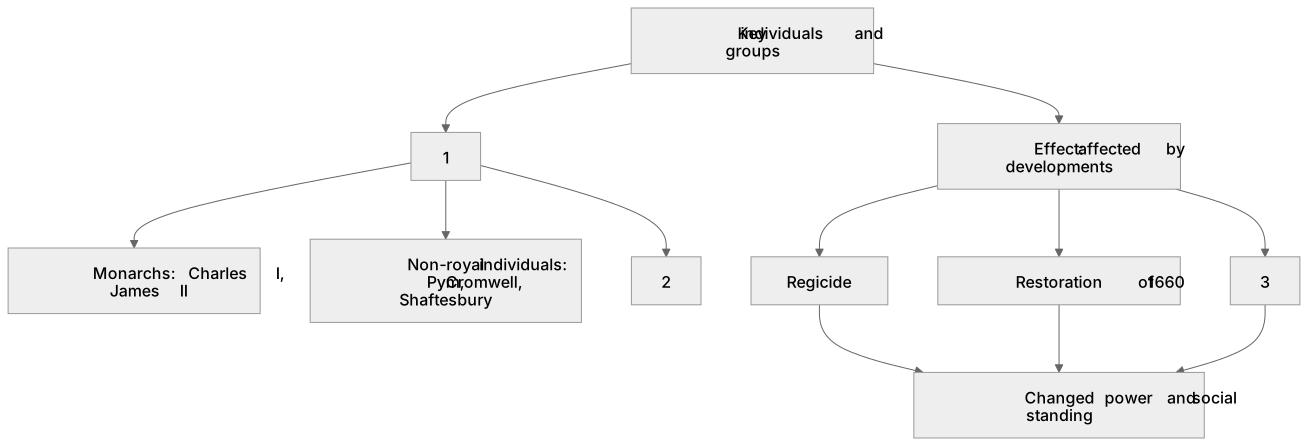
Some boxes have lost their names. Pick the right name for each number.
1Box 1
2Box 2
3Box 3
There is more to this lesson
The full lesson goes on to check your understanding and help you earn the marks. Create a free account to carry on, with your progress saved.
A week of Premium from your first lesson · Then the free plan continues · No card, no charge
Test your understanding of 1D Stuart Britain and the Crisis of Monarchy, 1603–1702 – consequence in this period through the following key questions:: How important was the role of key individuals and groups and how were they affected by developments?
Active recall beats re-reading. Take an instant quiz now to test what you’ve learned and lock it into long-term memory.
A week of Premium from your first lesson · Then the free plan continues · No card, no charge