AQA · A-Level · History
Course version: 7042 · Version from Sept 2017
How important were ideas and ideology?
Full specification wording
1D Stuart Britain and the Crisis of Monarchy, 1603–1702 – consequence in this period through the following key questions:: How important were ideas and ideology?
In Stuart Britain, ideas and ideology were central to the escalating crises between Crown and Parliament.
Checked against the AQA 7042 specification (opens in a new tab) on .
- Point 5 of 6
Study notes
From the checked teaching notes for this specification point.
The idea
In Stuart Britain, ideas and ideology were central to the escalating crises between Crown and Parliament. Political ideologies, such as the Divine Right of Kings championed by James I and Charles I, directly clashed with emerging Parliamentarian ideas of constitutionalism, ancient liberties, and the social contract. Religious ideas were equally explosive; Arminianism provoked fears of a Catholic absolutist plot, while radical Puritanism fuelled the New Model Army and the execution of the King. Later, the ideological shift towards toleration and limited monarchy culminated in the Glorious Revolution of 1688 and the writings of John Locke.
What earns the marks
- Assess the impact of the Divine Right of Kings on the breakdown of relations between the early Stuarts and their Parliaments.
- Evaluate the role of religious ideologies, such as Arminianism and Puritanism, in causing the Civil War and shaping the Interregnum.
- Analyse the emergence of radical political ideas during the 1640s, including Leveller demands for extended suffrage and religious toleration.
- Examine how ideological shifts regarding the social contract and constitutional monarchy justified the Glorious Revolution of 1688.
Common mistakes and how to put them right
Treating 'ideas' and 'ideology' as purely political.
Put it right: Ensure religious ideologies like Puritanism and Arminianism are given equal weight as they were inseparable from seventeenth-century politics.
Assuming radical ideas had widespread national support.
Put it right: Acknowledge that groups like the Levellers and Diggers were highly vocal but represented a minority of the population.
Viewing the Divine Right of Kings as a static concept.
Put it right: Recognise that its application and reception evolved from James I's theoretical writings to Charles I's practical absolutism.
Exam tips
- Link specific ideologies to concrete political actions, such as how Arminian reforms directly provoked the Scottish National Covenant.
- When evaluating importance, compare the weight of ideological factors against practical issues like finance, foreign policy, or multiple kingdom dynamics.
- Use contemporary terminology, such as 'ancient constitution' or 'popery', to demonstrate a precise understanding of seventeenth-century ideological debates.
Try the lesson
The start of the 1D Stuart Britain and the Crisis of Monarchy, 1603–1702 – consequence in this period through the following key questions:: How important were ideas and ideology? lesson, made from checked teaching notes for this specification point.
Have a go first
Which ideological concept was most central to James I's and Charles I's justification of their royal authority?
Listen
In Stuart Britain, ideas and ideology were central to the escalating crises between Crown and Parliament. Political ideologies, such as the Divine Right of Kings championed by James I and Charles I, directly clashed with emerging Parliamentarian ideas of constitutionalism, ancient liberties, and the social contract. Religious ideas were equally explosive; Arminianism provoked fears of a Catholic absolutist plot, while radical Puritanism fuelled the New Model Army and the execution of the King. Later, the ideological shift towards toleration and limited monarchy culminated in the Glorious Revolution of 1688 and the writings of John Locke. A strong answer earns marks for these points. Assess the impact of the Divine Right of Kings on the breakdown of relations between the early Stuarts and their Parliaments. Evaluate the role of religious ideologies, such as Arminianism and Puritanism, in causing the Civil War and shaping the Interregnum. Analyse the emergence of radical political ideas during the 1640s, including Leveller demands for extended suffrage and religious toleration. Examine how ideological shifts regarding the social contract and constitutional monarchy justified the Glorious Revolution of 1688. A common slip: Treating 'ideas' and 'ideology' as purely political. Instead, ensure religious ideologies like Puritanism and Arminianism are given equal weight as they were inseparable from seventeenth-century politics. Exam tip: Link specific ideologies to concrete political actions, such as how Arminian reforms directly provoked the Scottish National Covenant.
See it
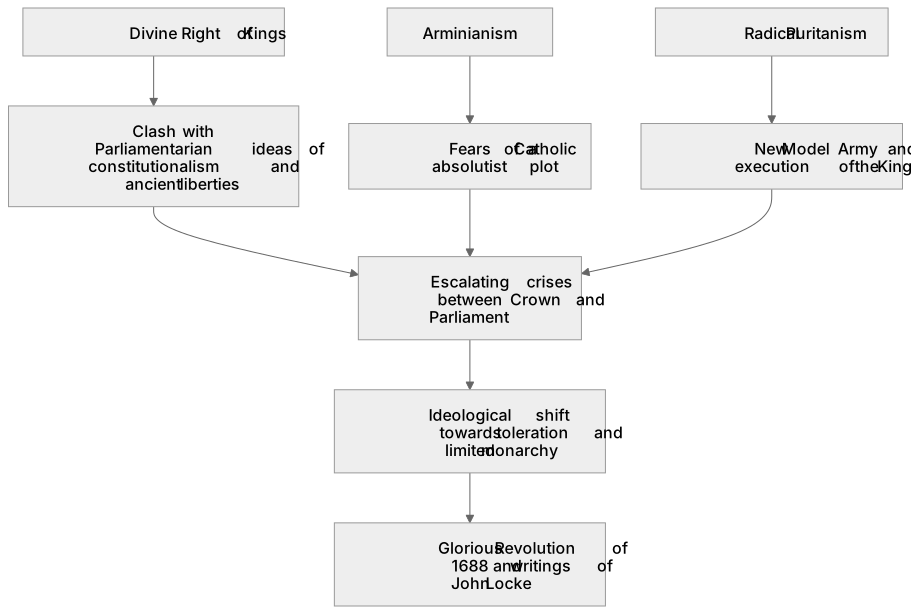
Label the diagram
Some boxes have lost their names. Pick the right name for each number.
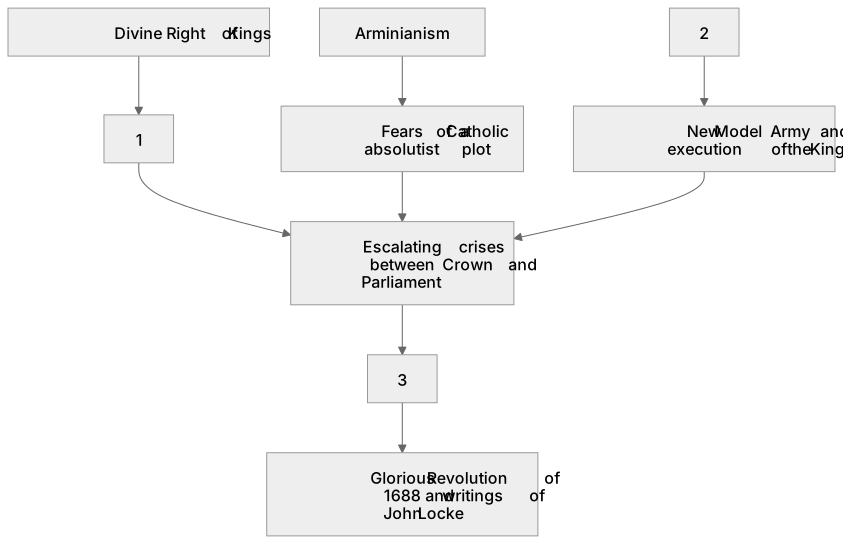
1Box 1
2Box 2
3Box 3
There is more to this lesson
The full lesson goes on to check your understanding and help you earn the marks. Create a free account to carry on, with your progress saved.
A week of Premium from your first lesson · Then the free plan continues · No card, no charge
Test your understanding of 1D Stuart Britain and the Crisis of Monarchy, 1603–1702 – consequence in this period through the following key questions:: How important were ideas and ideology?
Active recall beats re-reading. Take an instant quiz now to test what you’ve learned and lock it into long-term memory.
A week of Premium from your first lesson · Then the free plan continues · No card, no charge