AQA · A-Level · History
Course version: 7042 · Version from Sept 2017
Political divisions and experiments: Republicanism and the Rump;…
Full specification wording
1D Stuart Britain and the Crisis of Monarchy, 1603–1702 – From Republic to restored and limited monarchy, 1649–1678 (A-level only): Political divisions and experiments: Republicanism and the Rump; Millenarianism and the Parliament of Saints
Between 1649 and 1653, the Republic struggled to establish a legitimate government, leading to radical political experiments.
Checked against the AQA 7042 specification (opens in a new tab) on .
- Point 2 of 6
- 4 key terms
Study notes
From the checked teaching notes for this specification point.
The idea
Between 1649 and 1653, the Republic struggled to establish a legitimate government, leading to radical political experiments. The Rump Parliament, a conservative republican body, faced deep political divisions; it sought stability but frustrated the army with its slow progress on reform. This tension led Cromwell to forcibly dissolve the Rump in April 1653. Influenced by millenarianism—the belief in Christ's imminent return—radical army officers pushed for a godly government. This resulted in the Parliament of Saints (Barebone's Parliament) in 1653, an assembly of nominated men. However, deep divisions between radical millenarians demanding the abolition of tithes and moderates seeking social order caused the moderates to dissolve the assembly, ending the experiment.
What earns the marks
- Analyse the inherent tension between the Rump Parliament's desire for conservative stability and the New Model Army's demand for radical godly reform.
- Evaluate the influence of millenarianism, particularly the Fifth Monarchists, on the political experiments of 1653.
- Assess the achievements and failures of the Parliament of Saints, noting its progressive legal reforms alongside its fatal internal divisions.
- Explain the reasons for the dissolution of both the Rump and the Parliament of Saints, focusing on the role of Oliver Cromwell and the army.
Common mistakes and how to put them right
Viewing the Parliament of Saints as a democratically elected body.
Put it right: Specify that it was a nominated assembly selected by army officers and independent churches, not an elected parliament.
Assuming the Rump Parliament achieved no reforms.
Put it right: Acknowledge that the Rump did pass some reforms, such as the Navigation Act and the Toleration Act, despite its overall reputation for sluggishness.
Treating millenarianism as a fringe belief with no political impact.
Put it right: Emphasise that millenarian ideas directly influenced senior army officers like Thomas Harrison and the formation of the Parliament of Saints.
Exam tips
- Contrast the secular, legalistic republicanism of the Rump with the religious, millenarian zeal of the Parliament of Saints to highlight the era's political divisions.
- Use the issue of tithes as a concrete example of the irreconcilable differences between radicals and moderates in the Parliament of Saints.
- When discussing the failure of these experiments, emphasise the underlying problem of relying on military force to sustain political authority.
Try the lesson
The start of the 1D Stuart Britain and the Crisis of Monarchy, 1603–1702 – From Republic to restored and limited monarchy, 1649–1678 (A-level only): Political divisions and experiments: Republicanism and the Rump; Millenarianism and the Parliament of Saints lesson, made from checked teaching notes for this specification point.
Have a go first
Which religious group heavily influenced the formation and ideology of the Parliament of Saints (Barebone's Parliament) in 1653?
Listen
Between 1649 and 1653, the Republic struggled to establish a legitimate government, leading to radical political experiments. The Rump Parliament, a conservative republican body, faced deep political divisions; it sought stability but frustrated the army with its slow progress on reform. This tension led Cromwell to forcibly dissolve the Rump in April 1653. Influenced by millenarianism—the belief in Christ's imminent return—radical army officers pushed for a godly government. This resulted in the Parliament of Saints (Barebone's Parliament) in 1653, an assembly of nominated men. However, deep divisions between radical millenarians demanding the abolition of tithes and moderates seeking social order caused the moderates to dissolve the assembly, ending the experiment. A strong answer earns marks for these points. Analyse the inherent tension between the Rump Parliament's desire for conservative stability and the New Model Army's demand for radical godly reform. Evaluate the influence of millenarianism, particularly the Fifth Monarchists, on the political experiments of 1653. Assess the achievements and failures of the Parliament of Saints, noting its progressive legal reforms alongside its fatal internal divisions. Explain the reasons for the dissolution of both the Rump and the Parliament of Saints, focusing on the role of Oliver Cromwell and the army. A common slip: Viewing the Parliament of Saints as a democratically elected body. Instead, Specify that it was a nominated assembly selected by army officers and independent churches, not an elected parliament. Exam tip: Contrast the secular, legalistic republicanism of the Rump with the religious, millenarian zeal of the Parliament of Saints to highlight the era's political divisions.
See it
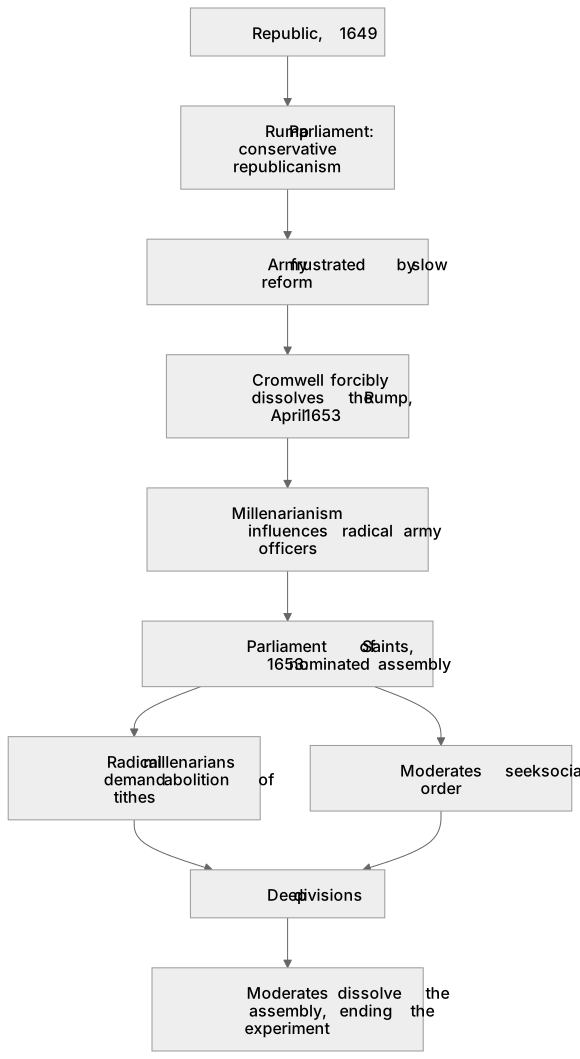
Key words
Say what each word means before you turn the card.
Radicalism
Try answering aloud or in your head before turning the card.
Religion and politics
Try answering aloud or in your head before turning the card.
Constitutional experimentation
Try answering aloud or in your head before turning the card.
Army vs Parliament
Try answering aloud or in your head before turning the card.
See every definition
- Radicalism
- The demand for radical godly reform that the New Model Army pressed for against the Rump Parliament's desire for conservative stability.
- Religion and politics
- The influence of millenarianism, the belief in Christ's imminent return, on radical army officers who pushed for a godly government.
- Constitutional experimentation
- The radical political experiments of the Republic between 1649 and 1653, as it struggled to establish a legitimate government.
- Army vs Parliament
- The tension between the conservative republican Rump Parliament and the army, whose demand for radical godly reform led Cromwell to forcibly dissolve the Rump in April 1653.
Label the diagram
Some boxes have lost their names. Pick the right name for each number.
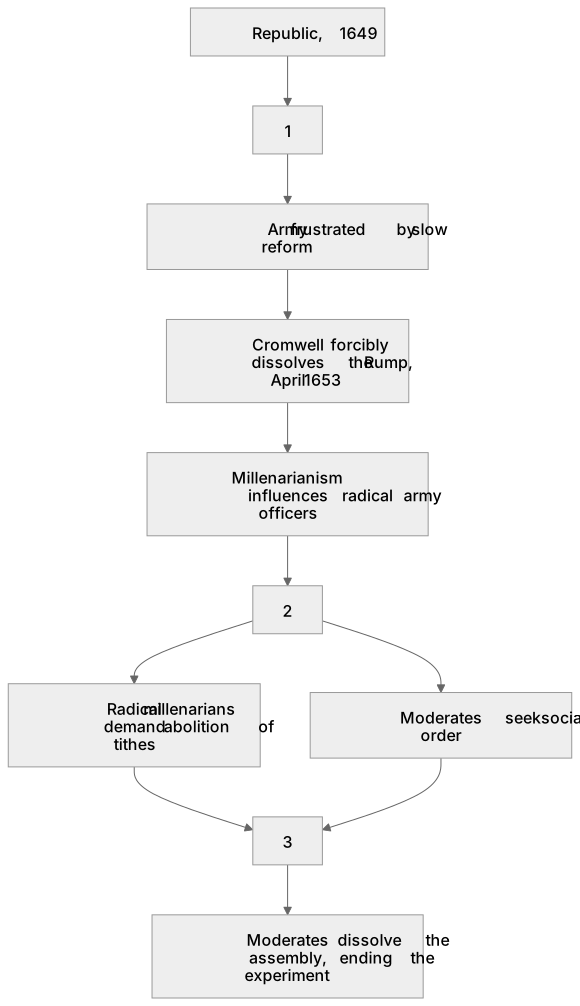
1Box 1
2Box 2
3Box 3
There is more to this lesson
The full lesson goes on to check your understanding and help you earn the marks. Create a free account to carry on, with your progress saved.
A week of Premium from your first lesson · Then the free plan continues · No card, no charge
Test your understanding of 1D Stuart Britain and the Crisis of Monarchy, 1603–1702 – From Republic to restored and limited monarchy, 1649–1678 (A-level only): Political divisions and experiments: Republicanism and the Rump; Millenarianism and the Parliament of Saints
Active recall beats re-reading. Take an instant quiz now to test what you’ve learned and lock it into long-term memory.
A week of Premium from your first lesson · Then the free plan continues · No card, no charge