AQA · A-Level · History
Course version: 7042 · Version from Sept 2017
Cromwell and his aims; the Protectorates; Major-Generals and the relations…
Full specification wording
1D Stuart Britain and the Crisis of Monarchy, 1603–1702 – From Republic to restored and limited monarchy, 1649–1678 (A-level only): Cromwell and his aims; the Protectorates; Major-Generals and the relations with the Political Nation
Cromwell’s dual aims of 'healing and settling' the nation while pursuing 'godly reformation' created contradictions during the Protectorates (1653–1659).
Checked against the AQA 7042 specification (opens in a new tab) on .
- Point 3 of 6
Study notes
From the checked teaching notes for this specification point.
The idea
Cromwell’s dual aims of 'healing and settling' the nation while pursuing 'godly reformation' created contradictions during the Protectorates (1653–1659). Established by the Instrument of Government, his parliaments clashed with him over the army's role. Following Penruddock's uprising, Cromwell instituted the Rule of the Major-Generals (1655–1656), dividing England into military districts to enforce moral reform. This alienated the Political Nation—the traditional gentry—who resented the decimation tax and the usurpation of their local authority by military men. The Humble Petition and Advice (1657) was an attempt by the Political Nation to restore traditional governance, offering Cromwell the crown to limit his power, which he ultimately refused.
What earns the marks
- Assess the inherent tension between Cromwell's desire for conservative political stability ('healing and settling') and his radical religious objectives ('godly reformation').
- Evaluate the constitutional significance of the Instrument of Government and the reasons for the failure of the First Protectorate Parliament.
- Analyse the impact of the Major-Generals on local government, specifically how the decimation tax and strict moral enforcement alienated the traditional gentry.
- Examine the Humble Petition and Advice as a conservative reaction by the Political Nation seeking to replace military rule with traditional parliamentary monarchy.
Common mistakes and how to put them right
Assuming the Political Nation supported the Major-Generals.
Put it right: In reality, the traditional gentry deeply resented the military interference in their local authority.
Claiming Cromwell accepted the crown in 1657.
Put it right: He actually refused the title of King while accepting the rest of the Humble Petition and Advice.
Treating the Protectorate as a single, unchanging period.
Put it right: It evolved significantly from the Instrument of Government to the Major-Generals and finally the Humble Petition and Advice.
Exam tips
- Use the phrase 'healing and settling' alongside 'godly reformation' to demonstrate an understanding of Cromwell's conflicting primary aims.
- When discussing the Major-Generals, explicitly link their failure to the alienation of the Political Nation to explain the shift towards the Humble Petition and Advice.
- Contrast the military basis of the Instrument of Government with the civilian, parliamentary origins of the Humble Petition and Advice.
Try the lesson
The start of the 1D Stuart Britain and the Crisis of Monarchy, 1603–1702 – From Republic to restored and limited monarchy, 1649–1678 (A-level only): Cromwell and his aims; the Protectorates; Major-Generals and the relations with the Political Nation lesson, made from checked teaching notes for this specification point.
Have a go first
Which of the following best describes Oliver Cromwell's two primary political and religious aims during the Protectorate?
Listen
Cromwell’s dual aims of 'healing and settling' the nation while pursuing 'godly reformation' created contradictions during the Protectorates (1653–1659). Established by the Instrument of Government, his parliaments clashed with him over the army's role. Following Penruddock's uprising, Cromwell instituted the Rule of the Major-Generals (1655–1656), dividing England into military districts to enforce moral reform. This alienated the Political Nation—the traditional gentry—who resented the decimation tax and the usurpation of their local authority by military men. The Humble Petition and Advice (1657) was an attempt by the Political Nation to restore traditional governance, offering Cromwell the crown to limit his power, which he ultimately refused. A strong answer earns marks for these points. Assess the inherent tension between Cromwell's desire for conservative political stability ('healing and settling') and his radical religious objectives ('godly reformation'). Evaluate the constitutional significance of the Instrument of Government and the reasons for the failure of the First Protectorate Parliament. Analyse the impact of the Major-Generals on local government, specifically how the decimation tax and strict moral enforcement alienated the traditional gentry. Examine the Humble Petition and Advice as a conservative reaction by the Political Nation seeking to replace military rule with traditional parliamentary monarchy. Exam tip: Use the phrase 'healing and settling' alongside 'godly reformation' to demonstrate an understanding of Cromwell's conflicting primary aims.
See it
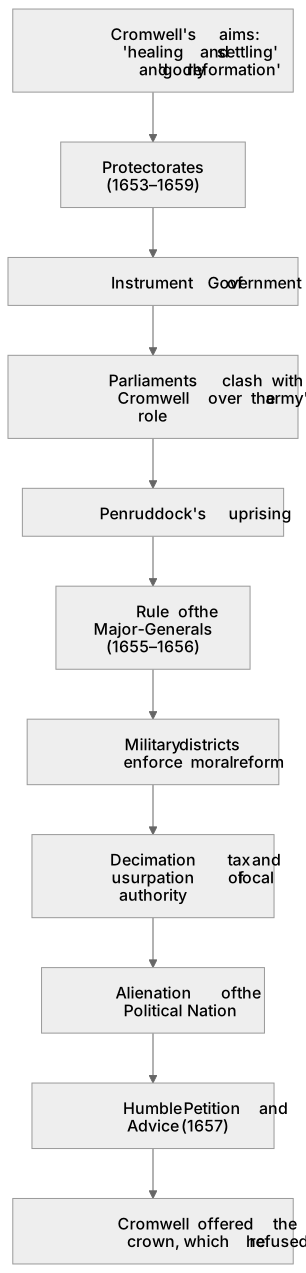
Put the events in order
Put these events in the order they happened, earliest first.
- 1. Instrument of Government establishes the Protectorate
- 2. Humble Petition and Advice offered Cromwell the crown
- 3. Rule of the Major-Generals instituted after Penruddock's uprising
Label the diagram
Some boxes have lost their names. Pick the right name for each number.
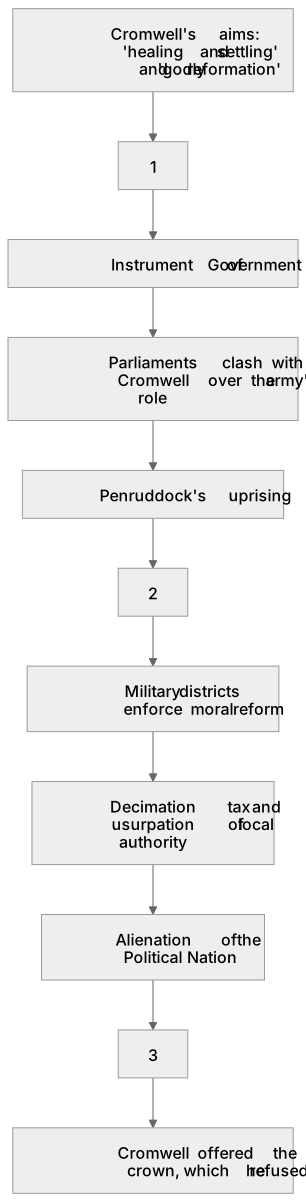
1Box 1
2Box 2
3Box 3
There is more to this lesson
The full lesson goes on to check your understanding and help you earn the marks. Create a free account to carry on, with your progress saved.
A week of Premium from your first lesson · Then the free plan continues · No card, no charge
Test your understanding of 1D Stuart Britain and the Crisis of Monarchy, 1603–1702 – From Republic to restored and limited monarchy, 1649–1678 (A-level only): Cromwell and his aims; the Protectorates; Major-Generals and the relations with the Political Nation
Active recall beats re-reading. Take an instant quiz now to test what you’ve learned and lock it into long-term memory.
A week of Premium from your first lesson · Then the free plan continues · No card, no charge