AQA · A-Level · History
Course version: 7042 · Version from Sept 2017
Religious divisions and conflicts: the defeat of Millenarianism; the…
Full specification wording
1D Stuart Britain and the Crisis of Monarchy, 1603–1702 – From Republic to restored and limited monarchy, 1649–1678 (A-level only): Religious divisions and conflicts: the defeat of Millenarianism; the restoration of the Church of England; Protestant Dissenters; conflict over Catholic influence at Court
The Restoration settlement failed to resolve deep religious divisions.
Checked against the AQA 7042 specification (opens in a new tab) on .
- Point 6 of 6
- 4 key terms
Study notes
From the checked teaching notes for this specification point.
The idea
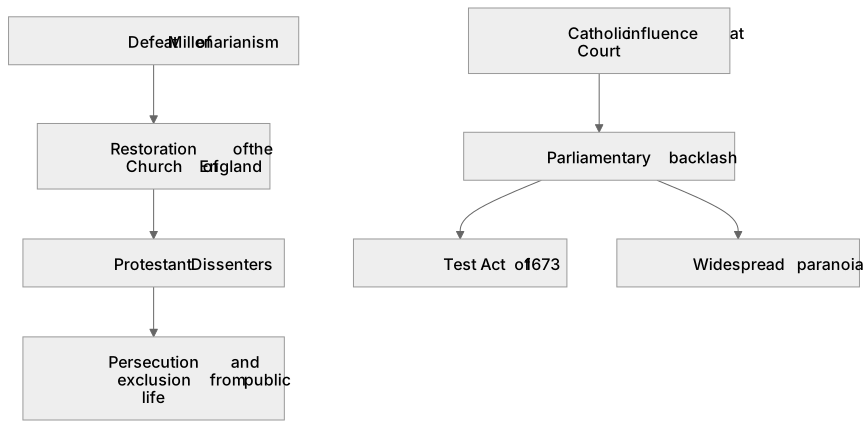
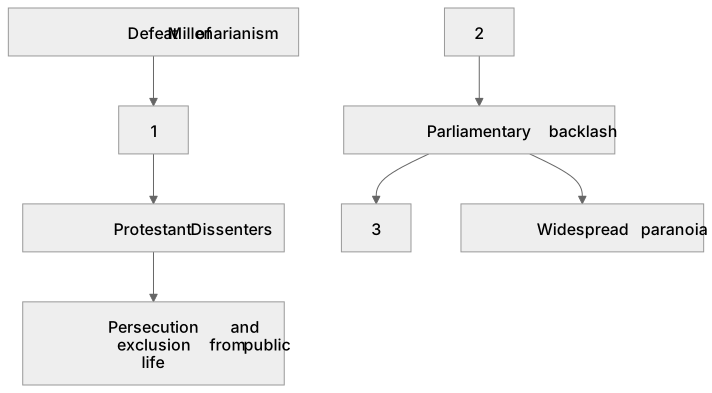
The Restoration settlement failed to resolve deep religious divisions. The defeat of Millenarianism was cemented by the suppression of Venner's Rising in 1661, discrediting radical sects. Consequently, the Cavalier Parliament enforced the restoration of a rigid Church of England through the Clarendon Code, rejecting comprehension. This created a permanent class of Protestant Dissenters, such as Quakers and Baptists, who faced severe persecution and exclusion from public life. Simultaneously, conflict over Catholic influence at Court intensified, driven by Charles II's Catholic mother and wife, his brother James's conversion, and the Cabal ministry. This Catholic influence provoked intense parliamentary backlash, leading to the Test Act of 1673 and fuelling widespread paranoia.
What earns the marks
- Explain how Venner's Rising led to the defeat of Millenarianism and provided a pretext for suppressing radical religious groups.
- Analyse the restoration of the Church of England, focusing on the Act of Uniformity and the failure of the Savoy Conference to achieve a broader, comprehensive church.
- Evaluate the impact of the Clarendon Code on Protestant Dissenters, detailing their persecution and marginalisation in society.
- Assess the causes and consequences of conflict over Catholic influence at Court, including the Duke of York's conversion and the passing of the Test Act.
Common mistakes and how to put them right
Stating that Charles II personally desired the strict persecution of Dissenters.
Put it right: Emphasise that Charles favoured religious toleration (as seen in his Declarations of Indulgence) but was forced into strict Anglican uniformity by the Cavalier Parliament.
Lumping all non-Anglicans together as a single united opposition.
Put it right: Distinguish between Protestant Dissenters (who faced the Clarendon Code) and Catholics (who were feared for their perceived influence at Court and links to absolutism).
Assuming Millenarianism disappeared entirely after 1660.
Put it right: Note that while politically defeated and driven underground after Venner's Rising, millenarian beliefs persisted quietly among some dissenting sects.
Exam tips
- Link the fear of Catholic influence at Court directly to fears of French absolutism and the secret clauses of the Treaty of Dover.
- Use the components of the Clarendon Code (Corporation, Uniformity, Conventicle, and Five Mile Acts) as concrete evidence when discussing the treatment of Protestant Dissenters.
- Contrast the King's attempts at religious toleration with Parliament's determination to restore a narrow Church of England to highlight political tensions.
Try the lesson
The start of the 1D Stuart Britain and the Crisis of Monarchy, 1603–1702 – From Republic to restored and limited monarchy, 1649–1678 (A-level only): Religious divisions and conflicts: the defeat of Millenarianism; the restoration of the Church of England; Protestant Dissenters; conflict over Catholic influence at Court lesson, made from checked teaching notes for this specification point.
Have a go first
Which legislative settlement formally restored the Church of England and restricted Protestant Dissenters following the Restoration?
Listen
The Restoration settlement failed to resolve deep religious divisions. The defeat of Millenarianism was cemented by the suppression of Venner's Rising in 1661, discrediting radical sects. Consequently, the Cavalier Parliament enforced the restoration of a rigid Church of England through the Clarendon Code, rejecting comprehension. This created a permanent class of Protestant Dissenters, such as Quakers and Baptists, who faced severe persecution and exclusion from public life. Simultaneously, conflict over Catholic influence at Court intensified, driven by Charles II's Catholic mother and wife, his brother James's conversion, and the Cabal ministry. This Catholic influence provoked intense parliamentary backlash, leading to the Test Act of 1673 and fuelling widespread paranoia. A strong answer earns marks for these points. Explain how Venner's Rising led to the defeat of Millenarianism and provided a pretext for suppressing radical religious groups. Analyse the restoration of the Church of England, focusing on the Act of Uniformity and the failure of the Savoy Conference to achieve a broader, comprehensive church. Evaluate the impact of the Clarendon Code on Protestant Dissenters, detailing their persecution and marginalisation in society. Assess the causes and consequences of conflict over Catholic influence at Court, including the Duke of York's conversion and the passing of the Test Act. A common slip: Stating that Charles II personally desired the strict persecution of Dissenters. Instead, Emphasise that Charles favoured religious toleration (as seen in his Declarations of Indulgence) but was forced into strict Anglican uniformity by the Cavalier Parliament. Exam tip: Link the fear of Catholic influence at Court directly to fears of French absolutism and the secret clauses of the Treaty of Dover.
See it
Key words
Say what each word means before you turn the card.
Protestant Dissenters
Try answering aloud or in your head before turning the card.
Millenarianism
Try answering aloud or in your head before turning the card.
Catholic influence at Court
Try answering aloud or in your head before turning the card.
Clarendon Code
Try answering aloud or in your head before turning the card.
See every definition
- Protestant Dissenters
- A permanent class, such as Quakers and Baptists, who faced severe persecution and exclusion from public life under the Clarendon Code.
- Millenarianism
- A movement whose defeat was cemented by the suppression of Venner's Rising in 1661, which discredited radical sects.
- Catholic influence at Court
- A source of intensified conflict, driven by Charles II's Catholic mother and wife, his brother James's conversion, and the Cabal ministry.
- Clarendon Code
- The means by which the Cavalier Parliament enforced the restoration of a rigid Church of England, rejecting comprehension.
Label the diagram
Some boxes have lost their names. Pick the right name for each number.
1Box 1
2Box 2
3Box 3
There is more to this lesson
The full lesson goes on to check your understanding and help you earn the marks. Create a free account to carry on, with your progress saved.
A week of Premium from your first lesson · Then the free plan continues · No card, no charge
Test your understanding of 1D Stuart Britain and the Crisis of Monarchy, 1603–1702 – From Republic to restored and limited monarchy, 1649–1678 (A-level only): Religious divisions and conflicts: the defeat of Millenarianism; the restoration of the Church of England; Protestant Dissenters; conflict over Catholic influence at Court
Active recall beats re-reading. Take an instant quiz now to test what you’ve learned and lock it into long-term memory.
A week of Premium from your first lesson · Then the free plan continues · No card, no charge