AQA · A-Level · History
Course version: 7042 · Version from Sept 2017
The emergence of Court and Country ‘parties’: causes, significance and…
Full specification wording
1D Stuart Britain and the Crisis of Monarchy, 1603–1702 – From Republic to restored and limited monarchy, 1649–1678 (A-level only): The emergence of Court and Country ‘parties’: causes, significance and consequences
The emergence of 'Court' and 'Country' factions under Charles II marked a crucial shift towards early party politics.
- Point 5 of 6
- 4 key terms
Study notes
From the checked teaching notes for this specification point.
The idea
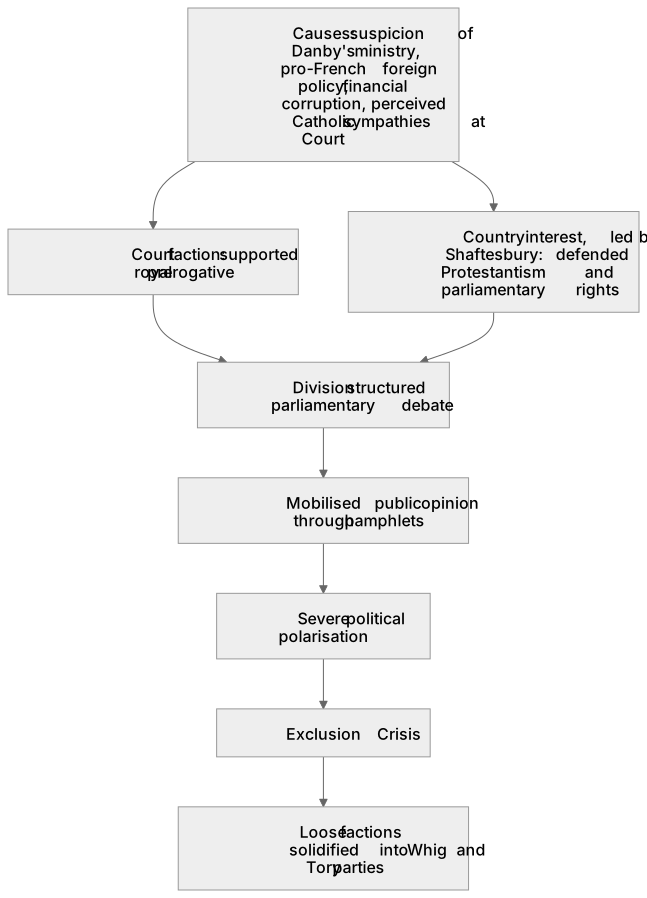
The emergence of 'Court' and 'Country' factions under Charles II marked a crucial shift towards early party politics. Causes included growing suspicion of Danby's ministry, pro-French foreign policy, financial corruption, and perceived Catholic sympathies at Court. The 'Country' interest, led by Shaftesbury, emerged to defend Protestantism and parliamentary rights against the 'Court' faction, which supported royal prerogative. The significance of this division was profound, structuring parliamentary debate and mobilising public opinion through pamphlets. The consequences included severe political polarisation, culminating in the Exclusion Crisis, where these loose factions solidified into the Whig and Tory parties capable of challenging or defending the monarchical succession.
What earns the marks
- Identify the specific causes of the Court and Country divide, such as Danby's use of crown patronage and the Secret Treaty of Dover.
- Explain the ideological differences, contrasting the Country's defence of parliamentary rights with the Court's defence of royal prerogative.
- Evaluate the significance of these factions in transforming parliamentary opposition from isolated grievances into organised political campaigns.
- Assess the consequences of this division, particularly how it escalated into the Exclusion Crisis and the formalisation of Whig and Tory identities.
Common mistakes and how to put them right
Treating the Court and Country factions as highly organised, modern political parties.
Put it right: Describe them as loose associations or interests based on shared attitudes rather than formal parties with strict whipping systems.
Assuming the Country party was entirely anti-monarchy.
Put it right: Clarify that the Country interest primarily opposed the corruption of the King's ministers and 'popery', not the institution of the monarchy itself.
Confusing the Court and Country divide with the later Whig and Tory divide.
Put it right: Explain that while Court and Country laid the groundwork, the specific Whig and Tory labels and strict party lines emerged specifically during the Exclusion Crisis.
Exam tips
- Use specific examples of Danby's financial management and patronage to illustrate the causes of Country opposition.
- When discussing significance, link the emergence of these factions to the growing importance of public opinion and the lapse of the Licensing Act.
- Analyse how foreign policy, particularly the alliance with Catholic France, acted as a catalyst for the formation of the Country interest.
Try the lesson
The start of the 1D Stuart Britain and the Crisis of Monarchy, 1603–1702 – From Republic to restored and limited monarchy, 1649–1678 (A-level only): The emergence of Court and Country ‘parties’: causes, significance and consequences lesson, made from checked teaching notes for this specification point.
Have a go first
Which of the following was a primary cause for the emergence of the 'Country' party in Parliament during the 1670s?
Listen
The emergence of 'Court' and 'Country' factions under Charles II marked a crucial shift towards early party politics. Causes included growing suspicion of Danby's ministry, pro-French foreign policy, financial corruption, and perceived Catholic sympathies at Court. The 'Country' interest, led by Shaftesbury, emerged to defend Protestantism and parliamentary rights against the 'Court' faction, which supported royal prerogative. The significance of this division was profound, structuring parliamentary debate and mobilising public opinion through pamphlets. The consequences included severe political polarisation, culminating in the Exclusion Crisis, where these loose factions solidified into the Whig and Tory parties capable of challenging or defending the monarchical succession. A strong answer earns marks for these points. Identify the specific causes of the Court and Country divide, such as Danby's use of crown patronage and the Secret Treaty of Dover. Explain the ideological differences, contrasting the Country's defence of parliamentary rights with the Court's defence of royal prerogative. Evaluate the significance of these factions in transforming parliamentary opposition from isolated grievances into organised political campaigns. Assess the consequences of this division, particularly how it escalated into the Exclusion Crisis and the formalisation of Whig and Tory identities. A common slip: Treating the Court and Country factions as highly organised, modern political parties. Instead, Describe them as loose associations or interests based on shared attitudes rather than formal parties with strict whipping systems. Exam tip: Use specific examples of Danby's financial management and patronage to illustrate the causes of Country opposition.
See it
Key words
Say what each word means before you turn the card.
Corruption and patronage
Try answering aloud or in your head before turning the card.
The influence of foreign policy on domestic politics
Try answering aloud or in your head before turning the card.
Political opposition and factionalism
Try answering aloud or in your head before turning the card.
Royal prerogative versus parliamentary privilege
Try answering aloud or in your head before turning the card.
See every definition
- Corruption and patronage
- Growing suspicion of Danby's ministry, including financial corruption and the use of crown patronage, was among the causes of the emergence of Court and Country factions.
- The influence of foreign policy on domestic politics
- Pro-French foreign policy, including the Secret Treaty of Dover and an alliance with Catholic France, acted as a catalyst for the formation of the Country interest.
- Political opposition and factionalism
- Loose factions or interests based on shared attitudes emerged, with the Country interest led by Shaftesbury defending Protestantism and parliamentary rights against the Court faction.
- Royal prerogative versus parliamentary privilege
- The Country interest defended parliamentary rights, while the Court faction supported royal prerogative, and this ideological difference structured parliamentary debate.
Label the diagram
Some boxes have lost their names. Pick the right name for each number.
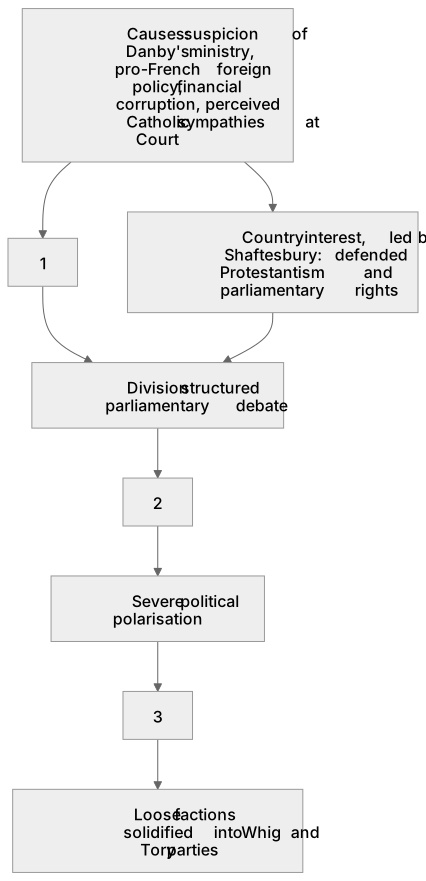
1Box 1
2Box 2
3Box 3
There is more to this lesson
The full lesson goes on to check your understanding and help you earn the marks. Create a free account to carry on, with your progress saved.
A week of Premium from your first lesson · Then the free plan continues · No card, no charge
Test your understanding of 1D Stuart Britain and the Crisis of Monarchy, 1603–1702 – From Republic to restored and limited monarchy, 1649–1678 (A-level only): The emergence of Court and Country ‘parties’: causes, significance and consequences
Active recall beats re-reading. Take an instant quiz now to test what you’ve learned and lock it into long-term memory.
A week of Premium from your first lesson · Then the free plan continues · No card, no charge