AQA · A-Level · History
Course version: 7042 · Version from Sept 2017
Relations and disputes with parliaments: parliamentary privileges;…
Full specification wording
1D Stuart Britain and the Crisis of Monarchy, 1603–1702 – Monarchs and Parliaments, 1603–1629: Relations and disputes with parliaments: parliamentary privileges; finance; religion; foreign affairs
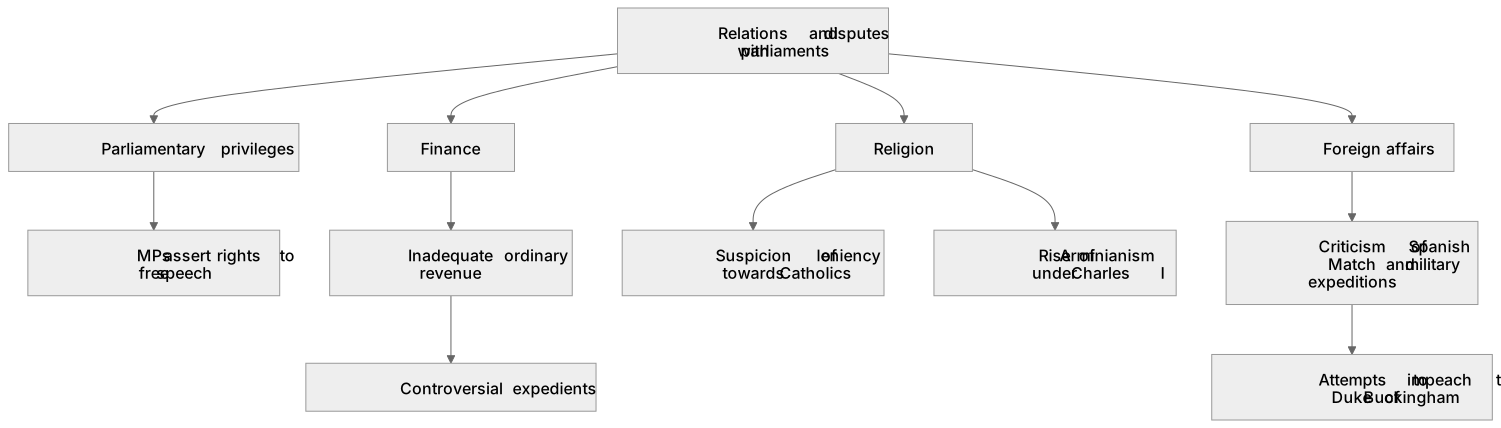
Between 1603 and 1629, relations between James I, Charles I, and their parliaments were increasingly strained by disputes over four key areas.
Checked against the AQA 7042 specification (opens in a new tab) on .
- Point 5 of 6
- 4 key terms
Study notes
From the checked teaching notes for this specification point.
The idea
Between 1603 and 1629, relations between James I, Charles I, and their parliaments were increasingly strained by disputes over four key areas. Parliamentary privileges were fiercely defended, notably in the 1604 Form of Apology and Satisfaction, where MPs asserted their rights to free speech. Finance caused constant friction, as the Crown's inadequate ordinary revenue led to controversial expedients like impositions (Bate's Case) and the Forced Loan. Religion provoked deep suspicion, particularly regarding the perceived leniency towards Catholics and the rise of Arminianism under Charles I. Finally, foreign affairs exacerbated tensions, with MPs criticising James's pursuit of the Spanish Match and Charles's disastrous military expeditions to Cadiz and La Rochelle, leading to attempts to impeach the Duke of Buckingham.
What earns the marks
- Assess the impact of financial disputes, such as the failure of the Great Contract (1610) and the controversy over Tonnage and Poundage.
- Evaluate how religious tensions, specifically the fear of Catholicism and the promotion of Arminian clerics like Richard Montagu, alienated Parliament.
- Analyse the role of foreign policy failures, including the Mansfield expedition and the Cadiz expedition, in destroying trust between Crown and Parliament.
- Explain the significance of parliamentary privileges, using examples like the Protestation of 1621 and the Petition of Right (1628) to show MPs defending their liberties.
Common mistakes and how to put them right
Treating James I and Charles I as having identical relationships with Parliament.
Put it right: Distinguish between James's pragmatic compromises and Charles's rigid, provocative approach.
Assuming Parliament wanted to overthrow the monarchy.
Put it right: Emphasise that MPs were generally conservative, seeking to restore perceived ancient liberties rather than innovate.
Viewing the four areas of dispute in isolation.
Put it right: Demonstrate how finance, religion, and foreign affairs were deeply interconnected, such as the cost of unpopular foreign wars necessitating controversial taxation.
Exam tips
- Link specific foreign policy failures directly to parliamentary reluctance to grant financial subsidies.
- Use the Duke of Buckingham as a focal point to demonstrate how grievances across finance, religion, and foreign affairs coalesced around a single figure.
- When evaluating the severity of disputes, contrast the rhetorical clashes under James I with the constitutional crises under Charles I.
Try the lesson
The start of the 1D Stuart Britain and the Crisis of Monarchy, 1603–1702 – Monarchs and Parliaments, 1603–1629: Relations and disputes with parliaments: parliamentary privileges; finance; religion; foreign affairs lesson, made from checked teaching notes for this specification point.
Have a go first
Which parliamentary privilege was the primary focus of the dispute in Shirley's Case (1604)?
Listen
Between 1603 and 1629, relations between James I, Charles I, and their parliaments were increasingly strained by disputes over four key areas. Parliamentary privileges were fiercely defended, notably in the 1604 Form of Apology and Satisfaction, where MPs asserted their rights to free speech. Finance caused constant friction, as the Crown's inadequate ordinary revenue led to controversial expedients like impositions (Bate's Case) and the Forced Loan. Religion provoked deep suspicion, particularly regarding the perceived leniency towards Catholics and the rise of Arminianism under Charles I. Finally, foreign affairs exacerbated tensions, with MPs criticising James's pursuit of the Spanish Match and Charles's disastrous military expeditions to Cadiz and La Rochelle, leading to attempts to impeach the Duke of Buckingham. A strong answer earns marks for these points. Assess the impact of financial disputes, such as the failure of the Great Contract (1610) and the controversy over Tonnage and Poundage. Evaluate how religious tensions, specifically the fear of Catholicism and the promotion of Arminian clerics like Richard Montagu, alienated Parliament. Analyse the role of foreign policy failures, including the Mansfield expedition and the Cadiz expedition, in destroying trust between Crown and Parliament. Explain the significance of parliamentary privileges, using examples like the Protestation of 1621 and the Petition of Right (1628) to show MPs defending their liberties. A common slip: Treating James I and Charles I as having identical relationships with Parliament. Instead, distinguish between James's pragmatic compromises and Charles's rigid, provocative approach. Exam tip: Link specific foreign policy failures directly to parliamentary reluctance to grant financial subsidies.
See it
Put the events in order
Put these events in the order they happened, earliest first.
- 1. MPs defended their liberties in the Petition of Right
- 2. MPs asserted rights to free speech in the Form of Apology and Satisfaction
- 3. MPs defended their liberties in the Protestation
- 4. The Great Contract failed
Key words
Say what each word means before you turn the card.
Crown and Parliament
Try answering aloud or in your head before turning the card.
Financial weakness
Try answering aloud or in your head before turning the card.
Religious division
Try answering aloud or in your head before turning the card.
Foreign policy
Try answering aloud or in your head before turning the card.
See every definition
- Crown and Parliament
- Relations between James I, Charles I and their parliaments were increasingly strained by disputes over four key areas between 1603 and 1629.
- Financial weakness
- The Crown's inadequate ordinary revenue caused constant friction and led to controversial expedients like impositions and the Forced Loan.
- Religious division
- Deep suspicion was provoked, particularly regarding perceived leniency towards Catholics and the rise of Arminianism under Charles I.
- Foreign policy
- Tensions were exacerbated by MPs criticising the Spanish Match and disastrous military expeditions, leading to attempts to impeach the Duke of Buckingham.
Label the diagram
Some boxes have lost their names. Pick the right name for each number.
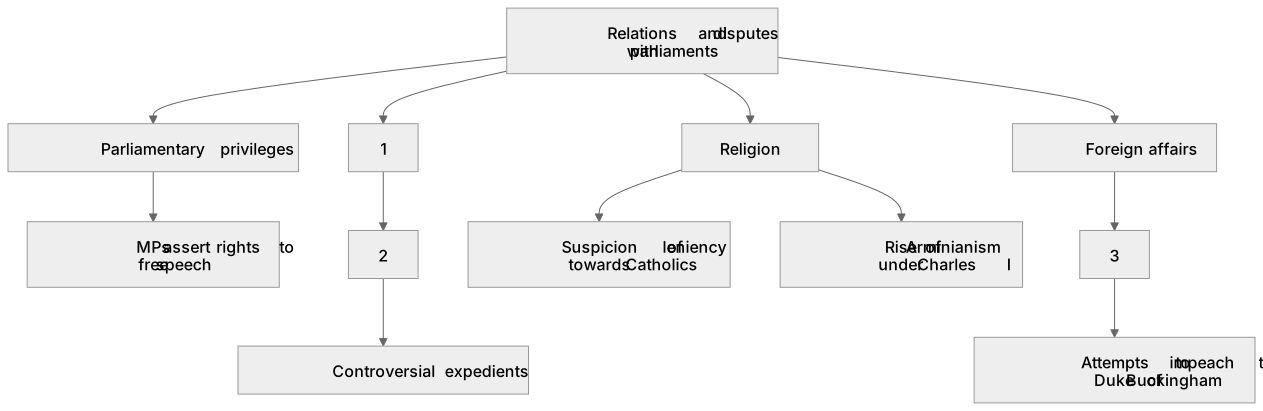
1Box 1
2Box 2
3Box 3
There is more to this lesson
The full lesson goes on to check your understanding and help you earn the marks. Create a free account to carry on, with your progress saved.
A week of Premium from your first lesson · Then the free plan continues · No card, no charge
Test your understanding of 1D Stuart Britain and the Crisis of Monarchy, 1603–1702 – Monarchs and Parliaments, 1603–1629: Relations and disputes with parliaments: parliamentary privileges; finance; religion; foreign affairs
Active recall beats re-reading. Take an instant quiz now to test what you’ve learned and lock it into long-term memory.
A week of Premium from your first lesson · Then the free plan continues · No card, no charge