AQA · A-Level · History
Course version: 7042 · Version from Sept 2017
Religion and religious divisions: challenges to the Church of England from…
Full specification wording
1D Stuart Britain and the Crisis of Monarchy, 1603–1702 – Monarchs and Parliaments, 1603–1629: Religion and religious divisions: challenges to the Church of England from Catholics and Puritans and the development of Arminianism
The Church of England faced deep religious divisions.
Checked against the AQA 7042 specification (opens in a new tab) on .
- Point 4 of 6
- 2 key terms
Study notes
From the checked teaching notes for this specification point.
The idea
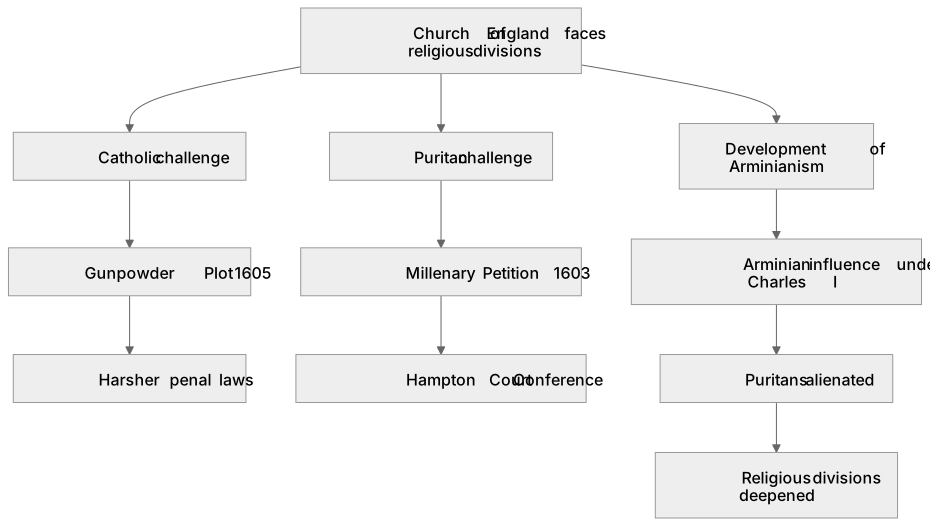
The Church of England faced deep religious divisions. Catholics challenged the state through conspiracies like the 1605 Gunpowder Plot, prompting harsher penal laws, though James I often showed leniency. Puritans challenged the Church by demanding the removal of Catholic remnants, presenting the 1603 Millenary Petition. James managed this at the Hampton Court Conference, offering the King James Bible while defending episcopal authority. However, the development of Arminianism disrupted this balance. Arminians, favouring ceremony, gained significant influence under Charles I. Their rise alienated Puritans, who viewed Arminianism as a dangerous return to Catholicism, severely deepening religious divisions and escalating political tensions in Parliament.
What earns the marks
- Assess the Catholic challenge to the Crown, focusing on the 1605 Gunpowder Plot and the subsequent tightening of penal laws and the Oath of Allegiance.
- Evaluate the Puritan challenge to the Church of England, including the Millenary Petition and the outcomes of the 1604 Hampton Court Conference.
- Analyse James I's success in maintaining a broad 'Jacobethan' Church that balanced moderate Puritan and conservative factions.
- Examine the development of Arminianism and its core theological and stylistic differences from Calvinism, such as the emphasis on free will and ceremony.
- Evaluate how the promotion of Arminian clerics, such as Richard Montagu, under Charles I exacerbated religious divisions and alienated Puritans.
Common mistakes and how to put them right
Treating Puritans as a separate religion.
Put it right: Clarify that Puritans were members of the Church of England who wanted to 'purify' it from within, not a separate denomination.
Confusing Arminianism with Catholicism.
Put it right: Explain that while Arminians favoured ceremony and sacraments (which Puritans likened to Catholicism), they remained firmly Protestant and rejected Papal authority.
Assuming James I persecuted all Catholics.
Put it right: Note that James distinguished between loyal Catholics, whom he tolerated, and radical plotters, whom he punished.
Exam tips
- Contrast James I's pragmatic management of religious divisions with Charles I's rigid promotion of Arminianism to explain the growing crisis.
- Use specific examples of Arminian influence, such as the publication of Richard Montagu's 'A New Gag for an Old Goose', to demonstrate the shift in Church politics.
- Link religious divisions to parliamentary conflicts, showing how Puritan MPs reacted against Arminianism and perceived Catholic sympathies at court.
Try the lesson
The start of the 1D Stuart Britain and the Crisis of Monarchy, 1603–1702 – Monarchs and Parliaments, 1603–1629: Religion and religious divisions: challenges to the Church of England from Catholics and Puritans and the development of Arminianism lesson, made from checked teaching notes for this specification point.
Have a go first
Which document was presented to James I in 1603 by Puritans seeking reforms to the Church of England, such as the abolition of the sign of the cross in baptism?
Listen
The Church of England faced deep religious divisions. Catholics challenged the state through conspiracies like the 1605 Gunpowder Plot, prompting harsher penal laws, though James I often showed leniency. Puritans challenged the Church by demanding the removal of Catholic remnants, presenting the 1603 Millenary Petition. James managed this at the Hampton Court Conference, offering the King James Bible while defending episcopal authority. However, the development of Arminianism disrupted this balance. Arminians, favouring ceremony, gained significant influence under Charles I. Their rise alienated Puritans, who viewed Arminianism as a dangerous return to Catholicism, severely deepening religious divisions and escalating political tensions in Parliament. A strong answer earns marks for these points. Assess the Catholic challenge to the Crown, focusing on the 1605 Gunpowder Plot and the subsequent tightening of penal laws and the Oath of Allegiance. Evaluate the Puritan challenge to the Church of England, including the Millenary Petition and the outcomes of the 1604 Hampton Court Conference. Analyse James I's success in maintaining a broad 'Jacobethan' Church that balanced moderate Puritan and conservative factions. Examine the development of Arminianism and its core theological and stylistic differences from Calvinism, such as the emphasis on free will and ceremony. A common slip: Treating Puritans as a separate religion. Instead, clarify that Puritans were members of the Church of England who wanted to 'purify' it from within, not a separate denomination. Exam tip: Contrast James I's pragmatic management of religious divisions with Charles I's rigid promotion of Arminianism to explain the growing crisis.
See it
Key words
Say what each word means before you turn the card.
The 'Jacobethan' balance
Try answering aloud or in your head before turning the card.
The rise of Arminianism
Try answering aloud or in your head before turning the card.
See every definition
- The 'Jacobethan' balance
- James I's broad Church balancing moderate Puritan and conservative factions, managed at the Hampton Court Conference by offering the King James Bible while defending episcopal authority.
- The rise of Arminianism
- Development of Arminianism, favouring ceremony and emphasising free will, which gained significant influence under Charles I and alienated Puritans.
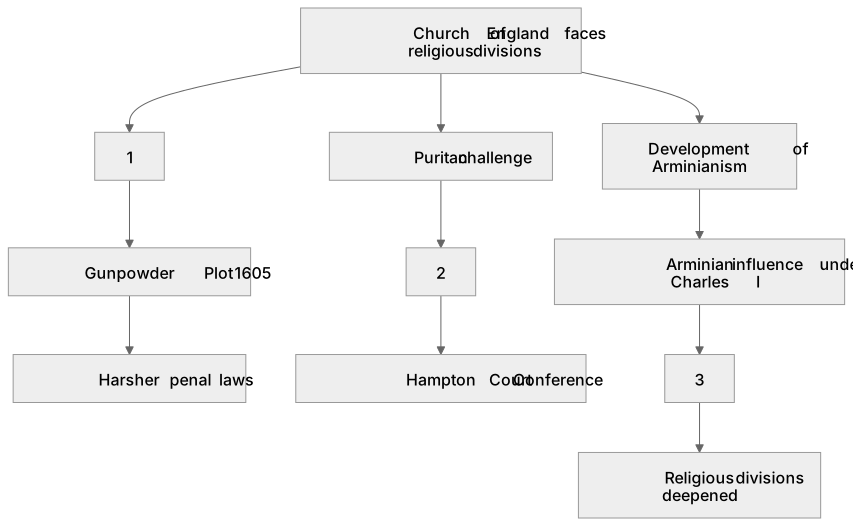
Label the diagram
Some boxes have lost their names. Pick the right name for each number.
1Box 1
2Box 2
3Box 3
There is more to this lesson
The full lesson goes on to check your understanding and help you earn the marks. Create a free account to carry on, with your progress saved.
A week of Premium from your first lesson · Then the free plan continues · No card, no charge
Test your understanding of 1D Stuart Britain and the Crisis of Monarchy, 1603–1702 – Monarchs and Parliaments, 1603–1629: Religion and religious divisions: challenges to the Church of England from Catholics and Puritans and the development of Arminianism
Active recall beats re-reading. Take an instant quiz now to test what you’ve learned and lock it into long-term memory.
A week of Premium from your first lesson · Then the free plan continues · No card, no charge