AQA · A-Level · History
Course version: 7042 · Version from Sept 2017
The financial weakness of the Crown and attempts to reform and strengthen…
Full specification wording
1D Stuart Britain and the Crisis of Monarchy, 1603–1702 – Monarchs and Parliaments, 1603–1629: The financial weakness of the Crown and attempts to reform and strengthen royal finance
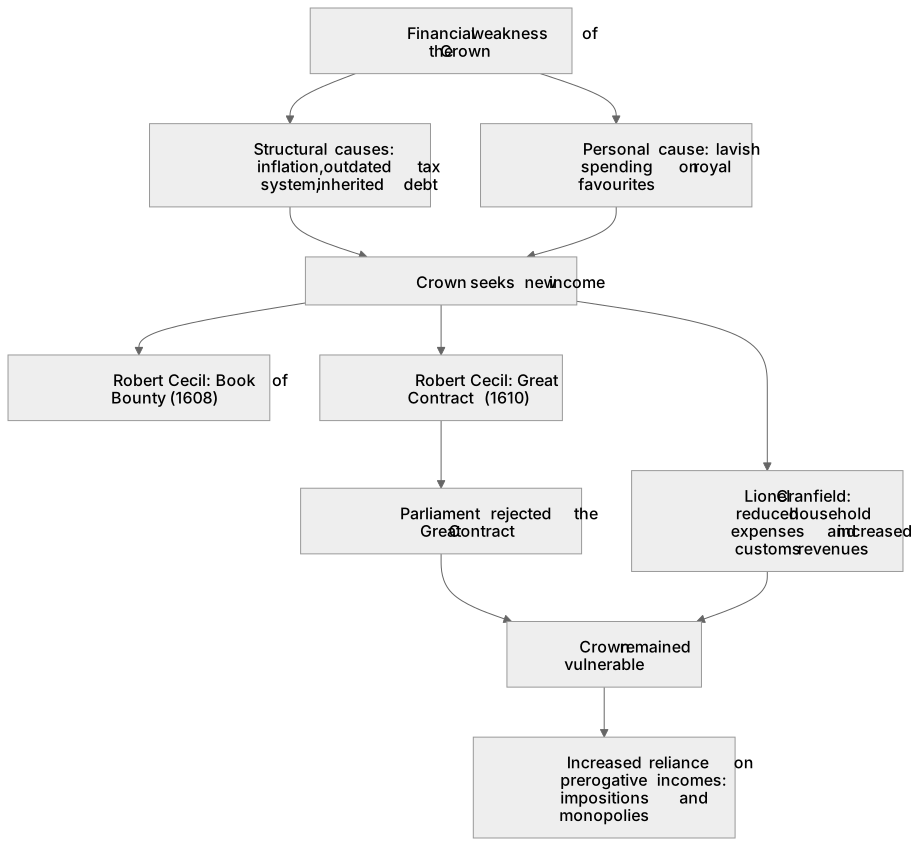
James I inherited a £400,000 debt, worsened by inflation, an outdated tax system, and lavish spending on royal favourites.
Checked against the AQA 7042 specification (opens in a new tab) on .
- Point 3 of 6
Study notes
From the checked teaching notes for this specification point.
The idea
James I inherited a £400,000 debt, worsened by inflation, an outdated tax system, and lavish spending on royal favourites. This profound financial weakness forced the Crown to seek new income. To strengthen royal finance, Lord Treasurers attempted major reforms. Robert Cecil introduced the 1608 Book of Bounty to curb expenditure and proposed the 1610 Great Contract, seeking a £200,000 annual grant in exchange for abolishing wardship, though Parliament rejected it. Lionel Cranfield later reduced household expenses and increased customs revenues. Despite these attempts to reform the system, structural flaws and James's extravagance meant the Crown remained vulnerable, increasing reliance on controversial prerogative incomes like impositions and monopolies.
What earns the marks
- Assess the structural causes of financial weakness, including inflation and the failure of the subsidy system to reflect true wealth.
- Evaluate the impact of James I's personal extravagance, particularly his expenditure on the royal household and Scottish favourites.
- Analyse Robert Cecil's attempts to reform finance, specifically the failure of the Great Contract (1610) and its political consequences.
- Examine the use of prerogative income to strengthen royal finance, such as impositions (following Bate's Case, 1606), monopolies, and the sale of titles.
- Evaluate Lionel Cranfield's administrative reforms in the 1620s and his success in temporarily reducing royal expenditure.
Common mistakes and how to put them right
Claiming James I's financial problems were entirely his own fault.
Put it right: Acknowledge the structural issues he inherited, such as inflation and Elizabeth I's £400,000 debt.
Confusing the Great Contract with a successful reform.
Put it right: State clearly that the Great Contract of 1610 failed because neither Parliament nor the King felt the terms were advantageous enough.
Assuming Parliament controlled all royal income.
Put it right: Distinguish between ordinary revenue (such as Crown lands and customs) which the King controlled, and extraordinary revenue (subsidies) which required parliamentary approval.
Exam tips
- Link financial weakness directly to political tension, showing how the Crown's need for money forced it to call Parliaments or use controversial prerogative powers.
- Use specific figures, such as the £400,000 inherited debt or the £200,000 requested in the Great Contract, to substantiate your arguments.
- Contrast the approaches of different Lord Treasurers, comparing Cecil's ambitious structural proposals with Cranfield's focus on administrative retrenchment.
Try the lesson
The start of the 1D Stuart Britain and the Crisis of Monarchy, 1603–1702 – Monarchs and Parliaments, 1603–1629: The financial weakness of the Crown and attempts to reform and strengthen royal finance lesson, made from checked teaching notes for this specification point.
Have a go first
Which of the following was a major proposal introduced by Robert Cecil in 1610 to reform the financial weakness of the Crown?
Listen
James I inherited a £400,000 debt, worsened by inflation, an outdated tax system, and lavish spending on royal favourites. This profound financial weakness forced the Crown to seek new income. To strengthen royal finance, Lord Treasurers attempted major reforms. Robert Cecil introduced the 1608 Book of Bounty to curb expenditure and proposed the 1610 Great Contract, seeking a £200,000 annual grant in exchange for abolishing wardship, though Parliament rejected it. Lionel Cranfield later reduced household expenses and increased customs revenues. Despite these attempts to reform the system, structural flaws and James's extravagance meant the Crown remained vulnerable, increasing reliance on controversial prerogative incomes like impositions and monopolies. A strong answer earns marks for these points. Assess the structural causes of financial weakness, including inflation and the failure of the subsidy system to reflect true wealth. Evaluate the impact of James I's personal extravagance, particularly his expenditure on the royal household and Scottish favourites. Analyse Robert Cecil's attempts to reform finance, specifically the failure of the Great Contract (1610) and its political consequences. Examine the use of prerogative income to strengthen royal finance, such as impositions (following Bate's Case, 1606), monopolies, and the sale of titles. A common slip: Claiming James I's financial problems were entirely his own fault. Instead, acknowledge the structural issues he inherited, such as inflation and Elizabeth I's £400,000 debt. Exam tip: Link financial weakness directly to political tension, showing how the Crown's need for money forced it to call Parliaments or use controversial prerogative powers.
See it
Label the diagram
Some boxes have lost their names. Pick the right name for each number.
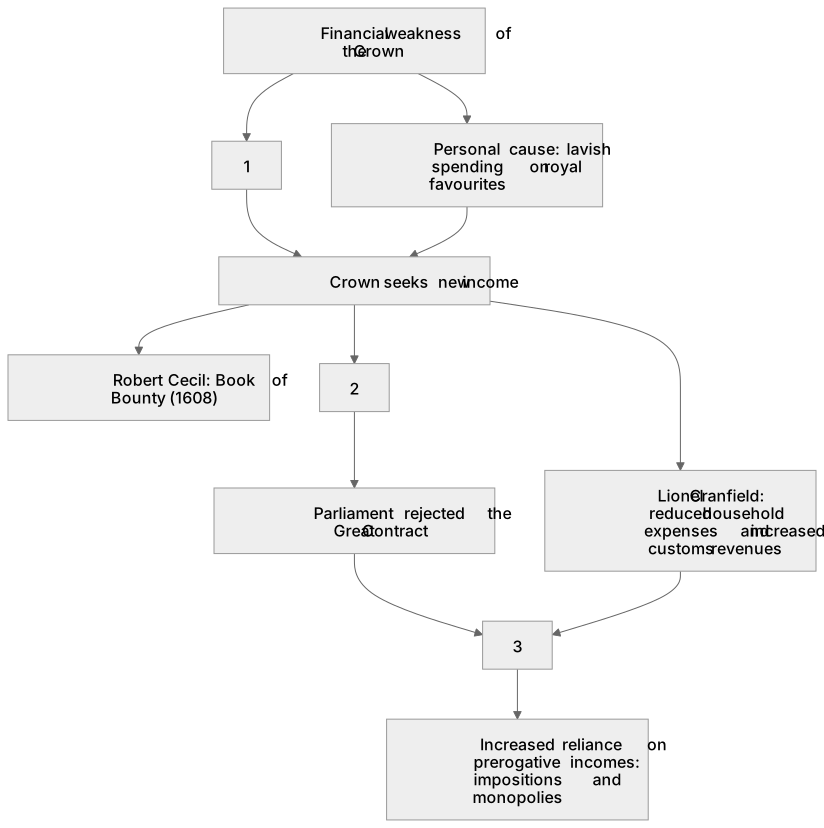
1Box 1
2Box 2
3Box 3
There is more to this lesson
The full lesson goes on to check your understanding and help you earn the marks. Create a free account to carry on, with your progress saved.
A week of Premium from your first lesson · Then the free plan continues · No card, no charge
Test your understanding of 1D Stuart Britain and the Crisis of Monarchy, 1603–1702 – Monarchs and Parliaments, 1603–1629: The financial weakness of the Crown and attempts to reform and strengthen royal finance
Active recall beats re-reading. Take an instant quiz now to test what you’ve learned and lock it into long-term memory.
A week of Premium from your first lesson · Then the free plan continues · No card, no charge