AQA · A-Level · History
Course version: 7042 · Version from Sept 2017
Political divisions: the Personal Rule and the extent of opposition to it…
Full specification wording
1D Stuart Britain and the Crisis of Monarchy, 1603–1702 – Revolution, 1629–1649: Political divisions: the Personal Rule and the extent of opposition to it in England, Scotland and Ireland; the Short and Long Parliaments and the leadership of Pym; divisions and the outbreak of Civil War
Charles I’s Personal Rule (1629–1640) generated underlying opposition across his kingdoms.
Checked against the AQA 7042 specification (opens in a new tab) on .
- Point 2 of 6
Study notes
From the checked teaching notes for this specification point.
The idea
Charles I’s Personal Rule (1629–1640) generated underlying opposition across his kingdoms. In England, financial expedients like Ship Money caused resentment. In Scotland, the new Prayer Book sparked the Bishops' Wars, while Wentworth’s harsh policies in Ireland alienated local factions. The Scottish crisis forced Charles to recall the Short Parliament, then the Long Parliament in 1640. Under John Pym’s leadership, Parliament dismantled the Personal Rule and targeted royal ministers. However, Pym’s radical methods, such as the Grand Remonstrance, alongside the Irish Rebellion of 1641, fractured the initial consensus. These deepening political divisions forced individuals to choose sides, precipitating the outbreak of the Civil War in 1642.
What earns the marks
- Assess the effectiveness and unpopularity of Charles I's financial and religious policies during the Personal Rule in England.
- Compare the nature and extent of opposition in Scotland, such as the National Covenant, and Ireland, focusing on reactions to Wentworth's 'Thorough' policy.
- Evaluate the role of the Short and Long Parliaments in dismantling royal prerogative courts and financial expedients.
- Analyse John Pym's leadership and use of popular pressure in radicalising Parliament and dividing moderate MPs.
- Explain how the Irish Rebellion and the debate over the militia exacerbated divisions, leading directly to the outbreak of Civil War.
Common mistakes and how to put them right
Claiming the Personal Rule faced constant, open rebellion in England.
Put it right by noting that opposition in England was largely muted until the Scottish crisis forced Charles to call Parliament.
Ignoring the British dimension of the crisis.
Put it right by integrating events in Scotland and Ireland as crucial triggers for the English conflict.
Viewing Parliament as a united front against the King in 1642.
Put it right by explaining how Pym's radicalism created a royalist party out of former critics of the King.
Exam tips
- Trace the timeline of the Long Parliament carefully to show how a united opposition in 1640 fractured into two warring parties by 1642.
- Use the Grand Remonstrance as a key turning point to illustrate Pym's divisive tactics and the emergence of constitutional royalism.
- Ensure you address all three kingdoms when evaluating the causes of the Civil War, demonstrating the interconnected nature of the crisis.
Try the lesson
The start of the 1D Stuart Britain and the Crisis of Monarchy, 1603–1702 – Revolution, 1629–1649: Political divisions: the Personal Rule and the extent of opposition to it in England, Scotland and Ireland; the Short and Long Parliaments and the leadership of Pym; divisions and the outbreak of Civil War lesson, made from checked teaching notes for this specification point.
Have a go first
What was the primary characteristic of Charles I's 'Personal Rule' in England between 1629 and 1640?
Listen
Charles I’s Personal Rule (1629–1640) generated underlying opposition across his kingdoms. In England, financial expedients like Ship Money caused resentment. In Scotland, the new Prayer Book sparked the Bishops' Wars, while Wentworth’s harsh policies in Ireland alienated local factions. The Scottish crisis forced Charles to recall the Short Parliament, then the Long Parliament in 1640. Under John Pym’s leadership, Parliament dismantled the Personal Rule and targeted royal ministers. However, Pym’s radical methods, such as the Grand Remonstrance, alongside the Irish Rebellion of 1641, fractured the initial consensus. These deepening political divisions forced individuals to choose sides, precipitating the outbreak of the Civil War in 1642. A strong answer earns marks for these points. Assess the effectiveness and unpopularity of Charles I's financial and religious policies during the Personal Rule in England. Compare the nature and extent of opposition in Scotland, such as the National Covenant, and Ireland, focusing on reactions to Wentworth's 'Thorough' policy. Evaluate the role of the Short and Long Parliaments in dismantling royal prerogative courts and financial expedients. Analyse John Pym's leadership and use of popular pressure in radicalising Parliament and dividing moderate MPs. A common slip: Claiming the Personal Rule faced constant, open rebellion in England. Instead, noting that opposition in England was largely muted until the Scottish crisis forced Charles to call Parliament. Exam tip: Trace the timeline of the Long Parliament carefully to show how a united opposition in 1640 fractured into two warring parties by 1642.
See it
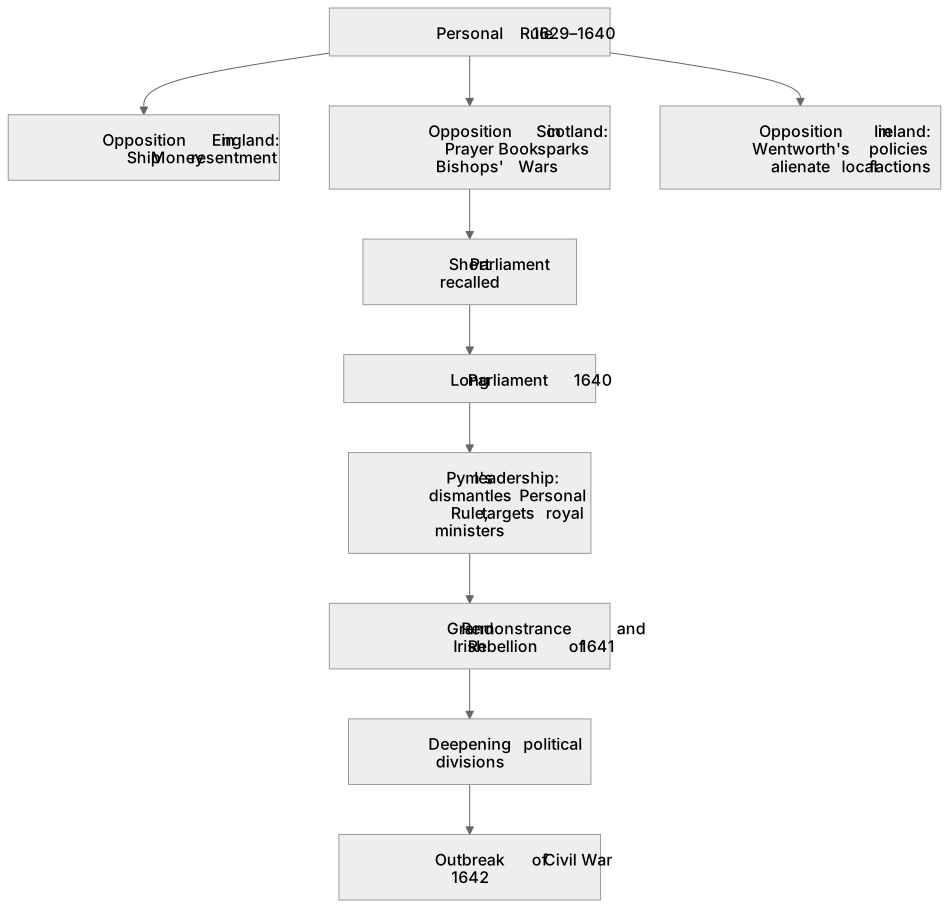
Put the events in order
Put these events in the order they happened, earliest first.
- 1. The outbreak of the Civil War
- 2. Charles I begins the Personal Rule
- 3. The Irish Rebellion fractures the initial consensus
- 4. Charles recalls the Short Parliament
Label the diagram
Some boxes have lost their names. Pick the right name for each number.
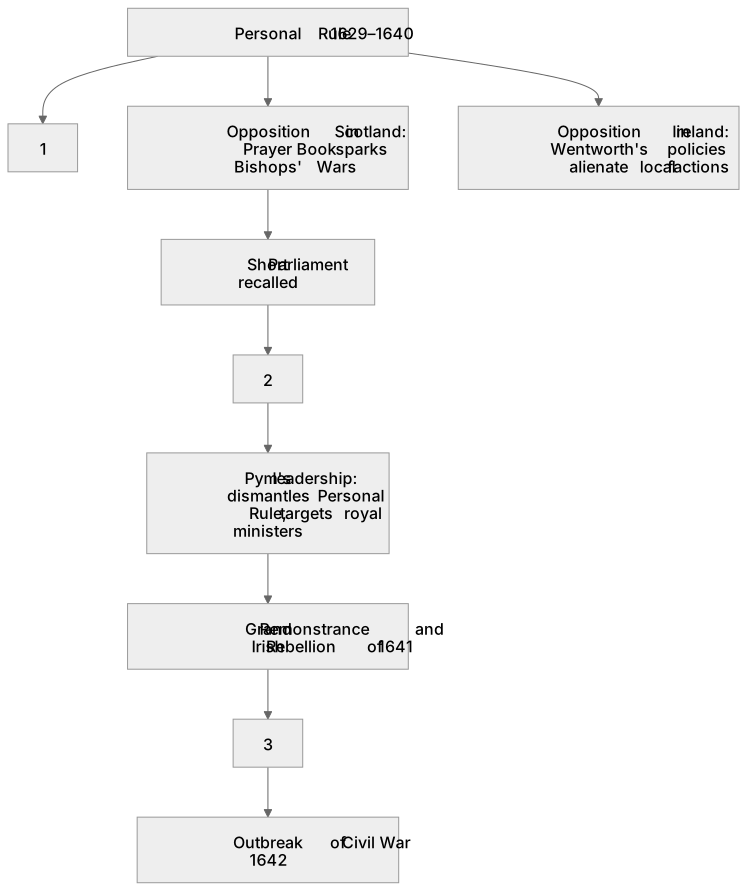
1Box 1
2Box 2
3Box 3
There is more to this lesson
The full lesson goes on to check your understanding and help you earn the marks. Create a free account to carry on, with your progress saved.
A week of Premium from your first lesson · Then the free plan continues · No card, no charge
Test your understanding of 1D Stuart Britain and the Crisis of Monarchy, 1603–1702 – Revolution, 1629–1649: Political divisions: the Personal Rule and the extent of opposition to it in England, Scotland and Ireland; the Short and Long Parliaments and the leadership of Pym; divisions and the outbreak of Civil War
Active recall beats re-reading. Take an instant quiz now to test what you’ve learned and lock it into long-term memory.
A week of Premium from your first lesson · Then the free plan continues · No card, no charge