AQA · A-Level · History
Course version: 7042 · Version from Sept 2017
Divisions within the Political Nation and the emergence of Whigs and…
Full specification wording
1D Stuart Britain and the Crisis of Monarchy, 1603–1702 – The establishment of constitutional monarchy, 1678–1702 (A-level only): Divisions within the Political Nation and the emergence of Whigs and Tories and their impact
The Exclusion Crisis (1679–1681) fractured the Political Nation, catalysing the emergence of the first formal political parties: the Whigs and the Tories.
Checked against the AQA 7042 specification (opens in a new tab) on .
- Point 3 of 6
- 4 key terms
Study notes
From the checked teaching notes for this specification point.
The idea
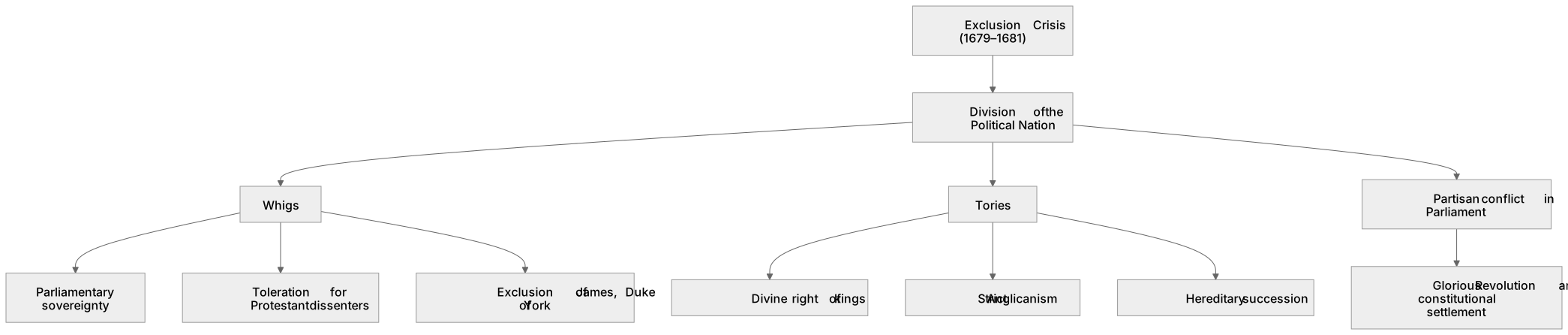
The Exclusion Crisis (1679–1681) fractured the Political Nation, catalysing the emergence of the first formal political parties: the Whigs and the Tories. The Whigs, led by Shaftesbury, championed parliamentary sovereignty, Protestant dissenters, and the exclusion of the Catholic James, Duke of York, from the succession. Conversely, the Tories defended the divine right of kings, strict Anglicanism, and the strict hereditary succession, fearing that exclusion would spark another civil war. This division profoundly impacted late Stuart politics, transforming parliamentary debates into partisan conflicts. Their rivalry shaped the Glorious Revolution and the subsequent constitutional settlement, embedding a two-party system that dictated government policy, patronage, and the balance of power between Crown and Parliament.
What earns the marks
- Identify the Exclusion Crisis as the primary catalyst for the formal division of the Political Nation into Whig and Tory factions.
- Explain the core Whig ideology, including support for parliamentary power, contractual government, and religious toleration for Protestant dissenters.
- Explain the core Tory ideology, focusing on the divine right of kings, non-resistance, and the monopoly of the Anglican Church.
- Evaluate the impact of this partisan division on the Crown's ability to govern, including Charles II's reliance on Tory support during his personal rule (1681–1685).
- Assess how the Whig-Tory divide influenced the Glorious Revolution and the subsequent drafting of the Bill of Rights.
Common mistakes and how to put them right
Claiming the Whigs and Tories were modern, highly organised political parties with formal membership.
Put it right: Describe them as loose factions or groupings of like-minded individuals within the Political Nation, rather than modern political parties.
Stating that the Tories supported James II unconditionally throughout his reign.
Put it right: Note that Tory support for James II collapsed when his pro-Catholic policies directly threatened the Anglican Church's monopoly.
Assuming the Political Nation included the majority of the population.
Put it right: Define the Political Nation as the wealthy, landowning elite and urban merchants who held the franchise and local offices.
Exam tips
- Use the Exclusion Crisis as a structural pivot when evaluating the origins of the Whig and Tory factions.
- Contrast the political philosophies of Locke (associated with Whig ideals) and Filmer (associated with Tory ideals) to demonstrate depth of knowledge.
- When discussing the impact of these divisions, explicitly link partisan conflicts to the shifting balance of power between the Crown and Parliament.
Try the lesson
The start of the 1D Stuart Britain and the Crisis of Monarchy, 1603–1702 – The establishment of constitutional monarchy, 1678–1702 (A-level only): Divisions within the Political Nation and the emergence of Whigs and Tories and their impact lesson, made from checked teaching notes for this specification point.
Have a go first
Which political crisis in the late 1670s and early 1680s directly led to the emergence of the Whig and Tory factions within the Political Nation?
Listen
The Exclusion Crisis (1679–1681) fractured the Political Nation, catalysing the emergence of the first formal political parties: the Whigs and the Tories. The Whigs, led by Shaftesbury, championed parliamentary sovereignty, Protestant dissenters, and the exclusion of the Catholic James, Duke of York, from the succession. Conversely, the Tories defended the divine right of kings, strict Anglicanism, and the strict hereditary succession, fearing that exclusion would spark another civil war. This division profoundly impacted late Stuart politics, transforming parliamentary debates into partisan conflicts. Their rivalry shaped the Glorious Revolution and the subsequent constitutional settlement, embedding a two-party system that dictated government policy, patronage, and the balance of power between Crown and Parliament. A strong answer earns marks for these points. Identify the Exclusion Crisis as the primary catalyst for the formal division of the Political Nation into Whig and Tory factions. Explain the core Whig ideology, including support for parliamentary power, contractual government, and religious toleration for Protestant dissenters. Explain the core Tory ideology, focusing on the divine right of kings, non-resistance, and the monopoly of the Anglican Church. Evaluate the impact of this partisan division on the Crown's ability to govern, including Charles II's reliance on Tory support during his personal rule (1681–1685). A common slip: Claiming the Whigs and Tories were modern, highly organised political parties with formal membership. Instead, Describe them as loose factions or groupings of like-minded individuals within the Political Nation, rather than modern political parties. Exam tip: Use the Exclusion Crisis as a structural pivot when evaluating the origins of the Whig and Tory factions.
See it
Key words
Say what each word means before you turn the card.
Political Nation
Try answering aloud or in your head before turning the card.
Whigs
Try answering aloud or in your head before turning the card.
Tories
Try answering aloud or in your head before turning the card.
Exclusion Crisis
Try answering aloud or in your head before turning the card.
See every definition
- Political Nation
- The wealthy, landowning elite and urban merchants who held the franchise and local offices, rather than the majority of the population.
- Whigs
- A faction that championed parliamentary sovereignty, Protestant dissenters, and the exclusion of the Catholic James, Duke of York, from the succession.
- Tories
- A faction that defended the divine right of kings, strict Anglicanism, and the strict hereditary succession, fearing that exclusion would spark another civil war.
- Exclusion Crisis
- The crisis of 1679–1681 that fractured the Political Nation and catalysed the emergence of the first formal political parties.
Label the diagram
Some boxes have lost their names. Pick the right name for each number.
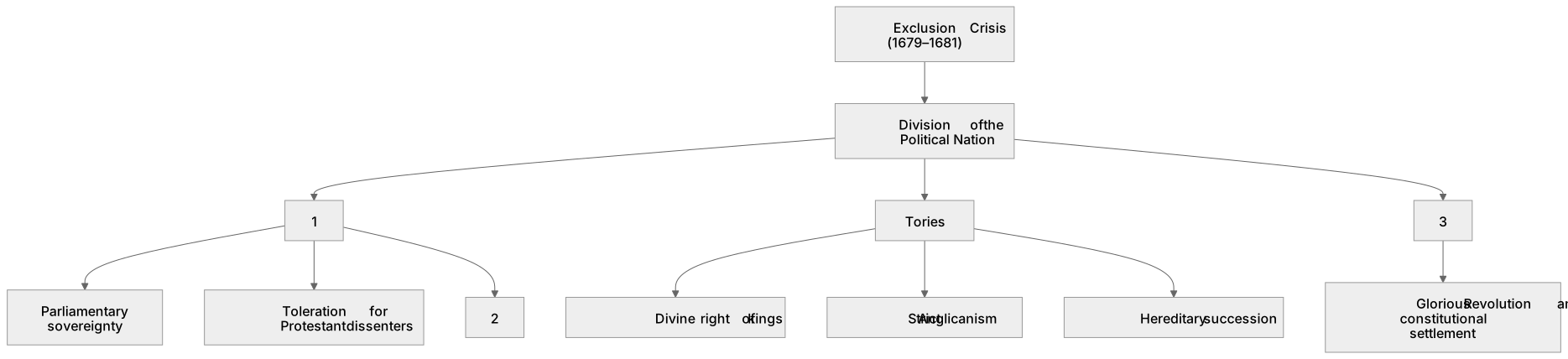
1Box 1
2Box 2
3Box 3
There is more to this lesson
The full lesson goes on to check your understanding and help you earn the marks. Create a free account to carry on, with your progress saved.
A week of Premium from your first lesson · Then the free plan continues · No card, no charge
Test your understanding of 1D Stuart Britain and the Crisis of Monarchy, 1603–1702 – The establishment of constitutional monarchy, 1678–1702 (A-level only): Divisions within the Political Nation and the emergence of Whigs and Tories and their impact
Active recall beats re-reading. Take an instant quiz now to test what you’ve learned and lock it into long-term memory.
A week of Premium from your first lesson · Then the free plan continues · No card, no charge