AQA · A-Level · History
Course version: 7042 · Version from Sept 2017
Religious changes: religious toleration and changes to the position of…
Full specification wording
1D Stuart Britain and the Crisis of Monarchy, 1603–1702 – The establishment of constitutional monarchy, 1678–1702 (A-level only): Religious changes: religious toleration and changes to the position of Anglicans, Protestants and Catholics
The period 1678–1702 witnessed profound religious changes, shifting from strict Anglican uniformity to limited religious toleration.
Checked against the AQA 7042 specification (opens in a new tab) on .
- Point 4 of 6
- 4 key terms
Study notes
From the checked teaching notes for this specification point.
The idea
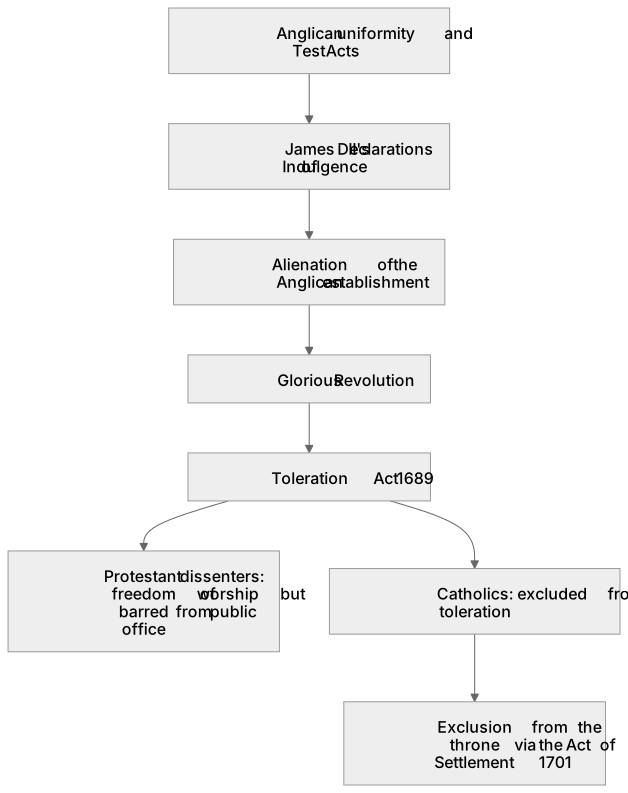
The period 1678–1702 witnessed profound religious changes, shifting from strict Anglican uniformity to limited religious toleration. Initially, the Anglican Church maintained a rigid monopoly, penalising Catholics and Protestant dissenters through the Test Acts. James II's attempts to grant broad toleration via Declarations of Indulgence alienated the Anglican establishment, precipitating the Glorious Revolution. The subsequent Toleration Act of 1689 fundamentally altered the religious landscape. It granted freedom of worship to Protestant dissenters, legally recognising their position, though they remained barred from public office. Conversely, the position of Catholics deteriorated; they were explicitly excluded from toleration and the royal succession, cementing Anglican dominance.
What earns the marks
- Analyse the initial dominance of the Anglican Church and the enforcement of the Clarendon Code against non-conformists.
- Evaluate James II's use of the royal prerogative to issue Declarations of Indulgence, aiming to improve the position of Catholics and dissenters.
- Assess the terms and limitations of the Toleration Act 1689, noting that it granted freedom of worship to Protestant dissenters but not political equality.
- Explain the deteriorating legal and social position of Catholics, culminating in their exclusion from the throne via the Act of Settlement 1701.
- Discuss how the concept of a comprehensive Church of England was ultimately abandoned in favour of a fragmented Protestant landscape.
Common mistakes and how to put them right
Stating that the Toleration Act 1689 granted full religious freedom to everyone.
Put it right: Specify that the Act only granted freedom of worship to Trinitarian Protestant dissenters, explicitly excluding Catholics and Unitarians, and kept the Test Acts in place.
Confusing Protestant dissenters with Anglicans.
Put it right: Clearly distinguish between conforming Anglicans (who accepted the Church of England) and Protestant dissenters or non-conformists (such as Quakers, Baptists, and Presbyterians) who worshipped outside it.
Claiming James II's religious policies were universally welcomed by Protestant dissenters.
Put it right: Note that many dissenters viewed James II's Declarations of Indulgence with suspicion, fearing it was a Trojan horse to establish Catholic absolutism.
Exam tips
- Always distinguish between freedom of worship and political equality when discussing the Toleration Act 1689.
- Use specific legislation, such as the Test Acts and the Act of Settlement, to evidence changes in the position of different religious groups.
- Link religious changes directly to political crises, demonstrating how fear of Catholicism drove constitutional changes.
Try the lesson
The start of the 1D Stuart Britain and the Crisis of Monarchy, 1603–1702 – The establishment of constitutional monarchy, 1678–1702 (A-level only): Religious changes: religious toleration and changes to the position of Anglicans, Protestants and Catholics lesson, made from checked teaching notes for this specification point.
Have a go first
Which religious group was explicitly granted the right to worship freely under the provisions of the Toleration Act of 1689?
Listen
The period 1678–1702 witnessed profound religious changes, shifting from strict Anglican uniformity to limited religious toleration. Initially, the Anglican Church maintained a rigid monopoly, penalising Catholics and Protestant dissenters through the Test Acts. James II's attempts to grant broad toleration via Declarations of Indulgence alienated the Anglican establishment, precipitating the Glorious Revolution. The subsequent Toleration Act of 1689 fundamentally altered the religious landscape. It granted freedom of worship to Protestant dissenters, legally recognising their position, though they remained barred from public office. Conversely, the position of Catholics deteriorated; they were explicitly excluded from toleration and the royal succession, cementing Anglican dominance. A strong answer earns marks for these points. Analyse the initial dominance of the Anglican Church and the enforcement of the Clarendon Code against non-conformists. Evaluate James II's use of the royal prerogative to issue Declarations of Indulgence, aiming to improve the position of Catholics and dissenters. Assess the terms and limitations of the Toleration Act 1689, noting that it granted freedom of worship to Protestant dissenters but not political equality. Explain the deteriorating legal and social position of Catholics, culminating in their exclusion from the throne via the Act of Settlement 1701. A common slip: Stating that the Toleration Act 1689 granted full religious freedom to everyone. Instead, Specify that the Act only granted freedom of worship to Trinitarian Protestant dissenters, explicitly excluding Catholics and Unitarians, and kept the Test Acts in place. Exam tip: Always distinguish between freedom of worship and political equality when discussing the Toleration Act 1689.
See it
Key words
Say what each word means before you turn the card.
Religious toleration and persecution
Try answering aloud or in your head before turning the card.
The relationship between Church and State
Try answering aloud or in your head before turning the card.
Anti-Catholicism
Try answering aloud or in your head before turning the card.
The limits of the Glorious Revolution
Try answering aloud or in your head before turning the card.
See every definition
- Religious toleration and persecution
- The note describes a shift from strict Anglican uniformity, penalising Catholics and Protestant dissenters, to limited religious toleration granted by the Toleration Act of 1689.
- The relationship between Church and State
- The Anglican Church maintained a rigid monopoly, while James II's use of the royal prerogative to issue Declarations of Indulgence alienated the Anglican establishment.
- Anti-Catholicism
- Catholics were explicitly excluded from toleration and the royal succession, cementing Anglican dominance.
- The limits of the Glorious Revolution
- The Toleration Act granted freedom of worship to Protestant dissenters, though they remained barred from public office, and Catholics were excluded from toleration.
Label the diagram
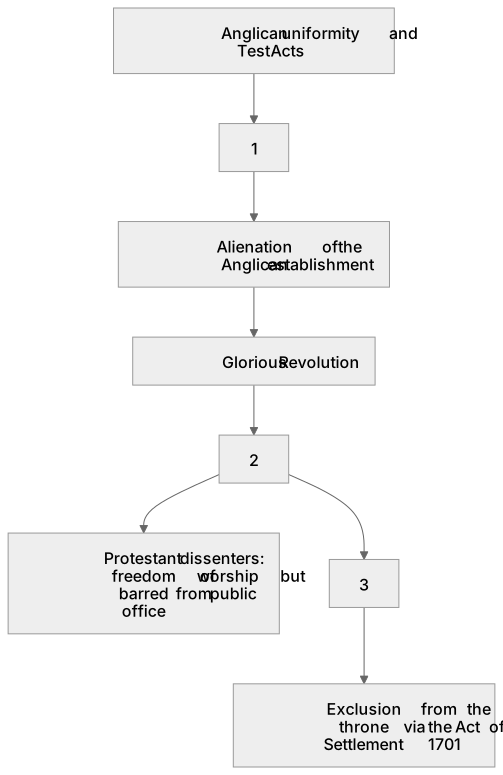
Some boxes have lost their names. Pick the right name for each number.
1Box 1
2Box 2
3Box 3
There is more to this lesson
The full lesson goes on to check your understanding and help you earn the marks. Create a free account to carry on, with your progress saved.
A week of Premium from your first lesson · Then the free plan continues · No card, no charge
Test your understanding of 1D Stuart Britain and the Crisis of Monarchy, 1603–1702 – The establishment of constitutional monarchy, 1678–1702 (A-level only): Religious changes: religious toleration and changes to the position of Anglicans, Protestants and Catholics
Active recall beats re-reading. Take an instant quiz now to test what you’ve learned and lock it into long-term memory.
A week of Premium from your first lesson · Then the free plan continues · No card, no charge