AQA · A-Level · History
Course version: 7042 · Version from Sept 2017
Foreign affairs and wars: Sweden; Turkey and Crimea; wars with Poland and…
Full specification wording
1E Russia in the Age of Absolutism and Enlightenment, 1682–1796 (A-level only) – Catherine the Great and Russia, 1762–1796: Foreign affairs and wars: Sweden; Turkey and Crimea; wars with Poland and its partition
Catherine’s foreign policy aggressively expanded Russian borders, securing her status as a great European power.
Checked against the AQA 7042 specification (opens in a new tab) on .
- Point 6 of 6
Study notes
From the checked teaching notes for this specification point.
The idea
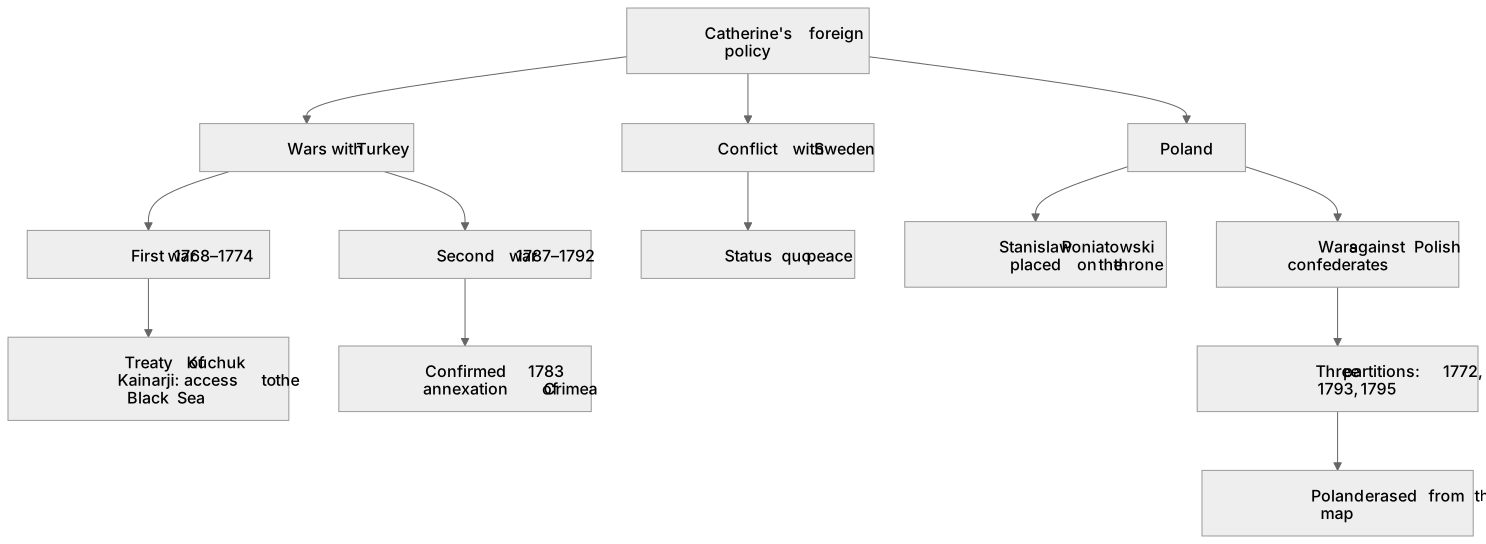
Catherine’s foreign policy aggressively expanded Russian borders, securing her status as a great European power. Wars with Turkey (1768–1774 and 1787–1792) were highly successful, resulting in the Treaty of Kuchuk Kainarji, granting Russia access to the Black Sea, and the 1783 annexation of Crimea. Conflict with Sweden (1788–1790) tested Russian resources but ended in a status quo peace. In Poland, Catherine manipulated internal weaknesses, placing Stanislaw Poniatowski on the throne. Following wars against Polish confederates, Russia orchestrated three partitions of Poland (1772, 1793, 1795). While Prussia participated in all three, Austria was excluded from the 1793 partition, ultimately erasing Poland from the map and vastly increasing Russian territory.
What earns the marks
- Assess the strategic aims and outcomes of the Russo-Turkish Wars, focusing on the acquisition of Black Sea ports and the annexation of Crimea.
- Explain the context and resolution of the Russo-Swedish War (1788–1790), noting how it diverted Russian attention but ultimately maintained the balance of power in the Baltic.
- Analyse Catherine's methods in Poland, including political interference, military intervention against the Bar Confederation, and diplomatic negotiations with Prussia and Austria.
- Evaluate the significance of the three Partitions of Poland (1772, 1793, 1795) in expanding the Russian Empire and altering the geopolitical map of Eastern Europe.
Common mistakes and how to put them right
Claiming Russia partitioned Poland alone.
Put it right: Emphasise that the partitions were complex diplomatic agreements involving Russia, Prussia, and (in 1772 and 1795) Austria to maintain a balance of power.
Confusing the outcomes of the two Russo-Turkish wars.
Put it right: Specify that the first war (1768–1774) led to the Treaty of Kuchuk Kainarji and independence for Crimea, while the second (1787–1792) confirmed Russia's 1783 annexation of Crimea.
Assuming Austria participated in all three partitions of Poland.
Put it right: Clarify that Austria was excluded from the Second Partition in 1793, which was carried out solely by Russia and Prussia.
Exam tips
- Link Catherine's foreign policy successes to her domestic standing; military victories helped legitimise her usurped rule.
- When evaluating foreign affairs, consider the financial and human cost of these wars on the Russian state and peasantry.
- Accurately identify the participating powers in each partition of Poland to demonstrate precise historical knowledge.
Try the lesson
The start of the 1E Russia in the Age of Absolutism and Enlightenment, 1682–1796 (A-level only) – Catherine the Great and Russia, 1762–1796: Foreign affairs and wars: Sweden; Turkey and Crimea; wars with Poland and its partition lesson, made from checked teaching notes for this specification point.
Have a go first
Which three European powers participated in the partitions of Poland during the reign of Catherine the Great?
Listen
Catherine’s foreign policy aggressively expanded Russian borders, securing her status as a great European power. Wars with Turkey (1768–1774 and 1787–1792) were highly successful, resulting in the Treaty of Kuchuk Kainarji, granting Russia access to the Black Sea, and the 1783 annexation of Crimea. Conflict with Sweden (1788–1790) tested Russian resources but ended in a status quo peace. In Poland, Catherine manipulated internal weaknesses, placing Stanislaw Poniatowski on the throne. Following wars against Polish confederates, Russia orchestrated three partitions of Poland (1772, 1793, 1795). While Prussia participated in all three, Austria was excluded from the 1793 partition, ultimately erasing Poland from the map and vastly increasing Russian territory. A strong answer earns marks for these points. Assess the strategic aims and outcomes of the Russo-Turkish Wars, focusing on the acquisition of Black Sea ports and the annexation of Crimea. Explain the context and resolution of the Russo-Swedish War (1788–1790), noting how it diverted Russian attention but ultimately maintained the balance of power in the Baltic. Analyse Catherine's methods in Poland, including political interference, military intervention against the Bar Confederation, and diplomatic negotiations with Prussia and Austria. Evaluate the significance of the three Partitions of Poland (1772, 1793, 1795) in expanding the Russian Empire and altering the geopolitical map of Eastern Europe. A common slip: Claiming Russia partitioned Poland alone. Instead, Emphasise that the partitions were complex diplomatic agreements involving Russia, Prussia, and (in 1772 and 1795) Austria to maintain a balance of power. Exam tip: Link Catherine's foreign policy successes to her domestic standing; military victories helped legitimise her usurped rule.
See it
Put the events in order
Put these events in the order they happened, earliest first.
- 1. Annexation of Crimea
- 2. Second war with Turkey begins
- 3. War with Sweden begins
- 4. First partition of Poland
- 5. First war with Turkey begins
- 6. Second partition of Poland
Label the diagram
Some boxes have lost their names. Pick the right name for each number.
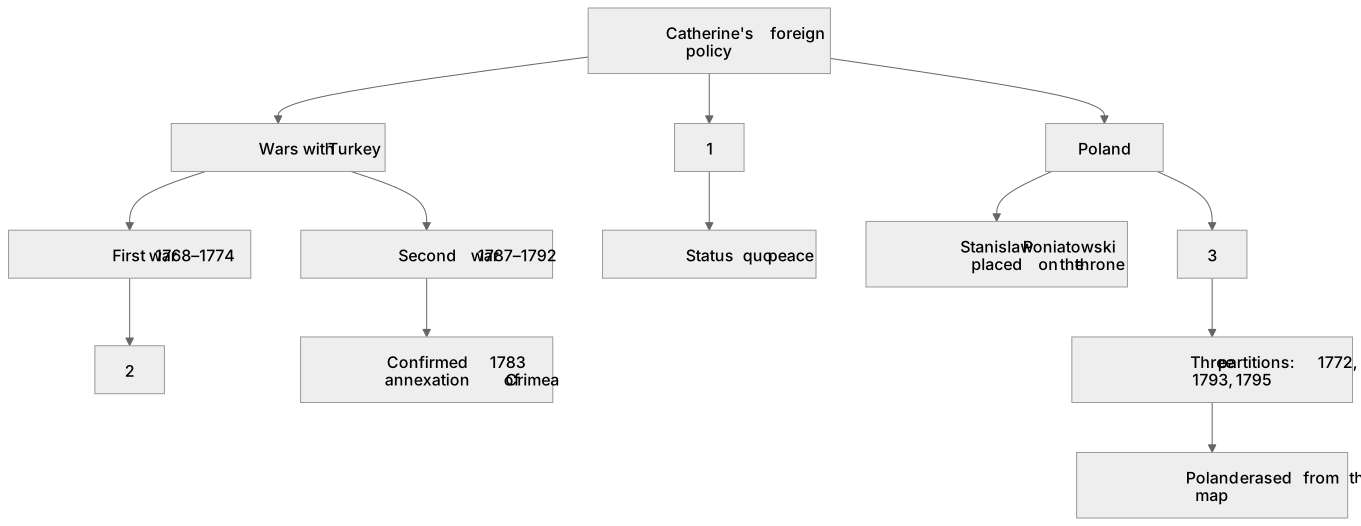
1Box 1
2Box 2
3Box 3
There is more to this lesson
The full lesson goes on to check your understanding and help you earn the marks. Create a free account to carry on, with your progress saved.
A week of Premium from your first lesson · Then the free plan continues · No card, no charge
Test your understanding of 1E Russia in the Age of Absolutism and Enlightenment, 1682–1796 (A-level only) – Catherine the Great and Russia, 1762–1796: Foreign affairs and wars: Sweden; Turkey and Crimea; wars with Poland and its partition
Active recall beats re-reading. Take an instant quiz now to test what you’ve learned and lock it into long-term memory.
A week of Premium from your first lesson · Then the free plan continues · No card, no charge