AQA · A-Level · History
Course version: 7042 · Version from Sept 2017
Opposition and rebellion; plots against her and Catherine’s reaction; the…
Full specification wording
1E Russia in the Age of Absolutism and Enlightenment, 1682–1796 (A-level only) – Catherine the Great and Russia, 1762–1796: Opposition and rebellion; plots against her and Catherine’s reaction; the Pugachev Revolt and its consequences
Catherine the Great faced significant opposition, stemming from her usurpation of the throne and the worsening conditions of the serfs.
Checked against the AQA 7042 specification (opens in a new tab) on .
- Point 5 of 6
- 3 key terms
Study notes
From the checked teaching notes for this specification point.
The idea
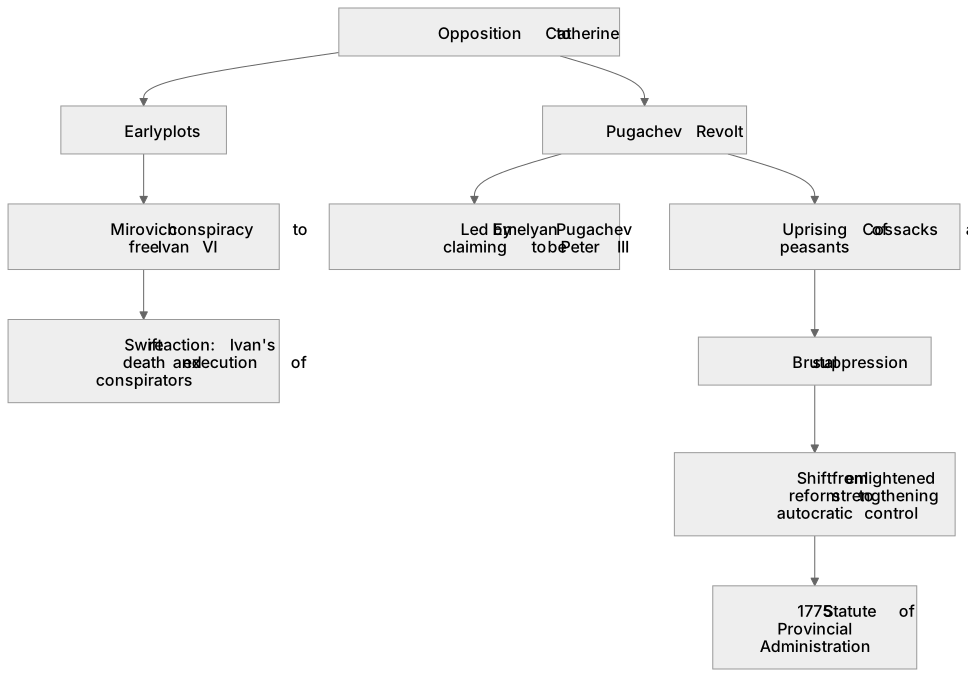
Catherine the Great faced significant opposition, stemming from her usurpation of the throne and the worsening conditions of the serfs. Early plots against her, such as the Mirovich conspiracy to free Ivan VI in 1764, were met with swift reactions, resulting in Ivan's death and the execution of conspirators. The most severe threat was the Pugachev Revolt (1773–1775), led by Emelyan Pugachev, who claimed to be Peter III. This massive uprising of Cossacks and peasants exposed the fragility of local administration. Following its brutal suppression, Catherine's reaction shifted from enlightened reform to strengthening autocratic control, culminating in the 1775 Statute of Provincial Administration to tighten noble authority over the provinces.
What earns the marks
- Identify the causes of early plots against Catherine, particularly her lack of legitimate claim to the throne and the existence of rivals like Ivan VI.
- Explain Catherine's reaction to early conspiracies, noting her reliance on the military and swift executions to deter further challenges.
- Analyse the origins of the Pugachev Revolt, including Cossack grievances, serf discontent, and Pugachev's impersonation of Peter III.
- Evaluate the consequences of the Pugachev Revolt, specifically the abandonment of enlightened reforms in favour of the 1775 provincial reforms that entrenched noble power.
Common mistakes and how to put them right
Claiming the Pugachev Revolt was solely a peasant uprising.
Put it right: Acknowledge that it was a diverse coalition including Yaik Cossacks, Old Believers, and ethnic minorities like the Bashkirs alongside peasants.
Stating Catherine reacted to the Pugachev Revolt with liberal reforms.
Put it right: Explain that her reaction was reactionary, leading to the 1775 Statute of Provincial Administration which strengthened central and noble control.
Confusing the pretenders to the throne.
Put it right: Ensure Emelyan Pugachev is correctly identified as claiming to be Peter III, not Ivan VI (who was the focus of the Mirovich plot).
Exam tips
- When discussing opposition, distinguish between elite political plots in St Petersburg and mass popular rebellions in the provinces.
- Use the Pugachev Revolt as a turning point in Catherine's reign to evaluate the limits of her 'Enlightened Absolutism'.
- Link Catherine's reaction to the Pugachev Revolt directly to her subsequent reliance on the nobility for local governance.
Try the lesson
The start of the 1E Russia in the Age of Absolutism and Enlightenment, 1682–1796 (A-level only) – Catherine the Great and Russia, 1762–1796: Opposition and rebellion; plots against her and Catherine’s reaction; the Pugachev Revolt and its consequences lesson, made from checked teaching notes for this specification point.
Have a go first
Which historical figure did Yemelyan Pugachev claim to be during his rebellion against Catherine the Great?
Listen
Catherine the Great faced significant opposition, stemming from her usurpation of the throne and the worsening conditions of the serfs. Early plots against her, such as the Mirovich conspiracy to free Ivan VI in 1764, were met with swift reactions, resulting in Ivan's death and the execution of conspirators. The most severe threat was the Pugachev Revolt (1773–1775), led by Emelyan Pugachev, who claimed to be Peter III. This massive uprising of Cossacks and peasants exposed the fragility of local administration. Following its brutal suppression, Catherine's reaction shifted from enlightened reform to strengthening autocratic control, culminating in the 1775 Statute of Provincial Administration to tighten noble authority over the provinces. A strong answer earns marks for these points. Identify the causes of early plots against Catherine, particularly her lack of legitimate claim to the throne and the existence of rivals like Ivan VI. Explain Catherine's reaction to early conspiracies, noting her reliance on the military and swift executions to deter further challenges. Analyse the origins of the Pugachev Revolt, including Cossack grievances, serf discontent, and Pugachev's impersonation of Peter III. Evaluate the consequences of the Pugachev Revolt, specifically the abandonment of enlightened reforms in favour of the 1775 provincial reforms that entrenched noble power. A common slip: Claiming the Pugachev Revolt was solely a peasant uprising. Instead, Acknowledge that it was a diverse coalition including Yaik Cossacks, Old Believers, and ethnic minorities like the Bashkirs alongside peasants. Exam tip: When discussing opposition, distinguish between elite political plots in St Petersburg and mass popular rebellions in the provinces.
See it
Put the events in order
Put these events in the order they happened, earliest first.
- 1. Mirovich conspiracy to free Ivan VI
- 2. Statute of Provincial Administration issued
- 3. Pugachev Revolt begins, led by Emelyan Pugachev
Key words
Say what each word means before you turn the card.
Pugachev Revolt
Try answering aloud or in your head before turning the card.
Mirovich conspiracy
Try answering aloud or in your head before turning the card.
Statute of Provincial Administration
Try answering aloud or in your head before turning the card.
See every definition
- Pugachev Revolt
- A massive uprising of Cossacks and peasants led by Emelyan Pugachev, who claimed to be Peter III, exposing the fragility of local administration.
- Mirovich conspiracy
- An early plot against Catherine to free Ivan VI in 1764, met with swift reaction resulting in Ivan's death and the execution of conspirators.
- Statute of Provincial Administration
- The 1775 reform that tightened noble authority over the provinces and entrenched noble power.
Label the diagram
Some boxes have lost their names. Pick the right name for each number.
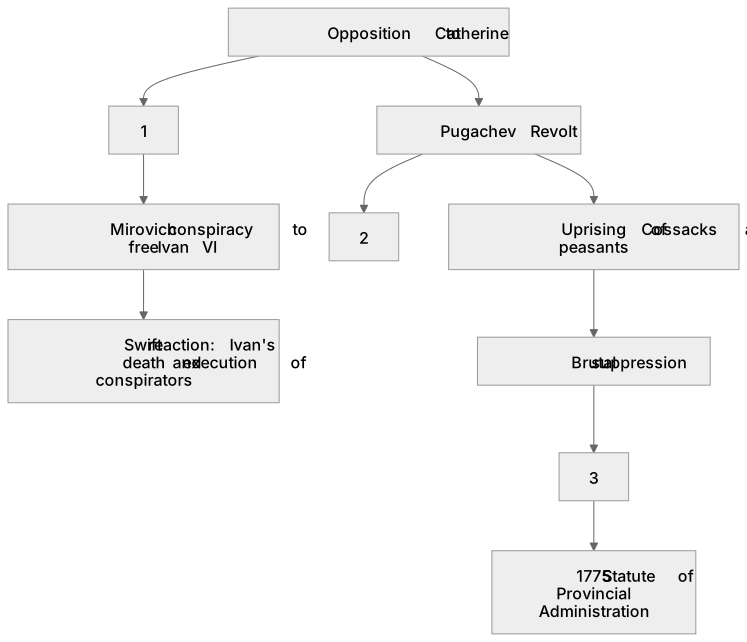
1Box 1
2Box 2
3Box 3
There is more to this lesson
The full lesson goes on to check your understanding and help you earn the marks. Create a free account to carry on, with your progress saved.
A week of Premium from your first lesson · Then the free plan continues · No card, no charge
Test your understanding of 1E Russia in the Age of Absolutism and Enlightenment, 1682–1796 (A-level only) – Catherine the Great and Russia, 1762–1796: Opposition and rebellion; plots against her and Catherine’s reaction; the Pugachev Revolt and its consequences
Active recall beats re-reading. Take an instant quiz now to test what you’ve learned and lock it into long-term memory.
A week of Premium from your first lesson · Then the free plan continues · No card, no charge