AQA · A-Level · History
Course version: 7042 · Version from Sept 2017
The economy and the persistence of serfdom and its impact on economic…
Full specification wording
1E Russia in the Age of Absolutism and Enlightenment, 1682–1796 (A-level only) – Catherine the Great and Russia, 1762–1796: The economy and the persistence of serfdom and its impact on economic development
Catherine the Great’s reign saw some economic expansion, particularly in foreign trade and the metallurgical industries of the Urals, but overall development was severely constrained by the…
Checked against the AQA 7042 specification (opens in a new tab) on .
- Point 4 of 6
- 4 key terms
Study notes
From the checked teaching notes for this specification point.
The idea
Catherine the Great’s reign saw some economic expansion, particularly in foreign trade and the metallurgical industries of the Urals, but overall development was severely constrained by the persistence of serfdom. The agricultural economy relied on unfree labour, which stifled innovation, prevented the emergence of a mobile industrial workforce, and limited the domestic market's purchasing power. Landowners extracted wealth through obrok (rent) or barshchina (labour), leaving serfs with little incentive or capital to improve yields. Consequently, while Russia remained a major European exporter of grain and iron, its underlying economic structure remained fundamentally agrarian and technologically stagnant, preventing the transition to a modern, capitalist economy seen elsewhere in Europe.
What earns the marks
- Identify the main features of the Russian economy under Catherine, including the growth of the Ural iron industry and grain exports.
- Explain how the institutions of obrok and barshchina disincentivised agricultural innovation and productivity.
- Analyse how the immobility of serf labour prevented the development of a substantial urban industrial workforce.
- Evaluate the long-term impact of serfdom on Russia's economic backwardness compared to Western European nations.
Common mistakes and how to put them right
Claiming that Russia experienced no economic growth under Catherine.
Put it right: Acknowledge the growth in exports and specific industries like metallurgy, while noting structural limitations.
Assuming serfs were only agricultural labourers.
Put it right: Recognise that many serfs worked in state or private factories, though their unfree status still hindered capitalist development.
Stating that Catherine attempted to abolish serfdom to help the economy.
Put it right: Clarify that despite early Enlightenment rhetoric, Catherine actually extended serfdom to appease the nobility.
Exam tips
- Use specific terms like obrok (cash rent) and barshchina (labour rent) to demonstrate precise knowledge of the serf economy.
- Connect the persistence of serfdom directly to the lack of a domestic consumer market, which is crucial for industrialisation.
- Contrast Russia's impressive macroeconomic output, such as iron exports, with its microeconomic stagnation, including peasant poverty and lack of innovation.
Try the lesson
The start of the 1E Russia in the Age of Absolutism and Enlightenment, 1682–1796 (A-level only) – Catherine the Great and Russia, 1762–1796: The economy and the persistence of serfdom and its impact on economic development lesson, made from checked teaching notes for this specification point.
Have a go first
During the reign of Catherine the Great, what was the primary economic consequence of the persistence of serfdom in Russia?
Listen
Catherine the Great’s reign saw some economic expansion, particularly in foreign trade and the metallurgical industries of the Urals, but overall development was severely constrained by the persistence of serfdom. The agricultural economy relied on unfree labour, which stifled innovation, prevented the emergence of a mobile industrial workforce, and limited the domestic market's purchasing power. Landowners extracted wealth through obrok (rent) or barshchina (labour), leaving serfs with little incentive or capital to improve yields. Consequently, while Russia remained a major European exporter of grain and iron, its underlying economic structure remained fundamentally agrarian and technologically stagnant, preventing the transition to a modern, capitalist economy seen elsewhere in Europe. A strong answer earns marks for these points. Identify the main features of the Russian economy under Catherine, including the growth of the Ural iron industry and grain exports. Explain how the institutions of obrok and barshchina disincentivised agricultural innovation and productivity. Analyse how the immobility of serf labour prevented the development of a substantial urban industrial workforce. Evaluate the long-term impact of serfdom on Russia's economic backwardness compared to Western European nations. A common slip: Claiming that Russia experienced no economic growth under Catherine. Instead, acknowledge the growth in exports and specific industries like metallurgy, while noting structural limitations. Exam tip: Use specific terms like obrok (cash rent) and barshchina (labour rent) to demonstrate precise knowledge of the serf economy.
See it
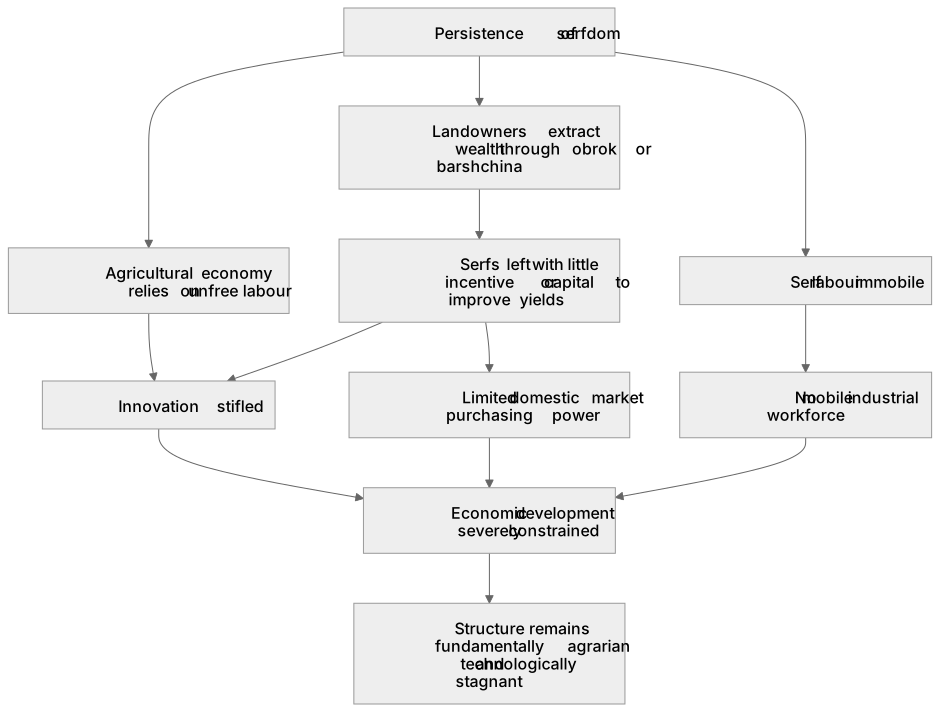
Key words
Say what each word means before you turn the card.
Serfdom and unfree labour
Try answering aloud or in your head before turning the card.
Obrok
Try answering aloud or in your head before turning the card.
Barshchina
Try answering aloud or in your head before turning the card.
Economic stagnation vs. growth
Try answering aloud or in your head before turning the card.
See every definition
- Serfdom and unfree labour
- A system in which the agricultural economy relied on unfree labour, which stifled innovation, prevented the emergence of a mobile industrial workforce, and limited the domestic market's purchasing power.
- Obrok
- A form of rent through which landowners extracted wealth from serfs, leaving them with little incentive or capital to improve yields.
- Barshchina
- A form of labour rent through which landowners extracted wealth from serfs, leaving them with little incentive or capital to improve yields.
- Economic stagnation vs. growth
- Some economic expansion occurred, particularly in foreign trade and the metallurgical industries of the Urals, but overall development was severely constrained by the persistence of serfdom.
Label the diagram
Some boxes have lost their names. Pick the right name for each number.
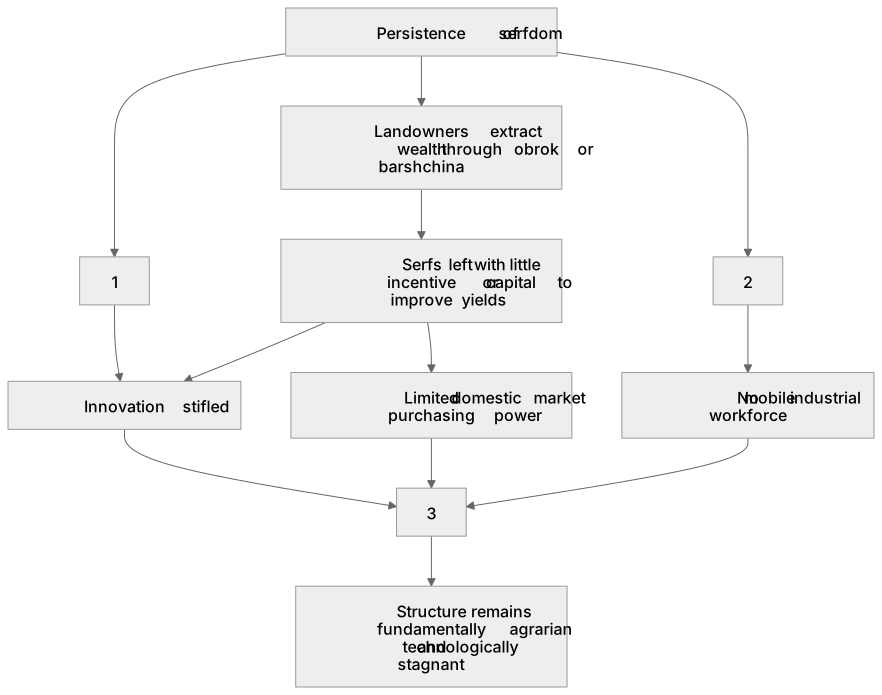
1Box 1
2Box 2
3Box 3
There is more to this lesson
The full lesson goes on to check your understanding and help you earn the marks. Create a free account to carry on, with your progress saved.
A week of Premium from your first lesson · Then the free plan continues · No card, no charge
Test your understanding of 1E Russia in the Age of Absolutism and Enlightenment, 1682–1796 (A-level only) – Catherine the Great and Russia, 1762–1796: The economy and the persistence of serfdom and its impact on economic development
Active recall beats re-reading. Take an instant quiz now to test what you’ve learned and lock it into long-term memory.
A week of Premium from your first lesson · Then the free plan continues · No card, no charge