AQA · A-Level · History
Course version: 7042 · Version from Sept 2017
How and why did Russian society and the economy develop?
Full specification wording
1E Russia in the Age of Absolutism and Enlightenment, 1682–1796 (A-level only) – consequence in this period through the following key questions:: How and why did Russian society and the economy develop?
This topic explores the mechanisms and drivers behind Russian social and economic development between 1682 and 1796.
Checked against the AQA 7042 specification (opens in a new tab) on .
- Point 2 of 6
Study notes
From the checked teaching notes for this specification point.
The idea
This topic explores the mechanisms and drivers behind Russian social and economic development between 1682 and 1796. You must analyse how society changed, focusing on the deepening entrenchment of serfdom and the Westernisation of the nobility. Economically, examine how the economy developed through state-sponsored mercantilism, the introduction of the soul tax, and the growth of the Ural iron industry. Crucially, you must explain why these developments occurred. The primary catalyst was the state’s insatiable need to fund continuous warfare, which forced economic modernisation while simultaneously rigidifying the social hierarchy to ensure the nobility's compliance and a steady supply of conscripts and taxes.
What earns the marks
- Identify the key features of economic development, including state-led industrialisation and changes to the taxation system.
- Explain the social transformations of the period, particularly the changing obligations of the nobility and the worsening conditions of the serfs.
- Analyse the reasons for economic change, emphasising the role of military requirements and mercantilist policies.
- Evaluate the limitations of economic and social development, noting the persistent reliance on backward agricultural practices and unfree labour.
Common mistakes and how to put them right
Describing social and economic changes without explaining why they happened.
Put it right: Link developments back to their causes, such as the need to finance the Great Northern War.
Assuming Westernisation affected all levels of Russian society.
Put it right: Specify that cultural and social Westernisation was largely confined to the nobility and urban elites, leaving the peasantry largely untouched.
Overstating the extent of Russian industrialisation.
Put it right: Acknowledge that while sectors like metallurgy grew significantly, the overall economy remained overwhelmingly agrarian and constrained by serfdom.
Exam tips
- Structure your analysis by explicitly separating the 'how' (the nature of the changes) from the 'why' (the driving forces behind them).
- Use specific examples of economic policy, such as Peter the Great's soul tax or Catherine the Great's Free Economic Society, to support your arguments.
- Discuss the interconnectedness of society and the economy, showing how the economic reliance on serfdom dictated the rigid social structure.
Try the lesson
The start of the 1E Russia in the Age of Absolutism and Enlightenment, 1682–1796 (A-level only) – consequence in this period through the following key questions:: How and why did Russian society and the economy develop? lesson, made from checked teaching notes for this specification point.
Have a go first
During the reign of Peter the Great, which sector of the Russian economy received the most significant state investment and development, primarily to support his extensive military campaigns?
Listen
This topic explores the mechanisms and drivers behind Russian social and economic development between 1682 and 1796. You must analyse how society changed, focusing on the deepening entrenchment of serfdom and the Westernisation of the nobility. Economically, examine how the economy developed through state-sponsored mercantilism, the introduction of the soul tax, and the growth of the Ural iron industry. Crucially, you must explain why these developments occurred. The primary catalyst was the state’s insatiable need to fund continuous warfare, which forced economic modernisation while simultaneously rigidifying the social hierarchy to ensure the nobility's compliance and a steady supply of conscripts and taxes. A strong answer earns marks for these points. Identify the key features of economic development, including state-led industrialisation and changes to the taxation system. Explain the social transformations of the period, particularly the changing obligations of the nobility and the worsening conditions of the serfs. Analyse the reasons for economic change, emphasising the role of military requirements and mercantilist policies. Evaluate the limitations of economic and social development, noting the persistent reliance on backward agricultural practices and unfree labour. A common slip: Describing social and economic changes without explaining why they happened. Instead, link developments back to their causes, such as the need to finance the Great Northern War. Exam tip: Structure your analysis by explicitly separating the 'how' (the nature of the changes) from the 'why' (the driving forces behind them).
See it
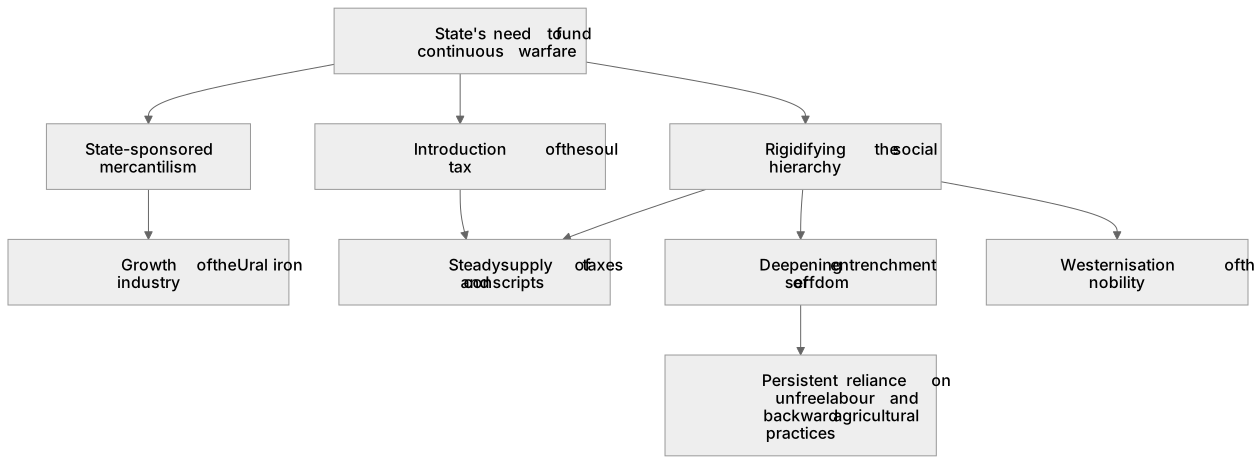
Label the diagram
Some boxes have lost their names. Pick the right name for each number.
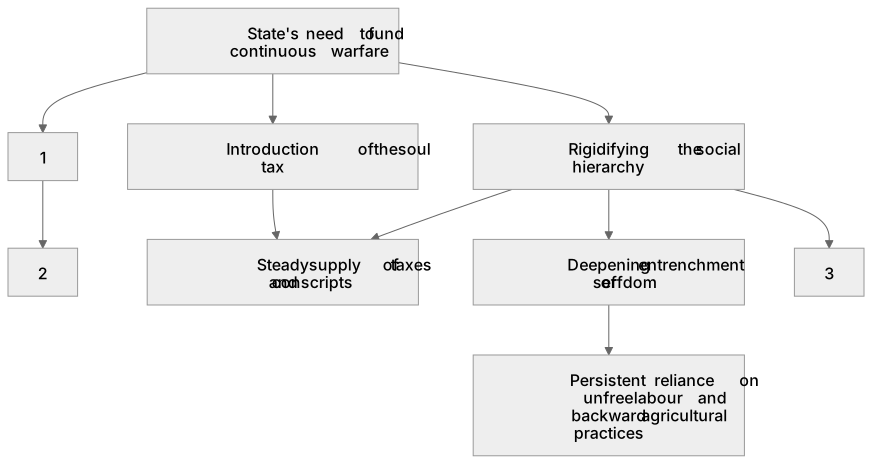
1Box 1
2Box 2
3Box 3
There is more to this lesson
The full lesson goes on to check your understanding and help you earn the marks. Create a free account to carry on, with your progress saved.
A week of Premium from your first lesson · Then the free plan continues · No card, no charge
Test your understanding of 1E Russia in the Age of Absolutism and Enlightenment, 1682–1796 (A-level only) – consequence in this period through the following key questions:: How and why did Russian society and the economy develop?
Active recall beats re-reading. Take an instant quiz now to test what you’ve learned and lock it into long-term memory.
A week of Premium from your first lesson · Then the free plan continues · No card, no charge