AQA · A-Level · History
Course version: 7042 · Version from Sept 2017
How important were ideology and ideas?
Full specification wording
1E Russia in the Age of Absolutism and Enlightenment, 1682–1796 (A-level only) – consequence in this period through the following key questions:: How important were ideology and ideas?
The importance of ideology and ideas in Russia between 1682 and 1796 centres on the tension between autocratic absolutism and the influx of Western Enlightenment thought.
Checked against the AQA 7042 specification (opens in a new tab) on .
- Point 3 of 6
Study notes
From the checked teaching notes for this specification point.
The idea
The importance of ideology and ideas in Russia between 1682 and 1796 centres on the tension between autocratic absolutism and the influx of Western Enlightenment thought. For example, Peter the Great’s ideology of Westernisation fundamentally reshaped the military and cultural elite, yet his core objective remained the practical consolidation of absolute power. Similarly, Catherine the Great’s engagement with Enlightenment ideas, famously articulated in her Nakaz (Instruction), suggested a shift towards rational, enlightened absolutism. However, the reality of her reign, particularly the expansion of serfdom and the brutal suppression of the Pugachev Rebellion, reveals that the ideology of autocracy and the need for noble support ultimately superseded progressive ideas.
What earns the marks
- Assess the influence of Westernisation as an ideology under Peter the Great, particularly its impact on the nobility and state administration.
- Evaluate the extent to which Enlightenment ideas shaped Catherine the Great's early policies, such as the Legislative Commission and the Nakaz.
- Contrast the rhetoric of enlightened absolutism with the practical realities of governance, including the entrenchment of serfdom.
- Analyse the enduring importance of the ideology of autocracy and Divine Right in maintaining the Romanov dynasty's absolute control.
Common mistakes and how to put them right
Treating the Enlightenment in Russia as a movement that affected the whole population.
Put it right: Specify that Enlightenment ideas were largely confined to the nobility and the imperial court.
Assuming Catherine the Great's Nakaz led to immediate, sweeping legal reforms.
Put it right: Acknowledge that while the Nakaz was ideologically significant, the Legislative Commission was dissolved without producing a new law code.
Viewing Peter the Great's Westernisation solely as a cultural ideology.
Put it right: Explain that Peter's Western ideas were heavily driven by pragmatic military and economic necessities.
Exam tips
- Always contrast the theoretical ideas of the rulers with the practical implementation of their policies to evaluate true importance.
- Use specific examples of Enlightenment thinkers, such as Voltaire or Montesquieu, when discussing Catherine the Great's ideological influences.
- Weigh the importance of new ideas against the traditional ideology of Russian autocracy and the Orthodox Church.
Try the lesson
The start of the 1E Russia in the Age of Absolutism and Enlightenment, 1682–1796 (A-level only) – consequence in this period through the following key questions:: How important were ideology and ideas? lesson, made from checked teaching notes for this specification point.
Have a go first
Which document, drafted by Catherine the Great in 1767, most clearly demonstrated her initial engagement with Enlightenment ideas regarding law and society?
Listen
The importance of ideology and ideas in Russia between 1682 and 1796 centres on the tension between autocratic absolutism and the influx of Western Enlightenment thought. For example, Peter the Great’s ideology of Westernisation fundamentally reshaped the military and cultural elite, yet his core objective remained the practical consolidation of absolute power. Similarly, Catherine the Great’s engagement with Enlightenment ideas, famously articulated in her Nakaz (Instruction), suggested a shift towards rational, enlightened absolutism. However, the reality of her reign, particularly the expansion of serfdom and the brutal suppression of the Pugachev Rebellion, reveals that the ideology of autocracy and the need for noble support ultimately superseded progressive ideas. A strong answer earns marks for these points. Assess the influence of Westernisation as an ideology under Peter the Great, particularly its impact on the nobility and state administration. Evaluate the extent to which Enlightenment ideas shaped Catherine the Great's early policies, such as the Legislative Commission and the Nakaz. Contrast the rhetoric of enlightened absolutism with the practical realities of governance, including the entrenchment of serfdom. Analyse the enduring importance of the ideology of autocracy and Divine Right in maintaining the Romanov dynasty's absolute control. A common slip: Treating the Enlightenment in Russia as a movement that affected the whole population. Instead, Specify that Enlightenment ideas were largely confined to the nobility and the imperial court. Exam tip: Always contrast the theoretical ideas of the rulers with the practical implementation of their policies to evaluate true importance.
See it
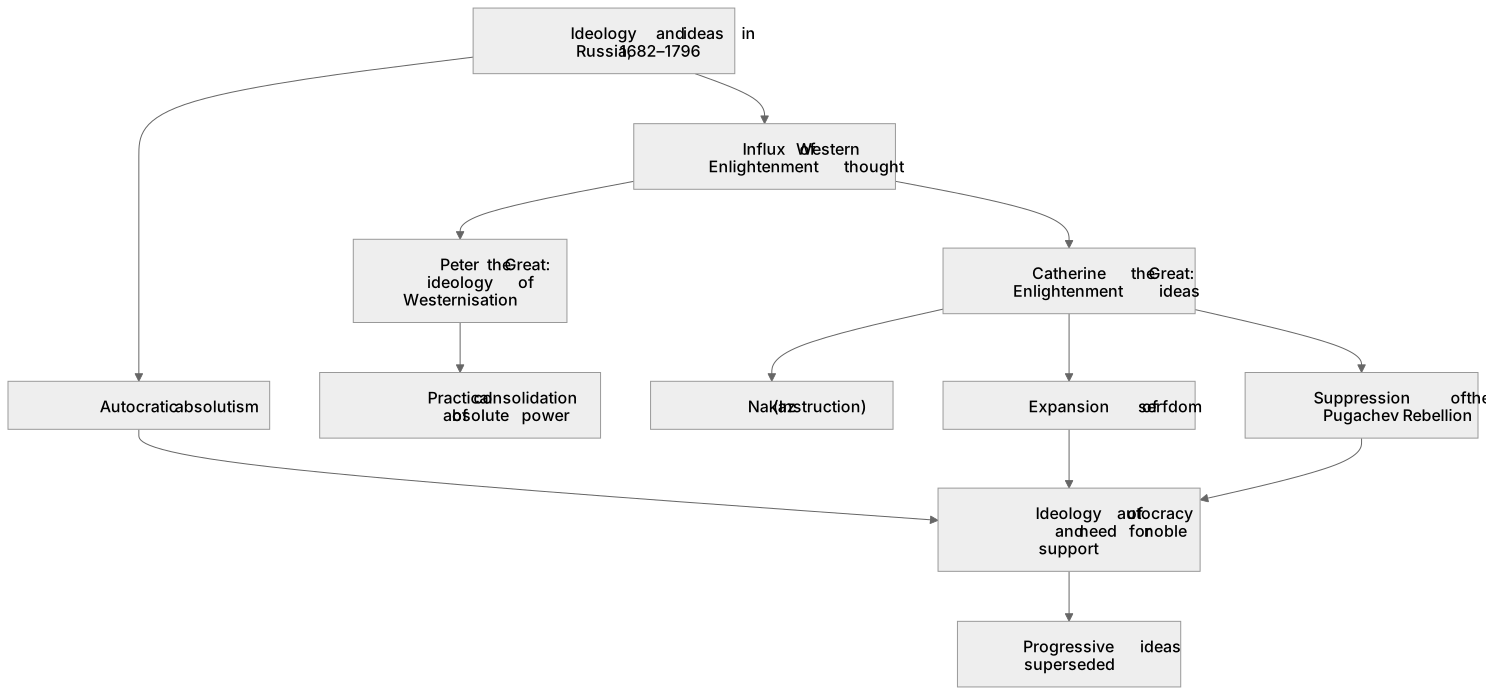
Label the diagram
Some boxes have lost their names. Pick the right name for each number.
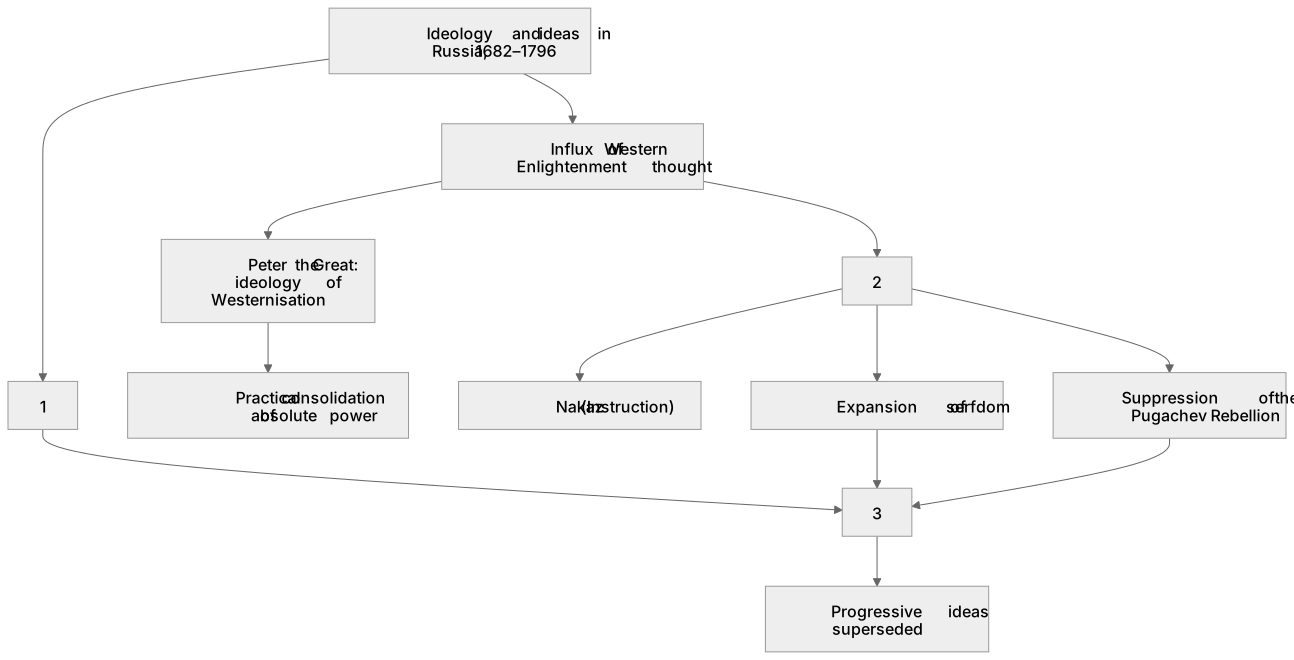
1Box 1
2Box 2
3Box 3
There is more to this lesson
The full lesson goes on to check your understanding and help you earn the marks. Create a free account to carry on, with your progress saved.
A week of Premium from your first lesson · Then the free plan continues · No card, no charge
Test your understanding of 1E Russia in the Age of Absolutism and Enlightenment, 1682–1796 (A-level only) – consequence in this period through the following key questions:: How important were ideology and ideas?
Active recall beats re-reading. Take an instant quiz now to test what you’ve learned and lock it into long-term memory.
A week of Premium from your first lesson · Then the free plan continues · No card, no charge