AQA · A-Level · History
Course version: 7042 · Version from Sept 2017
Foreign affairs and wars: wars against Turkey and Sweden
Full specification wording
1E Russia in the Age of Absolutism and Enlightenment, 1682–1796 (A-level only) – Establishing authority, 1682–1707: Foreign affairs and wars: wars against Turkey and Sweden
Peter I's early foreign policy focused on securing warm-water ports to expand Russian trade and naval power.
Checked against the AQA 7042 specification (opens in a new tab) on .
- Point 6 of 6
Study notes
From the checked teaching notes for this specification point.
The idea
Peter I's early foreign policy focused on securing warm-water ports to expand Russian trade and naval power. Against the Ottoman Empire (Turkey), Peter launched the Azov campaigns. After an initial failure in 1695, he successfully captured Azov in 1696 using a newly built fleet, securing a foothold on the Sea of Azov. Shifting his focus to the Baltic, Peter engaged in the Great Northern War against Sweden. The disastrous defeat at Narva in 1700 exposed the weaknesses of the Russian army, prompting sweeping military reforms. By 1703, Peter had captured the Neva River delta, founding St Petersburg, and by 1704 he had taken Dorpat and Narva, establishing a crucial Baltic presence despite ongoing Swedish resistance.
What earns the marks
- Assess the strategic importance of the Azov campaigns (1695–1696) in Peter's ambition to secure a southern naval presence against Turkey.
- Explain how the failure of the first Azov campaign led directly to the creation of the Russian navy at Voronezh.
- Analyse the impact of the Russian defeat at the Battle of Narva (1700) as a catalyst for comprehensive military and administrative reforms.
- Evaluate the significance of Peter's early successes against Sweden, including the foundation of St Petersburg in 1703, in establishing a Baltic foothold.
Common mistakes and how to put them right
Stating that Peter secured access to the Black Sea after the Azov campaigns.
Put it right: Specify that Peter only secured access to the Sea of Azov; the Kerch Strait and the Black Sea remained under Ottoman control.
Assuming the Great Northern War ended during this period (1682-1707).
Put it right: Note that the war continued until 1721, and this period only covers the initial phases, including Narva and the founding of St Petersburg.
Viewing the defeat at Narva solely as a disaster.
Put it right: Explain that while a tactical defeat, Narva was a strategic turning point that forced Peter to modernise his army.
Exam tips
- Contrast Peter's military capabilities in 1695 with his improved forces in 1696 to demonstrate his capacity to learn from failure.
- Link foreign policy directly to domestic reforms; explain how the demands of the Swedish war necessitated changes in taxation and conscription.
- Use the foundation of St Petersburg as a concrete example of Peter's strategic shift from the south (Turkey) to the north (Sweden).
Try the lesson
The start of the 1E Russia in the Age of Absolutism and Enlightenment, 1682–1796 (A-level only) – Establishing authority, 1682–1707: Foreign affairs and wars: wars against Turkey and Sweden lesson, made from checked teaching notes for this specification point.
Have a go first
What was the primary strategic objective of Peter the Great's Azov campaigns against the Ottoman Empire in 1695 and 1696?
Listen
Peter I's early foreign policy focused on securing warm-water ports to expand Russian trade and naval power. Against the Ottoman Empire (Turkey), Peter launched the Azov campaigns. After an initial failure in 1695, he successfully captured Azov in 1696 using a newly built fleet, securing a foothold on the Sea of Azov. Shifting his focus to the Baltic, Peter engaged in the Great Northern War against Sweden. The disastrous defeat at Narva in 1700 exposed the weaknesses of the Russian army, prompting sweeping military reforms. By 1703, Peter had captured the Neva River delta, founding St Petersburg, and by 1704 he had taken Dorpat and Narva, establishing a crucial Baltic presence despite ongoing Swedish resistance. A strong answer earns marks for these points. Assess the strategic importance of the Azov campaigns (1695–1696) in Peter's ambition to secure a southern naval presence against Turkey. Explain how the failure of the first Azov campaign led directly to the creation of the Russian navy at Voronezh. Analyse the impact of the Russian defeat at the Battle of Narva (1700) as a catalyst for comprehensive military and administrative reforms. Evaluate the significance of Peter's early successes against Sweden, including the foundation of St Petersburg in 1703, in establishing a Baltic foothold. A common slip: Stating that Peter secured access to the Black Sea after the Azov campaigns. Instead, Specify that Peter only secured access to the Sea of Azov; the Kerch Strait and the Black Sea remained under Ottoman control. Exam tip: Contrast Peter's military capabilities in 1695 with his improved forces in 1696 to demonstrate his capacity to learn from failure.
See it
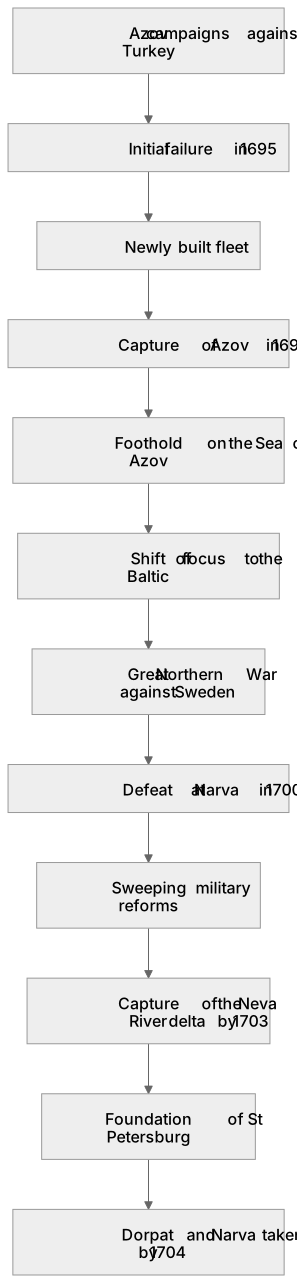
Put the events in order
Put these events in the order they happened, earliest first.
- 1. Peter captured Azov using a newly built fleet
- 2. Peter launched the first Azov campaign against Turkey
- 3. Peter took Dorpat and Narva
- 4. Disastrous Russian defeat at the Battle of Narva
- 5. Peter captured the Neva River delta and founded St Petersburg
Label the diagram
Some boxes have lost their names. Pick the right name for each number.
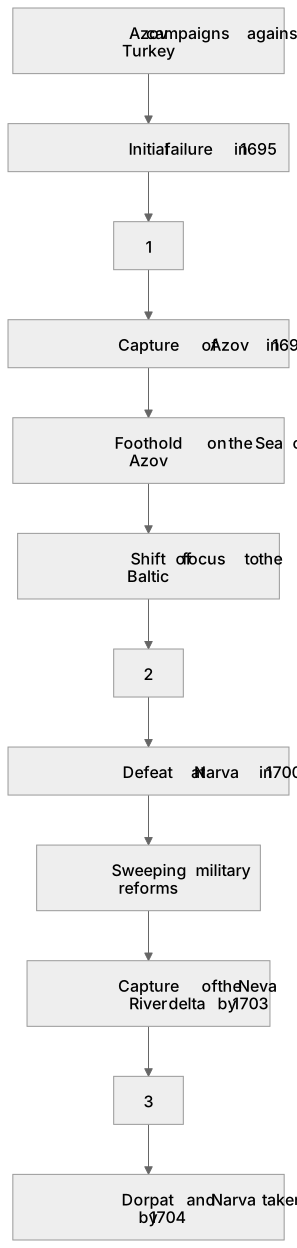
1Box 1
2Box 2
3Box 3
There is more to this lesson
The full lesson goes on to check your understanding and help you earn the marks. Create a free account to carry on, with your progress saved.
A week of Premium from your first lesson · Then the free plan continues · No card, no charge
Test your understanding of 1E Russia in the Age of Absolutism and Enlightenment, 1682–1796 (A-level only) – Establishing authority, 1682–1707: Foreign affairs and wars: wars against Turkey and Sweden
Active recall beats re-reading. Take an instant quiz now to test what you’ve learned and lock it into long-term memory.
A week of Premium from your first lesson · Then the free plan continues · No card, no charge