AQA · A-Level · History
Course version: 7042 · Version from Sept 2017
Opposition: the Church; the Streltsy
Full specification wording
1E Russia in the Age of Absolutism and Enlightenment, 1682–1796 (A-level only) – Establishing authority, 1682–1707: Opposition: the Church; the Streltsy
Peter I faced significant resistance to his modernising reforms from traditional institutions.
Checked against the AQA 7042 specification (opens in a new tab) on .
- Point 5 of 6
- 4 key terms
Study notes
From the checked teaching notes for this specification point.
The idea
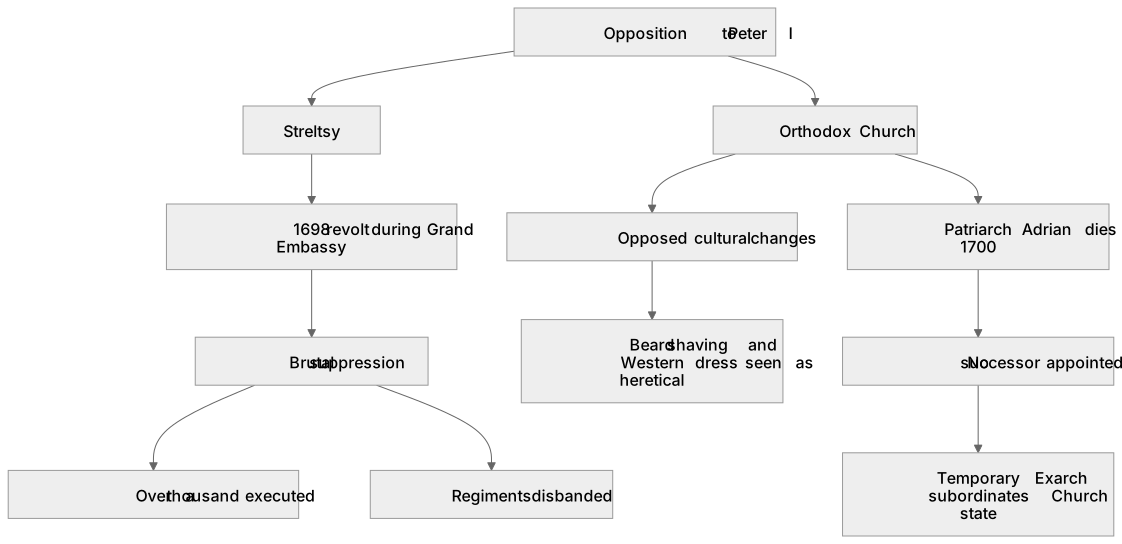
Peter I faced significant resistance to his modernising reforms from traditional institutions. The Streltsy, elite musketeer guards, rebelled multiple times, most notably in 1698 while Peter was on his Grand Embassy. Peter brutally suppressed this revolt, executing over a thousand guards and disbanding the regiments to eliminate their political threat. The Orthodox Church opposed his cultural changes, such as the shaving of beards and Western dress, viewing them as heretical. When Patriarch Adrian died in 1700, Peter refused to appoint a successor, instead appointing a temporary Exarch to subordinate the Church to the state, neutralising its ability to oppose his autocratic rule.
What earns the marks
- Explain the causes of the 1698 Streltsy revolt, including grievances over pay, conditions, and opposition to foreign officers.
- Detail Peter's ruthless suppression of the Streltsy, including mass executions and the permanent disbandment of the regiments.
- Analyse the ideological opposition of the Orthodox Church to Peter's Westernisation policies, such as the beard tax and calendar changes.
- Evaluate Peter's structural response to Church opposition, specifically his refusal to replace Patriarch Adrian in 1700 to weaken clerical independence.
Common mistakes and how to put them right
Confusing the 1682 Streltsy uprising with the 1698 revolt.
Put it right: Clearly distinguish the 1698 revolt as the catalyst for Peter's final destruction of the Streltsy as a military and political force.
Claiming Peter abolished the Orthodox Church.
Put it right: State that Peter subordinated the Church to the state, initially by leaving the Patriarchate vacant in 1700, rather than abolishing the religion itself.
Treating the Streltsy and the Church as a unified, coordinated opposition movement.
Put it right: Analyse them as distinct traditionalist factions that shared a dislike of Westernisation but operated independently.
Exam tips
- Link Peter's suppression of the Streltsy directly to his broader goal of establishing absolute, unchallenged autocratic authority.
- Use specific examples of cultural reforms, such as the beard tax, to illustrate exactly what the Church found objectionable.
- When evaluating opposition, consider how Peter's absence during the Grand Embassy created a power vacuum that the Streltsy attempted to exploit.
Try the lesson
The start of the 1E Russia in the Age of Absolutism and Enlightenment, 1682–1796 (A-level only) – Establishing authority, 1682–1707: Opposition: the Church; the Streltsy lesson, made from checked teaching notes for this specification point.
Have a go first
What was a primary motivation for the Streltsy uprising in 1698 during Peter the Great's absence on the Grand Embassy?
Listen
Peter I faced significant resistance to his modernising reforms from traditional institutions. The Streltsy, elite musketeer guards, rebelled multiple times, most notably in 1698 while Peter was on his Grand Embassy. Peter brutally suppressed this revolt, executing over a thousand guards and disbanding the regiments to eliminate their political threat. The Orthodox Church opposed his cultural changes, such as the shaving of beards and Western dress, viewing them as heretical. When Patriarch Adrian died in 1700, Peter refused to appoint a successor, instead appointing a temporary Exarch to subordinate the Church to the state, neutralising its ability to oppose his autocratic rule. A strong answer earns marks for these points. Explain the causes of the 1698 Streltsy revolt, including grievances over pay, conditions, and opposition to foreign officers. Detail Peter's ruthless suppression of the Streltsy, including mass executions and the permanent disbandment of the regiments. Analyse the ideological opposition of the Orthodox Church to Peter's Westernisation policies, such as the beard tax and calendar changes. Evaluate Peter's structural response to Church opposition, specifically his refusal to replace Patriarch Adrian in 1700 to weaken clerical independence. A common slip: Confusing the 1682 Streltsy uprising with the 1698 revolt. Instead, Clearly distinguish the 1698 revolt as the catalyst for Peter's final destruction of the Streltsy as a military and political force. Exam tip: Link Peter's suppression of the Streltsy directly to his broader goal of establishing absolute, unchallenged autocratic authority.
See it
Key words
Say what each word means before you turn the card.
Autocracy
Try answering aloud or in your head before turning the card.
Westernisation
Try answering aloud or in your head before turning the card.
Traditionalism
Try answering aloud or in your head before turning the card.
Streltsy
Try answering aloud or in your head before turning the card.
See every definition
- Autocracy
- The form of unchallenged rule that Peter sought to establish by suppressing the Streltsy and subordinating the Church to the state.
- Westernisation
- The cultural changes promoted by Peter, such as the shaving of beards and Western dress, which the Orthodox Church viewed as heretical.
- Traditionalism
- The outlook of distinct factions such as the Streltsy and the Church, which shared a dislike of Westernisation but operated independently.
- Streltsy
- Elite musketeer guards who rebelled multiple times, most notably in 1698, and were brutally suppressed and disbanded by Peter.
Label the diagram
Some boxes have lost their names. Pick the right name for each number.
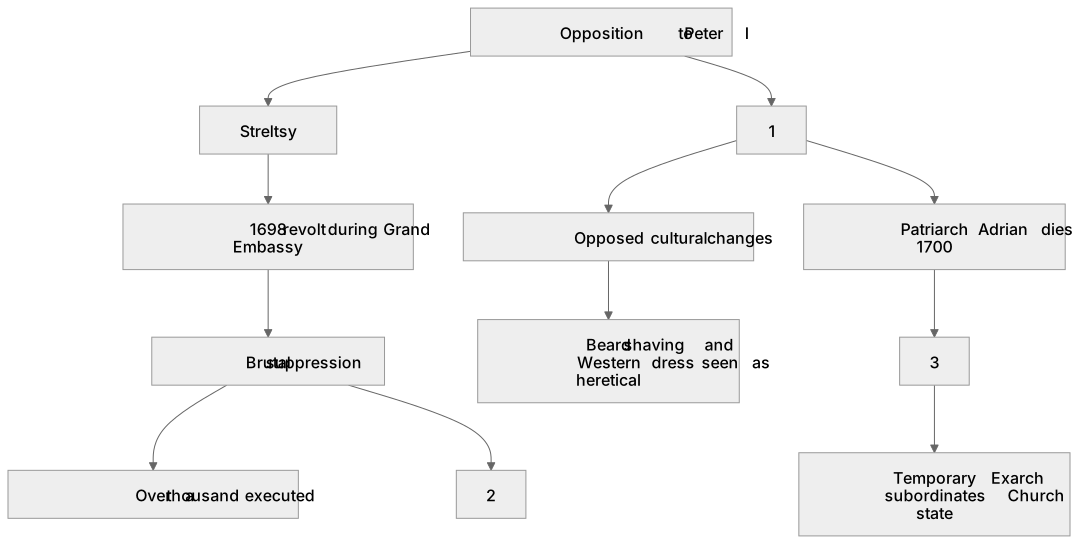
1Box 1
2Box 2
3Box 3
There is more to this lesson
The full lesson goes on to check your understanding and help you earn the marks. Create a free account to carry on, with your progress saved.
A week of Premium from your first lesson · Then the free plan continues · No card, no charge
Test your understanding of 1E Russia in the Age of Absolutism and Enlightenment, 1682–1796 (A-level only) – Establishing authority, 1682–1707: Opposition: the Church; the Streltsy
Active recall beats re-reading. Take an instant quiz now to test what you’ve learned and lock it into long-term memory.
A week of Premium from your first lesson · Then the free plan continues · No card, no charge