AQA · A-Level · History
Course version: 7042 · Version from Sept 2017
The Regency; the role of the Streltsy; Peter as joint ruler and the…
Full specification wording
1E Russia in the Age of Absolutism and Enlightenment, 1682–1796 (A-level only) – Establishing authority, 1682–1707: The Regency; the role of the Streltsy; Peter as joint ruler and the establishment of sole rule
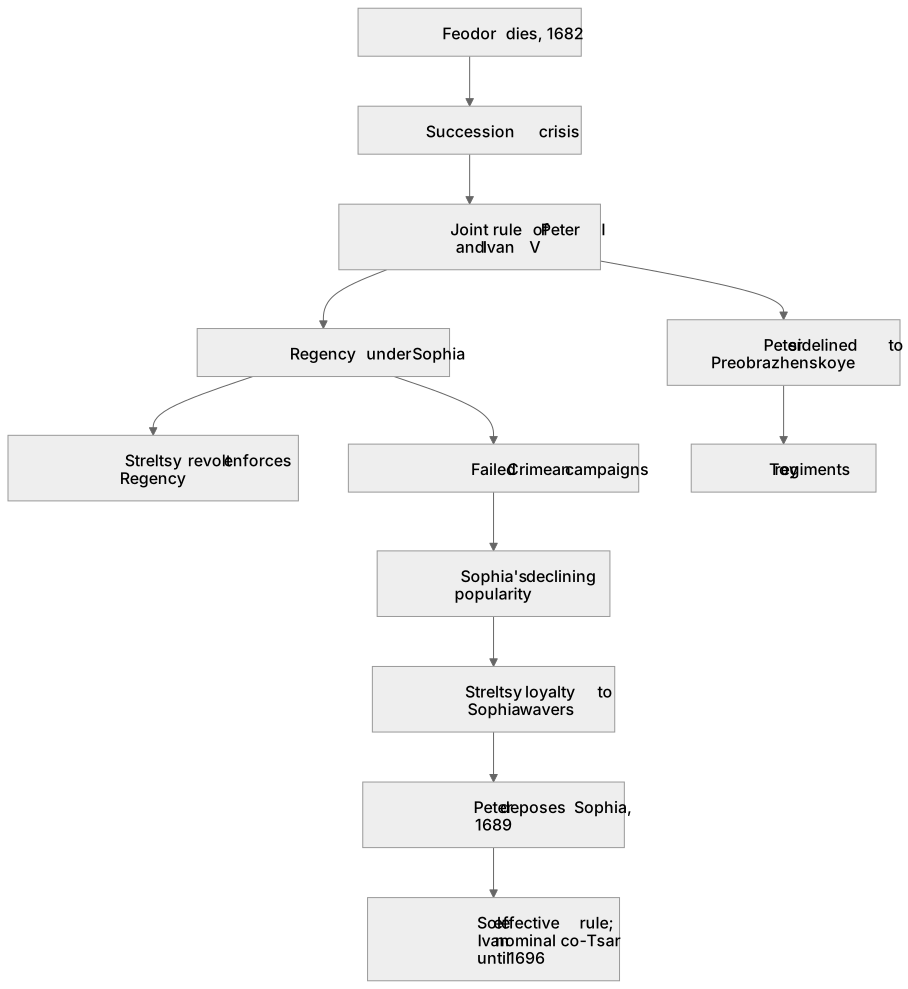
Following Tsar Feodor's death in 1682, a succession crisis led to the joint rule of young Peter I and his half-brother Ivan V. A Regency was established under their ambitious half-sister, Sophia.
Checked against the AQA 7042 specification (opens in a new tab) on .
- Point 2 of 6
- 4 key terms
Study notes
From the checked teaching notes for this specification point.
The idea
Following Tsar Feodor's death in 1682, a succession crisis led to the joint rule of young Peter I and his half-brother Ivan V. A Regency was established under their ambitious half-sister, Sophia. She secured power by manipulating the Streltsy, Russia's elite but volatile musketeer guard, who staged a bloody revolt to enforce her Regency. During his joint rule, Peter was sidelined to Preobrazhenskoye, where he formed his own 'toy regiments'. By 1689, Peter capitalised on Sophia's declining popularity following failed Crimean campaigns. When the Streltsy's loyalty to Sophia wavered, Peter successfully deposed her, establishing his sole effective rule, though Ivan remained nominal co-Tsar until his death in 1696.
What earns the marks
- Explain the circumstances that led to the dual monarchy of Peter I and Ivan V and the necessity of Sophia's Regency.
- Analyse the political and military role of the Streltsy, specifically their involvement in the 1682 uprising and their influence as kingmakers.
- Detail Peter's activities during his period as joint ruler, including his military exercises at Preobrazhenskoye which prepared him for future leadership.
- Evaluate the events of 1689 that enabled Peter to overthrow Sophia's Regency and establish his sole effective authority over the Russian state.
Common mistakes and how to put them right
Stating that Peter became the sole Tsar immediately in 1689.
Put it right: Clarify that while Peter achieved sole effective political power in 1689 by deposing Sophia, Ivan V remained joint Tsar in name until his death in 1696.
Describing the Streltsy merely as a modern, disciplined army.
Put it right: Identify the Streltsy as a traditional, privileged, and highly politicised military force that often acted in its own self-interest rather than strictly following state orders.
Assuming Peter's time as joint ruler was spent entirely at court.
Put it right: Emphasise that Peter was largely exiled from the Kremlin to the royal estate of Preobrazhenskoye, which allowed him to develop independent military and Western interests.
Exam tips
- Use the 1682 Streltsy uprising as a key example of the fragility of autocratic power during succession crises.
- When discussing the establishment of sole rule, contrast Sophia's diplomatic and military failures (like the Crimean campaigns) with Peter's growing military support.
- Highlight the factional rivalry between the Miloslavsky (Ivan's family) and Naryshkin (Peter's family) clans to explain the political instability of the Regency.
Try the lesson
The start of the 1E Russia in the Age of Absolutism and Enlightenment, 1682–1796 (A-level only) – Establishing authority, 1682–1707: The Regency; the role of the Streltsy; Peter as joint ruler and the establishment of sole rule lesson, made from checked teaching notes for this specification point.
Have a go first
What was the primary role of the Streltsy during the political crisis of 1682?
Listen
Following Tsar Feodor's death in 1682, a succession crisis led to the joint rule of young Peter I and his half-brother Ivan V. A Regency was established under their ambitious half-sister, Sophia. She secured power by manipulating the Streltsy, Russia's elite but volatile musketeer guard, who staged a bloody revolt to enforce her Regency. During his joint rule, Peter was sidelined to Preobrazhenskoye, where he formed his own 'toy regiments'. By 1689, Peter capitalised on Sophia's declining popularity following failed Crimean campaigns. When the Streltsy's loyalty to Sophia wavered, Peter successfully deposed her, establishing his sole effective rule, though Ivan remained nominal co-Tsar until his death in 1696. A strong answer earns marks for these points. Explain the circumstances that led to the dual monarchy of Peter I and Ivan V and the necessity of Sophia's Regency. Analyse the political and military role of the Streltsy, specifically their involvement in the 1682 uprising and their influence as kingmakers. Detail Peter's activities during his period as joint ruler, including his military exercises at Preobrazhenskoye which prepared him for future leadership. Evaluate the events of 1689 that enabled Peter to overthrow Sophia's Regency and establish his sole effective authority over the Russian state. A common slip: Stating that Peter became the sole Tsar immediately in 1689. Instead, Clarify that while Peter achieved sole effective political power in 1689 by deposing Sophia, Ivan V remained joint Tsar in name until his death in 1696. Exam tip: Use the 1682 Streltsy uprising as a key example of the fragility of autocratic power during succession crises.
See it
Put the events in order
Put these events in the order they happened, earliest first.
- 1. Succession crisis and Streltsy revolt enforcing Sophia's Regency
- 2. Ivan remained nominal co-Tsar until his death
- 3. Peter capitalised on Sophia's declining popularity and deposed her
Key words
Say what each word means before you turn the card.
Regency
Try answering aloud or in your head before turning the card.
Streltsy
Try answering aloud or in your head before turning the card.
joint rule
Try answering aloud or in your head before turning the card.
sole effective rule
Try answering aloud or in your head before turning the card.
See every definition
- Regency
- A period of rule established under Sophia after the succession crisis of 1682, during the joint rule of Peter I and Ivan V.
- Streltsy
- Russia's elite but volatile musketeer guard, who staged a bloody revolt to enforce Sophia's Regency and later wavered in loyalty.
- joint rule
- The arrangement in which young Peter I and his half-brother Ivan V ruled together following the succession crisis of 1682.
- sole effective rule
- Peter's position after deposing Sophia in 1689, though Ivan remained nominal co-Tsar until his death in 1696.
Label the diagram
Some boxes have lost their names. Pick the right name for each number.
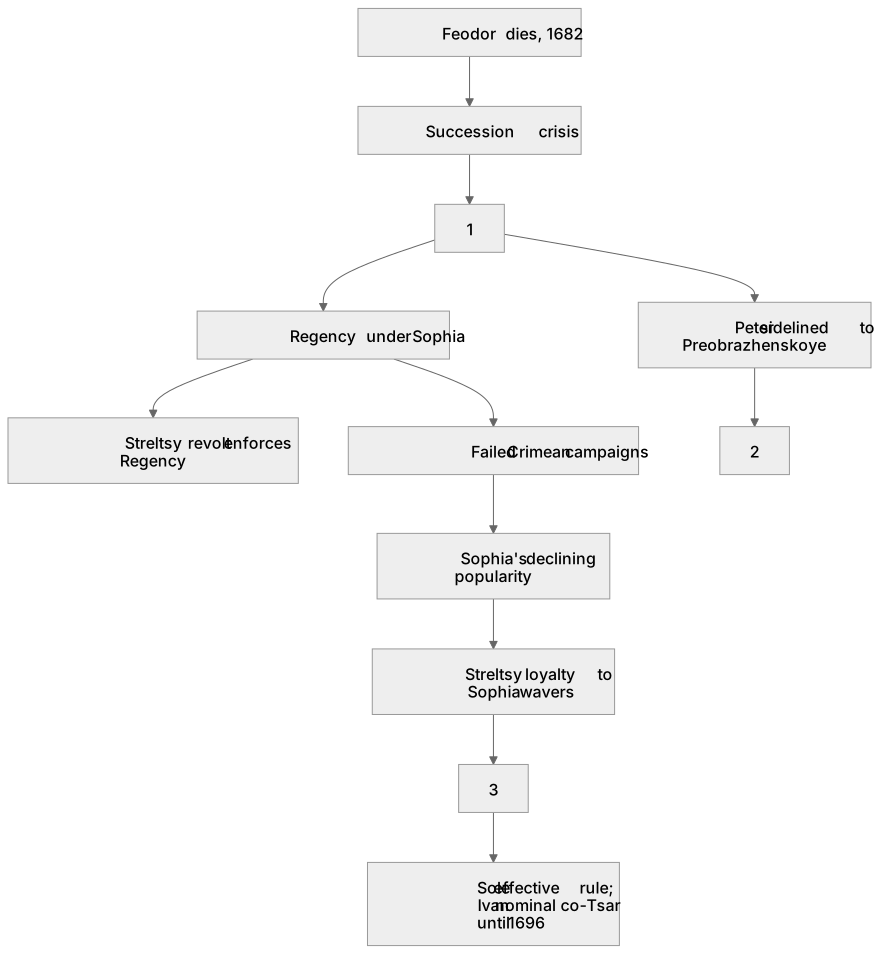
1Box 1
2Box 2
3Box 3
There is more to this lesson
The full lesson goes on to check your understanding and help you earn the marks. Create a free account to carry on, with your progress saved.
A week of Premium from your first lesson · Then the free plan continues · No card, no charge
Test your understanding of 1E Russia in the Age of Absolutism and Enlightenment, 1682–1796 (A-level only) – Establishing authority, 1682–1707: The Regency; the role of the Streltsy; Peter as joint ruler and the establishment of sole rule
Active recall beats re-reading. Take an instant quiz now to test what you’ve learned and lock it into long-term memory.
A week of Premium from your first lesson · Then the free plan continues · No card, no charge