AQA · A-Level · History
Course version: 7042 · Version from Sept 2017
Westernisation; influences on Peter as a child; the Great Embassy; the…
Full specification wording
1E Russia in the Age of Absolutism and Enlightenment, 1682–1796 (A-level only) – Establishing authority, 1682–1707: Westernisation; influences on Peter as a child; the Great Embassy; the reasons for and significance of the development of St Petersburg
Peter the Great’s drive for Westernisation stemmed from his childhood in Moscow's German Quarter, where interactions with European expatriates sparked his fascination with Western technology and…
Checked against the AQA 7042 specification (opens in a new tab) on .
- Point 3 of 6
Study notes
From the checked teaching notes for this specification point.
The idea
Peter the Great’s drive for Westernisation stemmed from his childhood in Moscow's German Quarter, where interactions with European expatriates sparked his fascination with Western technology and shipbuilding. This culminated in the Great Embassy (1697–1698), a diplomatic mission to Europe. While failing to secure an anti-Ottoman alliance, Peter recruited foreign specialists and studied naval engineering. The foundation of St Petersburg in 1703 physically embodied this Western orientation. Built on captured Swedish land, it provided a vital Baltic port for European trade and naval expansion. Its significance lay in shifting the capital away from conservative Moscow, forcing the nobility to adopt Western architecture and culture, and cementing Peter's vision of a modernised, outward-looking Russian state.
What earns the marks
- Assess the impact of the German Quarter on Peter's early intellectual development and military interests.
- Evaluate the dual purpose of the Great Embassy: diplomatic alliance-building versus technological and cultural acquisition.
- Analyse the strategic and economic reasons for founding St Petersburg, particularly the need for a Baltic port.
- Explain the cultural significance of moving the capital to St Petersburg in breaking the power of the traditional Muscovite boyars.
Common mistakes and how to put them right
Claiming the Great Embassy was a complete success.
Put it right: Note that while it succeeded in gathering technology and personnel, it failed in its primary diplomatic goal of securing an alliance against the Ottoman Empire.
Stating St Petersburg was built on empty Russian land.
Put it right: Specify that it was built on the Neva River delta, territory recently captured from Sweden during the Great Northern War.
Assuming Westernisation was universally welcomed.
Put it right: Highlight the deep resistance from traditionalists, the Streltsy, and the Orthodox Church against foreign innovations.
Exam tips
- Link Peter's childhood experiences directly to specific policies he later implemented, such as naval expansion.
- Use the foundation of St Petersburg as a primary example of Peter forcing cultural change upon the Russian nobility.
- When evaluating Westernisation, distinguish between superficial changes like beard-shaving and structural changes like naval technology.
Try the lesson
The start of the 1E Russia in the Age of Absolutism and Enlightenment, 1682–1796 (A-level only) – Establishing authority, 1682–1707: Westernisation; influences on Peter as a child; the Great Embassy; the reasons for and significance of the development of St Petersburg lesson, made from checked teaching notes for this specification point.
Have a go first
What was a primary purpose of Peter the Great's 'Great Embassy' to Western Europe in 1697-1698?
Listen
Peter the Great’s drive for Westernisation stemmed from his childhood in Moscow's German Quarter, where interactions with European expatriates sparked his fascination with Western technology and shipbuilding. This culminated in the Great Embassy (1697–1698), a diplomatic mission to Europe. While failing to secure an anti-Ottoman alliance, Peter recruited foreign specialists and studied naval engineering. The foundation of St Petersburg in 1703 physically embodied this Western orientation. Built on captured Swedish land, it provided a vital Baltic port for European trade and naval expansion. Its significance lay in shifting the capital away from conservative Moscow, forcing the nobility to adopt Western architecture and culture, and cementing Peter's vision of a modernised, outward-looking Russian state. A strong answer earns marks for these points. Assess the impact of the German Quarter on Peter's early intellectual development and military interests. Evaluate the dual purpose of the Great Embassy: diplomatic alliance-building versus technological and cultural acquisition. Analyse the strategic and economic reasons for founding St Petersburg, particularly the need for a Baltic port. Explain the cultural significance of moving the capital to St Petersburg in breaking the power of the traditional Muscovite boyars. A common slip: Claiming the Great Embassy was a complete success. Instead, note that while it succeeded in gathering technology and personnel, it failed in its primary diplomatic goal of securing an alliance against the Ottoman Empire. Exam tip: Link Peter's childhood experiences directly to specific policies he later implemented, such as naval expansion.
See it
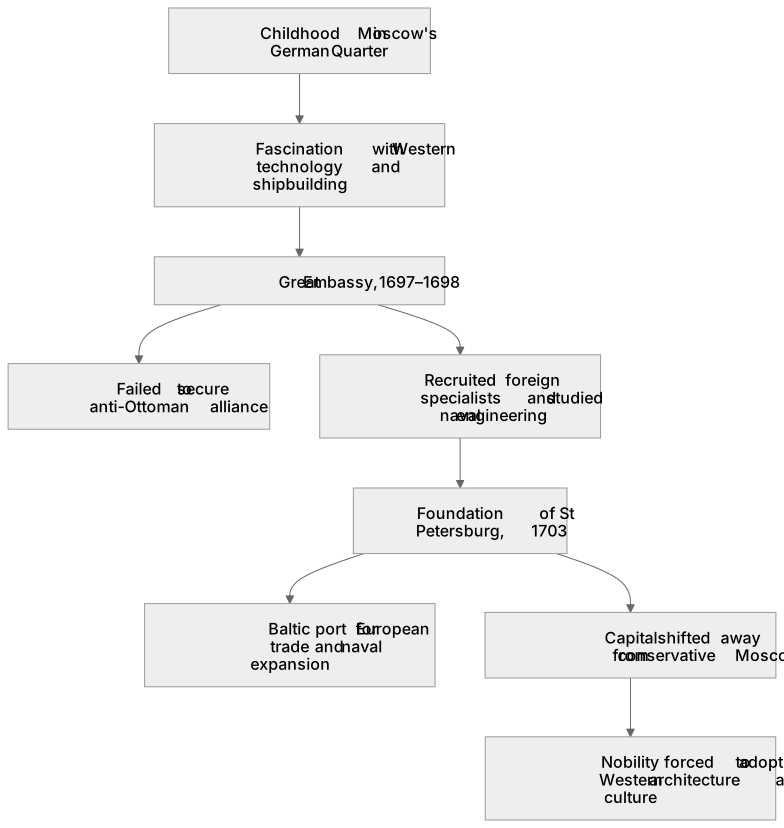
Label the diagram
Some boxes have lost their names. Pick the right name for each number.
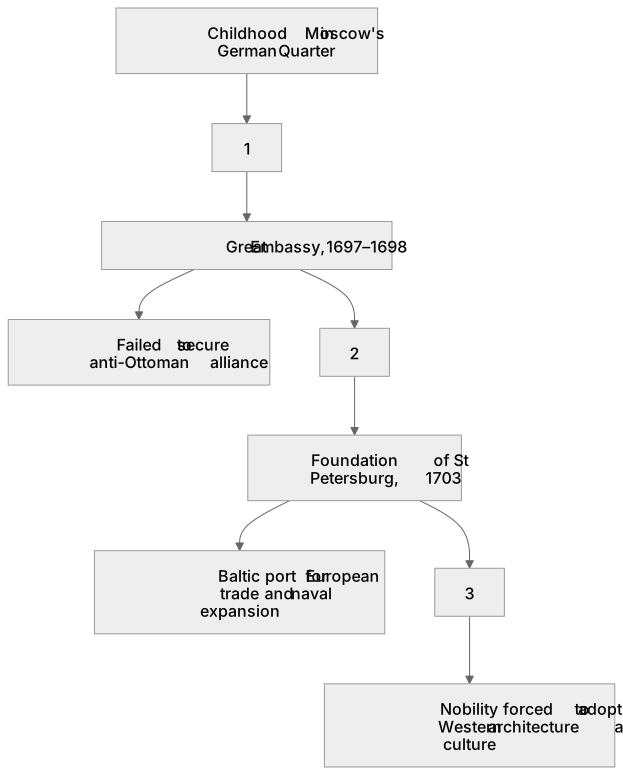
1Box 1
2Box 2
3Box 3
There is more to this lesson
The full lesson goes on to check your understanding and help you earn the marks. Create a free account to carry on, with your progress saved.
A week of Premium from your first lesson · Then the free plan continues · No card, no charge
Test your understanding of 1E Russia in the Age of Absolutism and Enlightenment, 1682–1796 (A-level only) – Establishing authority, 1682–1707: Westernisation; influences on Peter as a child; the Great Embassy; the reasons for and significance of the development of St Petersburg
Active recall beats re-reading. Take an instant quiz now to test what you’ve learned and lock it into long-term memory.
A week of Premium from your first lesson · Then the free plan continues · No card, no charge