AQA · A-Level · History
Course version: 7042 · Version from Sept 2017
Economic and financial reforms and their success
Full specification wording
1E Russia in the Age of Absolutism and Enlightenment, 1682–1796 (A-level only) – Increasing the glory of Russia, 1707–1725: Economic and financial reforms and their success
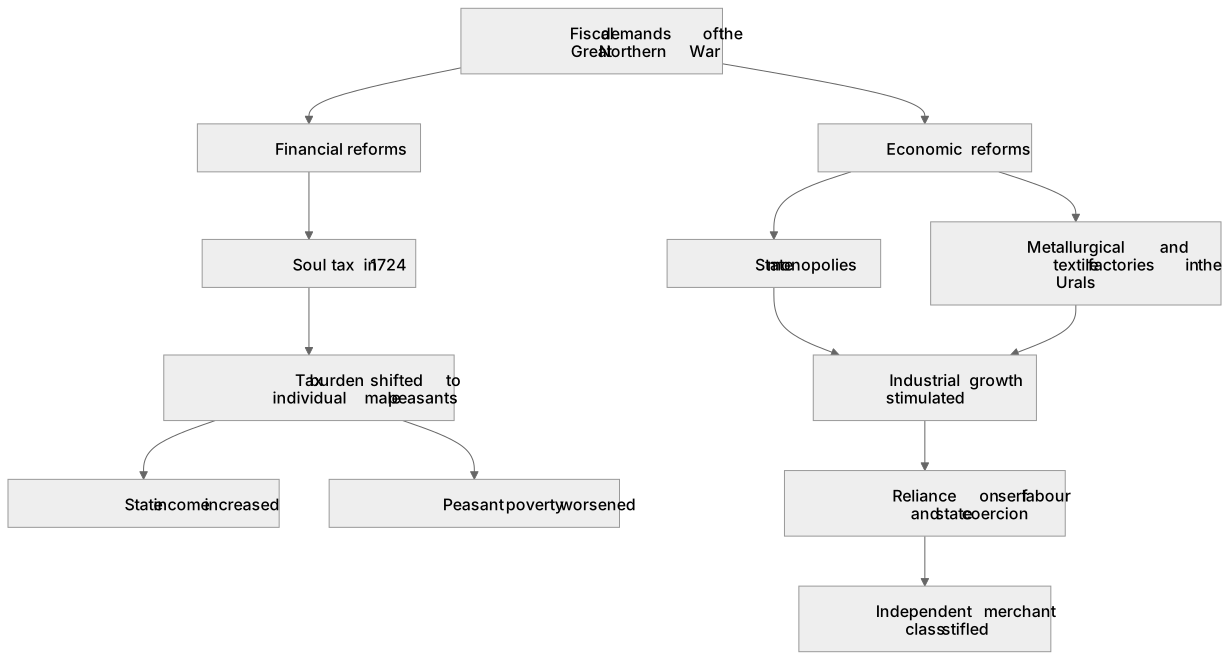
Peter the Great’s economic and financial reforms between 1707 and 1725 were driven by the immense fiscal demands of the Great Northern War.
Checked against the AQA 7042 specification (opens in a new tab) on .
- Point 1 of 6
Study notes
From the checked teaching notes for this specification point.
The idea
Peter the Great’s economic and financial reforms between 1707 and 1725 were driven by the immense fiscal demands of the Great Northern War. To maximise revenue, Peter introduced the soul tax in 1724, shifting the tax burden from households to individual male peasants. This significantly increased state income but worsened peasant poverty. Economically, he stimulated industrial growth through state monopolies and the establishment of metallurgical and textile factories in the Urals. While financially successful in funding his military campaigns and establishing a foundational industrial base, the reforms were limited by their reliance on serf labour and state coercion, which stifled the emergence of an independent merchant class.
What earns the marks
- Identify the introduction of the soul tax in 1724 and its profound impact on both state revenue and the peasantry.
- Explain the role of mercantilism in Peter's economic policies, including state monopolies and protectionist tariffs such as the 1724 Tariff.
- Evaluate the development of industry, particularly metallurgy in the Urals, to supply the military.
- Assess the overall success of these reforms, balancing the achievement of funding the war against the long-term structural weaknesses caused by reliance on serfdom.
Common mistakes and how to put them right
Confusing the soul tax with a household tax.
Put it right: Specify that the soul tax was levied on individual male peasants, replacing the older household tax to prevent tax evasion.
Claiming Peter created a modern capitalist economy.
Put it right: Emphasise that his economy was state-directed and reliant on unfree serf labour, not free-market capitalism.
Ignoring the financial aspect of the reforms.
Put it right: Ensure you explicitly discuss revenue-raising measures like the soul tax and debasement of coinage alongside industrial developments.
Exam tips
- Use the 1724 soul tax as your primary evidence when evaluating the success of Peter's financial reforms in raising state revenue.
- Link economic policies directly to military needs; Peter's industrialisation was primarily driven by the necessity of supplying the army and navy.
- When assessing success, differentiate between short-term military survival and long-term economic modernisation.
Try the lesson
The start of the 1E Russia in the Age of Absolutism and Enlightenment, 1682–1796 (A-level only) – Increasing the glory of Russia, 1707–1725: Economic and financial reforms and their success lesson, made from checked teaching notes for this specification point.
Have a go first
Which major financial reform did Peter the Great introduce in 1724 to significantly increase state revenue and fund his military campaigns?
Listen
Peter the Great’s economic and financial reforms between 1707 and 1725 were driven by the immense fiscal demands of the Great Northern War. To maximise revenue, Peter introduced the soul tax in 1724, shifting the tax burden from households to individual male peasants. This significantly increased state income but worsened peasant poverty. Economically, he stimulated industrial growth through state monopolies and the establishment of metallurgical and textile factories in the Urals. While financially successful in funding his military campaigns and establishing a foundational industrial base, the reforms were limited by their reliance on serf labour and state coercion, which stifled the emergence of an independent merchant class. A strong answer earns marks for these points. Identify the introduction of the soul tax in 1724 and its profound impact on both state revenue and the peasantry. Explain the role of mercantilism in Peter's economic policies, including state monopolies and protectionist tariffs such as the 1724 Tariff. Evaluate the development of industry, particularly metallurgy in the Urals, to supply the military. Assess the overall success of these reforms, balancing the achievement of funding the war against the long-term structural weaknesses caused by reliance on serfdom. A common slip: Confusing the soul tax with a household tax. Instead, Specify that the soul tax was levied on individual male peasants, replacing the older household tax to prevent tax evasion. Exam tip: Use the 1724 soul tax as your primary evidence when evaluating the success of Peter's financial reforms in raising state revenue.
See it
Label the diagram
Some boxes have lost their names. Pick the right name for each number.
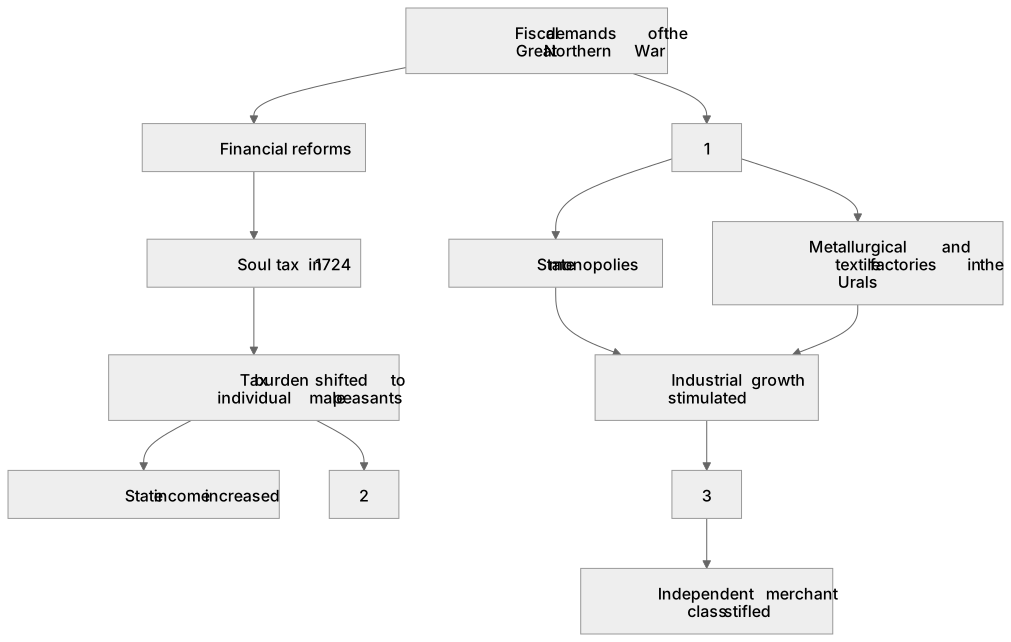
1Box 1
2Box 2
3Box 3
There is more to this lesson
The full lesson goes on to check your understanding and help you earn the marks. Create a free account to carry on, with your progress saved.
A week of Premium from your first lesson · Then the free plan continues · No card, no charge
Test your understanding of 1E Russia in the Age of Absolutism and Enlightenment, 1682–1796 (A-level only) – Increasing the glory of Russia, 1707–1725: Economic and financial reforms and their success
Active recall beats re-reading. Take an instant quiz now to test what you’ve learned and lock it into long-term memory.
A week of Premium from your first lesson · Then the free plan continues · No card, no charge