AQA · A-Level · History
Course version: 7042 · Version from Sept 2017
Orthodoxy and developments in the Church: attempts to increase the power…
Full specification wording
1E Russia in the Age of Absolutism and Enlightenment, 1682–1796 (A-level only) – Increasing the glory of Russia, 1707–1725: Orthodoxy and developments in the Church: attempts to increase the power of the Tsar
Between 1707 and 1725, Peter the Great restructured Russian Orthodoxy to eliminate the Church as a rival authority and increase the power of the Tsar.
Checked against the AQA 7042 specification (opens in a new tab) on .
- Point 2 of 6
Study notes
From the checked teaching notes for this specification point.
The idea
Between 1707 and 1725, Peter the Great restructured Russian Orthodoxy to eliminate the Church as a rival authority and increase the power of the Tsar. Having refused to replace Patriarch Adrian, Peter enacted the 1721 Spiritual Regulation, drafted by Feofan Prokopovich, which formally abolished the Patriarchate. In its place, he established the Holy Synod, a council of clerics overseen by a secular official, the Chief Procurator. This development transformed the Church into a department of the state, ensuring its vast wealth and influence served the Tsar’s autocratic ambitions. Priests were even required to report treasonous confessions, cementing the Tsar's absolute control over both the spiritual and secular realms in Russia.
What earns the marks
- Explain the significance of the 1721 Spiritual Regulation in abolishing the independent Patriarchate.
- Analyse the structure and function of the Holy Synod, highlighting the role of the secular Chief Procurator.
- Evaluate how the subordination of the Church increased the Tsar's autocratic power and financial resources.
- Discuss the ideological justification for these changes, such as Feofan Prokopovich's arguments for the divine right of the Tsar over the Church.
Common mistakes and how to put them right
Stating that Peter abolished the Orthodox Church.
Put it right: Clarify that Peter abolished the Patriarchate, not the Church itself, which he instead subordinated to the state.
Confusing the Holy Synod with a secular government department like the Senate.
Put it right: Specify that the Holy Synod was a council of clerics, but it was supervised by a secular Chief Procurator appointed by the Tsar.
Ignoring the financial motives behind Church reform.
Put it right: Mention that controlling the Church allowed Peter to access monastic revenues to fund his wars and state-building.
Exam tips
- Use the establishment of the Holy Synod in 1721 as the definitive turning point in the relationship between the Tsar and the Orthodox Church.
- Connect Church reforms to Peter's broader goal of absolutism; controlling the Church removed the last institutional check on his power.
- Reference the requirement for priests to break the seal of confession for treason as a powerful example of the Church becoming an instrument of state control.
Try the lesson
The start of the 1E Russia in the Age of Absolutism and Enlightenment, 1682–1796 (A-level only) – Increasing the glory of Russia, 1707–1725: Orthodoxy and developments in the Church: attempts to increase the power of the Tsar lesson, made from checked teaching notes for this specification point.
Have a go first
Which institution did Peter the Great establish in 1721 to replace the Patriarchate and bring the Russian Orthodox Church under direct state control?
Listen
Between 1707 and 1725, Peter the Great restructured Russian Orthodoxy to eliminate the Church as a rival authority and increase the power of the Tsar. Having refused to replace Patriarch Adrian, Peter enacted the 1721 Spiritual Regulation, drafted by Feofan Prokopovich, which formally abolished the Patriarchate. In its place, he established the Holy Synod, a council of clerics overseen by a secular official, the Chief Procurator. This development transformed the Church into a department of the state, ensuring its vast wealth and influence served the Tsar’s autocratic ambitions. Priests were even required to report treasonous confessions, cementing the Tsar's absolute control over both the spiritual and secular realms in Russia. A strong answer earns marks for these points. Explain the significance of the 1721 Spiritual Regulation in abolishing the independent Patriarchate. Analyse the structure and function of the Holy Synod, highlighting the role of the secular Chief Procurator. Evaluate how the subordination of the Church increased the Tsar's autocratic power and financial resources. Discuss the ideological justification for these changes, such as Feofan Prokopovich's arguments for the divine right of the Tsar over the Church. A common slip: Stating that Peter abolished the Orthodox Church. Instead, Clarify that Peter abolished the Patriarchate, not the Church itself, which he instead subordinated to the state. Exam tip: Use the establishment of the Holy Synod in 1721 as the definitive turning point in the relationship between the Tsar and the Orthodox Church.
See it
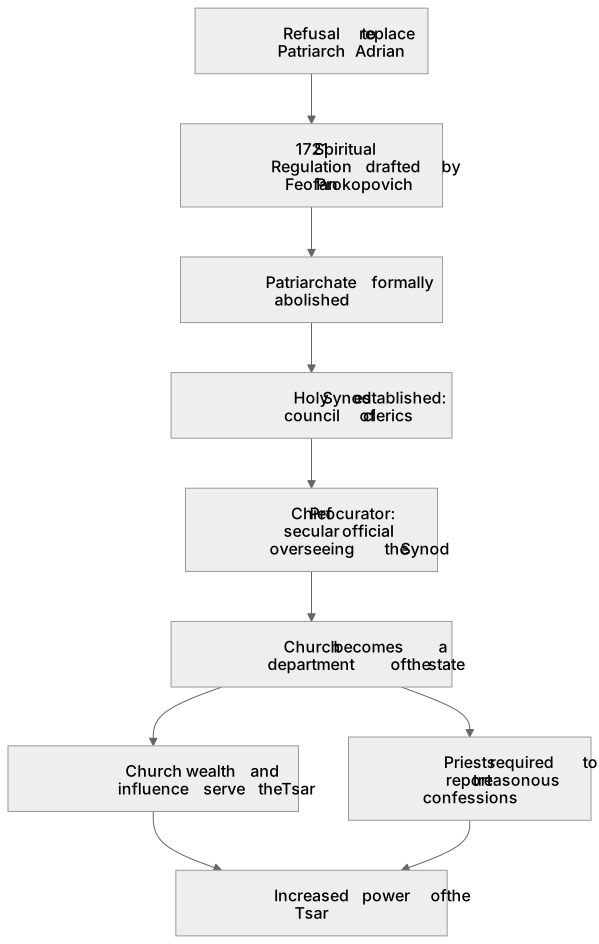
Label the diagram
Some boxes have lost their names. Pick the right name for each number.
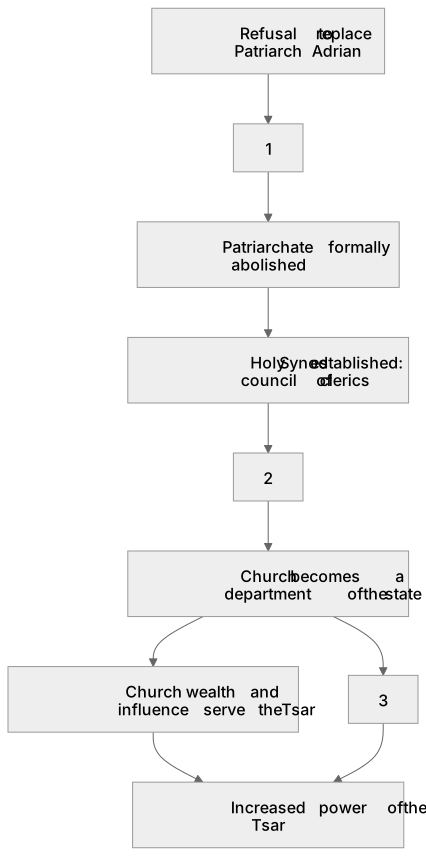
1Box 1
2Box 2
3Box 3
There is more to this lesson
The full lesson goes on to check your understanding and help you earn the marks. Create a free account to carry on, with your progress saved.
A week of Premium from your first lesson · Then the free plan continues · No card, no charge
Test your understanding of 1E Russia in the Age of Absolutism and Enlightenment, 1682–1796 (A-level only) – Increasing the glory of Russia, 1707–1725: Orthodoxy and developments in the Church: attempts to increase the power of the Tsar
Active recall beats re-reading. Take an instant quiz now to test what you’ve learned and lock it into long-term memory.
A week of Premium from your first lesson · Then the free plan continues · No card, no charge