AQA · A-Level · History
Course version: 7042 · Version from Sept 2017
Social developments, Westernisation and extent of change by 1725
Full specification wording
1E Russia in the Age of Absolutism and Enlightenment, 1682–1796 (A-level only) – Increasing the glory of Russia, 1707–1725: Social developments, Westernisation and extent of change by 1725
Peter the Great's drive for Westernisation profoundly impacted Russian society, though the extent of change by 1725 remained uneven.
Checked against the AQA 7042 specification (opens in a new tab) on .
- Point 4 of 6
Study notes
From the checked teaching notes for this specification point.
The idea
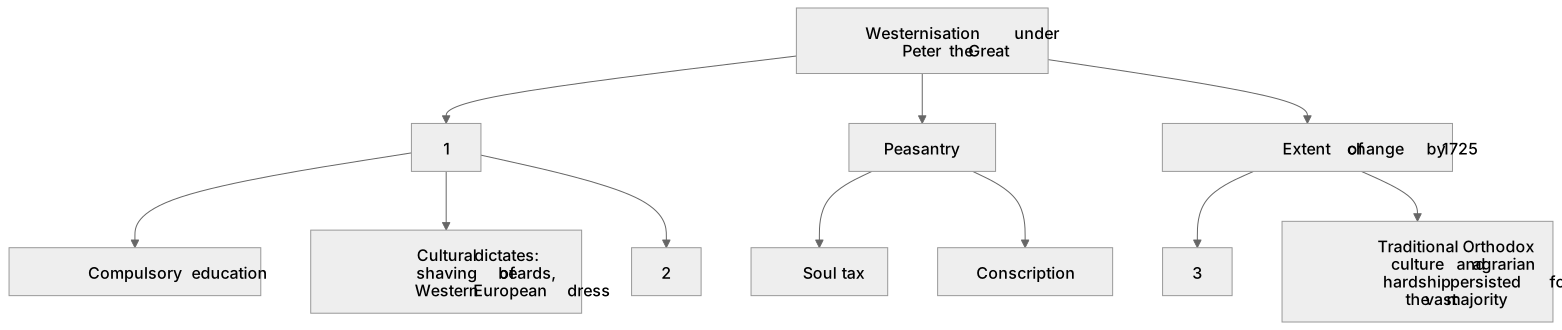
Peter the Great's drive for Westernisation profoundly impacted Russian society, though the extent of change by 1725 remained uneven. Social developments were stark: the nobility faced compulsory education and cultural dictates, while the peasantry endured increased burdens through the soul tax and conscription. Westernisation manifested in forced cultural shifts, such as the shaving of beards, the adoption of Western European dress, and the introduction of social assemblies that ended the seclusion of elite women (terem). However, the extent of change was largely superficial and confined to the urban elite and St Petersburg. For the vast majority of the population, traditional Orthodox culture and agrarian hardship persisted, highlighting the limits of Peter's social revolution.
What earns the marks
- Identify key policies of Westernisation, including changes to dress, grooming (beard tax), and the introduction of Western-style assemblies.
- Analyse the social developments affecting the nobility, such as compulsory education and the end of female seclusion (terem).
- Evaluate the impact of Peter's reforms on the peasantry, focusing on the increased financial and physical burdens of the soul tax and conscription.
- Assess the overall extent of change by 1725, contrasting the transformed elite culture in St Petersburg with the unchanged traditional lives of the rural masses.
Common mistakes and how to put them right
Claiming that Westernisation affected all of Russian society.
Put it right: It was almost entirely restricted to the nobility and urban elites, leaving the peasantry largely untouched culturally.
Assuming the end of the terem meant full equality for women.
Put it right: It only applied to elite women and was designed to mimic Western court life rather than promote genuine emancipation.
Stating that Peter completely destroyed the Orthodox Church's influence.
Put it right: While he subordinated it to the state, traditional religious beliefs remained central to the lives of most Russians.
Exam tips
- When discussing the extent of change, explicitly contrast the visual transformation of the nobility with the continuity of peasant life to demonstrate nuanced evaluation.
- Use the introduction of the soul tax (poll tax) as a primary example of how social developments negatively impacted the peasantry.
- Argue whether Westernisation was an end in itself or merely a practical tool to modernise the state and support Peter's military ambitions.
Try the lesson
The start of the 1E Russia in the Age of Absolutism and Enlightenment, 1682–1796 (A-level only) – Increasing the glory of Russia, 1707–1725: Social developments, Westernisation and extent of change by 1725 lesson, made from checked teaching notes for this specification point.
Have a go first
Which of the following was a key social policy implemented by Peter the Great to enforce Westernisation among the Russian nobility?
Listen
Peter the Great's drive for Westernisation profoundly impacted Russian society, though the extent of change by 1725 remained uneven. Social developments were stark: the nobility faced compulsory education and cultural dictates, while the peasantry endured increased burdens through the soul tax and conscription. Westernisation manifested in forced cultural shifts, such as the shaving of beards, the adoption of Western European dress, and the introduction of social assemblies that ended the seclusion of elite women (terem). However, the extent of change was largely superficial and confined to the urban elite and St Petersburg. For the vast majority of the population, traditional Orthodox culture and agrarian hardship persisted, highlighting the limits of Peter's social revolution. A strong answer earns marks for these points. Identify key policies of Westernisation, including changes to dress, grooming (beard tax), and the introduction of Western-style assemblies. Analyse the social developments affecting the nobility, such as compulsory education and the end of female seclusion (terem). Evaluate the impact of Peter's reforms on the peasantry, focusing on the increased financial and physical burdens of the soul tax and conscription. Assess the overall extent of change by 1725, contrasting the transformed elite culture in St Petersburg with the unchanged traditional lives of the rural masses. Exam tip: When discussing the extent of change, explicitly contrast the visual transformation of the nobility with the continuity of peasant life to demonstrate nuanced evaluation.
See it

Label the diagram
Some boxes have lost their names. Pick the right name for each number.
1Box 1
2Box 2
3Box 3
There is more to this lesson
The full lesson goes on to check your understanding and help you earn the marks. Create a free account to carry on, with your progress saved.
A week of Premium from your first lesson · Then the free plan continues · No card, no charge
Test your understanding of 1E Russia in the Age of Absolutism and Enlightenment, 1682–1796 (A-level only) – Increasing the glory of Russia, 1707–1725: Social developments, Westernisation and extent of change by 1725
Active recall beats re-reading. Take an instant quiz now to test what you’ve learned and lock it into long-term memory.
A week of Premium from your first lesson · Then the free plan continues · No card, no charge