AQA · A-Level · History
Course version: 7042 · Version from Sept 2017
Opposition: Astrakhan; Bashkir; Don Cossacks; Tsarevich Alexis
Full specification wording
1E Russia in the Age of Absolutism and Enlightenment, 1682–1796 (A-level only) – Increasing the glory of Russia, 1707–1725: Opposition: Astrakhan; Bashkir; Don Cossacks; Tsarevich Alexis
Peter the Great’s radical reforms and heavy taxation provoked significant opposition across Russian society.
Checked against the AQA 7042 specification (opens in a new tab) on .
- Point 5 of 6
Study notes
From the checked teaching notes for this specification point.
The idea
Peter the Great’s radical reforms and heavy taxation provoked significant opposition across Russian society. The Astrakhan revolt was triggered by new taxes and cultural edicts, such as the beard tax, uniting merchants and soldiers against the state. Similarly, the Bashkir rebellion erupted when Russian officials imposed new taxes and attempted to conscript the Muslim population, threatening their autonomy. The Don Cossacks, led by Kondraty Bulavin, rebelled against state encroachment on their traditional sanctuary for runaway serfs. Finally, opposition coalesced around Tsarevich Alexis, Peter’s son, who became a figurehead for traditionalist nobles and clerics resisting Westernisation, culminating in his trial and death in 1718.
What earns the marks
- Explain the economic and cultural triggers of the Astrakhan revolt, noting the resentment towards Westernisation policies like the beard tax.
- Analyse the Bashkir rebellion as a reaction to religious insensitivity and the imposition of new taxes on a non-Russian, Muslim population.
- Evaluate the Bulavin Rebellion of the Don Cossacks as a defence of traditional regional autonomy and the right to harbour fugitive serfs from state conscription.
- Assess the political threat posed by Tsarevich Alexis as a focal point for conservative opposition, including the clergy and old nobility, against Peter's reforms.
Common mistakes and how to put them right
Confusing the causes of the Cossack and Bashkir rebellions.
Put it right: Ensure you distinguish that the Bashkirs rebelled primarily over religious and ethnic autonomy, whereas the Don Cossacks fought to protect their tradition of harbouring runaway serfs.
Assuming Tsarevich Alexis actively led a military uprising against Peter.
Put it right: Clarify that Alexis was a passive figurehead who fled abroad, rather than a military commander, but was perceived as a severe dynastic threat.
Treating all opposition as purely anti-Westernisation.
Put it right: Acknowledge that while cultural reforms sparked the Astrakhan revolt, heavy taxation and conscription for the Great Northern War were the primary drivers for the provincial rebellions.
Exam tips
- Compare the different motives for rebellion, contrasting the dynastic threat of Alexis with the socio-economic grievances of the Cossacks and Bashkirs.
- Use the Bulavin Rebellion to demonstrate the tension between Peter's need for military manpower and traditional regional autonomies.
- When discussing Tsarevich Alexis, evaluate how his death secured Peter's reforms in the short term but created long-term succession instability.
Try the lesson
The start of the 1E Russia in the Age of Absolutism and Enlightenment, 1682–1796 (A-level only) – Increasing the glory of Russia, 1707–1725: Opposition: Astrakhan; Bashkir; Don Cossacks; Tsarevich Alexis lesson, made from checked teaching notes for this specification point.
Have a go first
Which leader instigated the major rebellion among the Don Cossacks against Peter the Great's authority in 1707?
Listen
Peter the Great’s radical reforms and heavy taxation provoked significant opposition across Russian society. The Astrakhan revolt was triggered by new taxes and cultural edicts, such as the beard tax, uniting merchants and soldiers against the state. Similarly, the Bashkir rebellion erupted when Russian officials imposed new taxes and attempted to conscript the Muslim population, threatening their autonomy. The Don Cossacks, led by Kondraty Bulavin, rebelled against state encroachment on their traditional sanctuary for runaway serfs. Finally, opposition coalesced around Tsarevich Alexis, Peter’s son, who became a figurehead for traditionalist nobles and clerics resisting Westernisation, culminating in his trial and death in 1718. A strong answer earns marks for these points. Explain the economic and cultural triggers of the Astrakhan revolt, noting the resentment towards Westernisation policies like the beard tax. Analyse the Bashkir rebellion as a reaction to religious insensitivity and the imposition of new taxes on a non-Russian, Muslim population. Evaluate the Bulavin Rebellion of the Don Cossacks as a defence of traditional regional autonomy and the right to harbour fugitive serfs from state conscription. Assess the political threat posed by Tsarevich Alexis as a focal point for conservative opposition, including the clergy and old nobility, against Peter's reforms. A common slip: Confusing the causes of the Cossack and Bashkir rebellions. Instead, Ensure you distinguish that the Bashkirs rebelled primarily over religious and ethnic autonomy, whereas the Don Cossacks fought to protect their tradition of harbouring runaway serfs. Exam tip: Compare the different motives for rebellion, contrasting the dynastic threat of Alexis with the socio-economic grievances of the Cossacks and Bashkirs.
See it
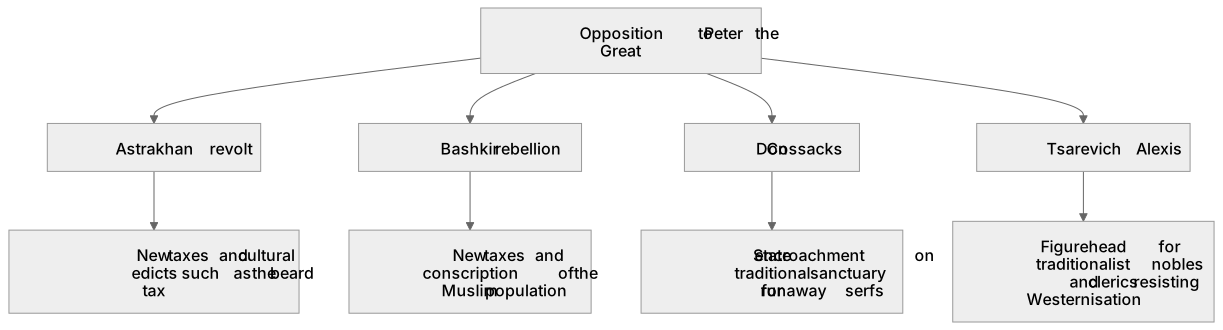
Label the diagram
Some boxes have lost their names. Pick the right name for each number.
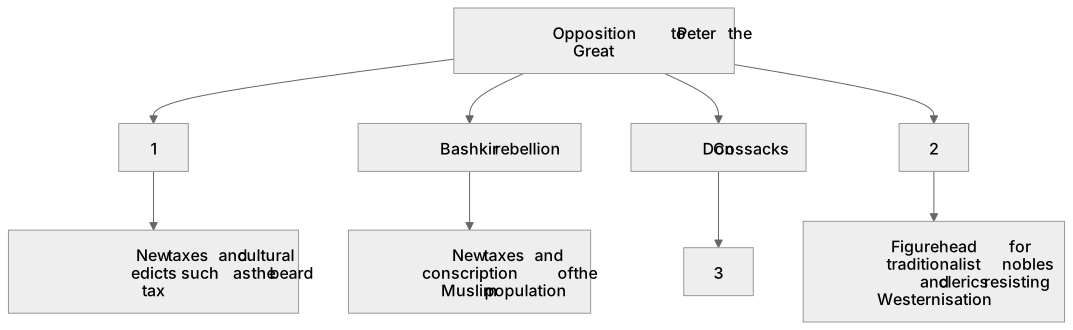
1Box 1
2Box 2
3Box 3
There is more to this lesson
The full lesson goes on to check your understanding and help you earn the marks. Create a free account to carry on, with your progress saved.
A week of Premium from your first lesson · Then the free plan continues · No card, no charge
Test your understanding of 1E Russia in the Age of Absolutism and Enlightenment, 1682–1796 (A-level only) – Increasing the glory of Russia, 1707–1725: Opposition: Astrakhan; Bashkir; Don Cossacks; Tsarevich Alexis
Active recall beats re-reading. Take an instant quiz now to test what you’ve learned and lock it into long-term memory.
A week of Premium from your first lesson · Then the free plan continues · No card, no charge