AQA · A-Level · History
Course version: 7042 · Version from Sept 2017
Britain, c1783–1885 – Economy, society and politics, 1846–1885 (A-level…
Full specification wording
1F Industrialisation and the people: Britain, c1783–1885 – Economy, society and politics, 1846–1885 (A-level only): Pressure for change: social campaigns, Public Health reform; Chartism; pressure for parliamentary reform; Irish Nationalism
Between 1846 and 1885, Britain faced intense pressure for change from multiple avenues.
Checked against the AQA 7042 specification (opens in a new tab) on .
- Point 3 of 6
Study notes
From the checked teaching notes for this specification point.
The idea
Between 1846 and 1885, Britain faced intense pressure for change from multiple avenues. Social campaigns and Public Health reform, driven by figures like Edwin Chadwick and the cholera epidemics, forced the state to abandon laissez-faire attitudes, culminating in the 1848 and 1875 Public Health Acts. Chartism, though declining after 1848, left a legacy that fuelled renewed pressure for parliamentary reform, ultimately leading to the 1867 Second Reform Act which enfranchised parts of the urban working class. Concurrently, Irish Nationalism intensified; the Fenian movement and later Charles Stewart Parnell's Home Rule League applied significant pressure on Westminster, forcing Gladstone to address Irish land and governance issues.
What earns the marks
- Evaluate the impact of social campaigns and the shift from laissez-faire to state intervention in Public Health, noting the 1875 Act.
- Assess the legacy of Chartism post-1848 and how its underlying grievances contributed to the 1867 Reform Act.
- Analyse the methods and impact of pressure for parliamentary reform, including the Reform League and Reform Union.
- Examine the evolution of Irish Nationalism from Fenian militancy to Parnell's constitutional Home Rule campaign and its disruption of British politics.
Common mistakes and how to put them right
Assuming Chartism achieved nothing because the 1848 petition failed.
Put it right: Acknowledge that while the movement faded, its demands heavily influenced subsequent parliamentary reform campaigns leading to 1867.
Confusing the 1848 and 1875 Public Health Acts.
Put it right: Distinguish the 1848 Act as permissive and the 1875 Act as compulsory, marking a definitive shift in state intervention.
Treating Irish Nationalism as a single uniform movement.
Put it right: Differentiate between the militant republicanism of the Fenians and the constitutional parliamentary tactics of the Home Rule League.
Exam tips
- Link the pressure for parliamentary reform to the changing socio-economic landscape and the perceived respectability of the working class.
- When discussing Public Health, use specific examples like the Broad Street pump or the Great Stink to illustrate the catalysts for legislative change.
- Compare the effectiveness of extra-parliamentary pressure (like Fenianism) with parliamentary pressure (like Parnell's obstructionism) in achieving political goals.
Try the lesson
The start of the 1F Industrialisation and the people: Britain, c1783–1885 – Economy, society and politics, 1846–1885 (A-level only): Pressure for change: social campaigns, Public Health reform; Chartism; pressure for parliamentary reform; Irish Nationalism lesson, made from checked teaching notes for this specification point.
Have a go first
Which of the following was the primary objective of the Fenian movement in Ireland during the 1860s?
Listen
Between 1846 and 1885, Britain faced intense pressure for change from multiple avenues. Social campaigns and Public Health reform, driven by figures like Edwin Chadwick and the cholera epidemics, forced the state to abandon laissez-faire attitudes, culminating in the 1848 and 1875 Public Health Acts. Chartism, though declining after 1848, left a legacy that fuelled renewed pressure for parliamentary reform, ultimately leading to the 1867 Second Reform Act which enfranchised parts of the urban working class. Concurrently, Irish Nationalism intensified; the Fenian movement and later Charles Stewart Parnell's Home Rule League applied significant pressure on Westminster, forcing Gladstone to address Irish land and governance issues. A strong answer earns marks for these points. Evaluate the impact of social campaigns and the shift from laissez-faire to state intervention in Public Health, noting the 1875 Act. Assess the legacy of Chartism post-1848 and how its underlying grievances contributed to the 1867 Reform Act. Analyse the methods and impact of pressure for parliamentary reform, including the Reform League and Reform Union. Examine the evolution of Irish Nationalism from Fenian militancy to Parnell's constitutional Home Rule campaign and its disruption of British politics. A common slip: Assuming Chartism achieved nothing because the 1848 petition failed. Instead, Acknowledge that while the movement faded, its demands heavily influenced subsequent parliamentary reform campaigns leading to 1867. Exam tip: Link the pressure for parliamentary reform to the changing socio-economic landscape and the perceived respectability of the working class.
See it
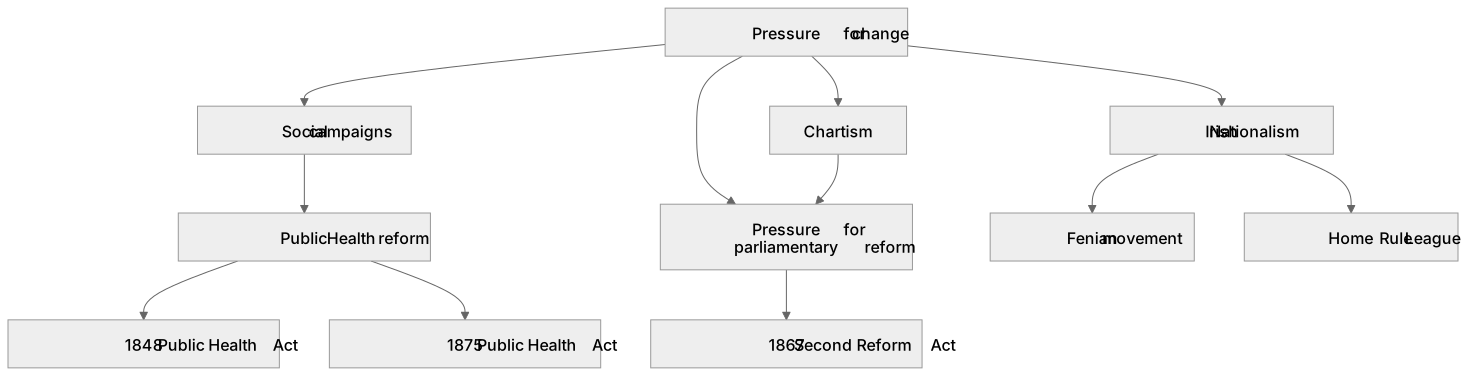
Put the events in order
Put these events in the order they happened, earliest first.
- 1. Public Health Act passed as permissive legislation
- 2. Public Health Act made compulsory, marking shift to state intervention
- 3. Second Reform Act enfranchised parts of urban working class
Label the diagram
Some boxes have lost their names. Pick the right name for each number.
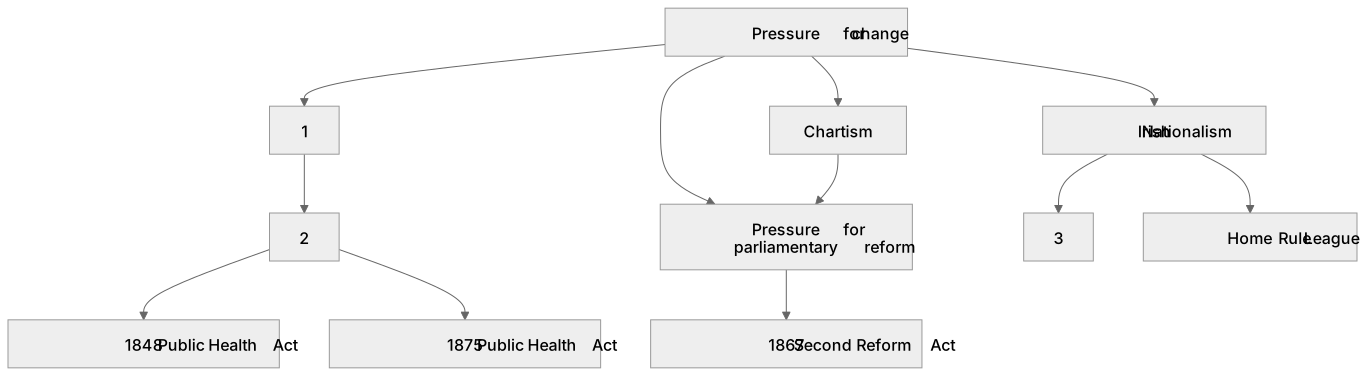
1Box 1
2Box 2
3Box 3
There is more to this lesson
The full lesson goes on to check your understanding and help you earn the marks. Create a free account to carry on, with your progress saved.
A week of Premium from your first lesson · Then the free plan continues · No card, no charge
Test your understanding of 1F Industrialisation and the people: Britain, c1783–1885 – Economy, society and politics, 1846–1885 (A-level only): Pressure for change: social campaigns, Public Health reform; Chartism; pressure for parliamentary reform; Irish Nationalism
Active recall beats re-reading. Take an instant quiz now to test what you’ve learned and lock it into long-term memory.
A week of Premium from your first lesson · Then the free plan continues · No card, no charge