AQA · A-Level · History
Course version: 7042 · Version from Sept 2017
Britain, c1783–1885 – Economy, society and politics, 1846–1885 (A-level…
Full specification wording
1F Industrialisation and the people: Britain, c1783–1885 – Economy, society and politics, 1846–1885 (A-level only): Economic developments: the mid-Victorian boom; the 'golden age' of agriculture; industrial and transport developments; impact of increased trade; the Great Depression
The period 1846 to 1885 witnessed profound economic shifts, beginning with the mid-Victorian boom where Britain became the 'workshop of the world'.
Checked against the AQA 7042 specification (opens in a new tab) on .
- Point 4 of 6
- 4 key terms
Study notes
From the checked teaching notes for this specification point.
The idea
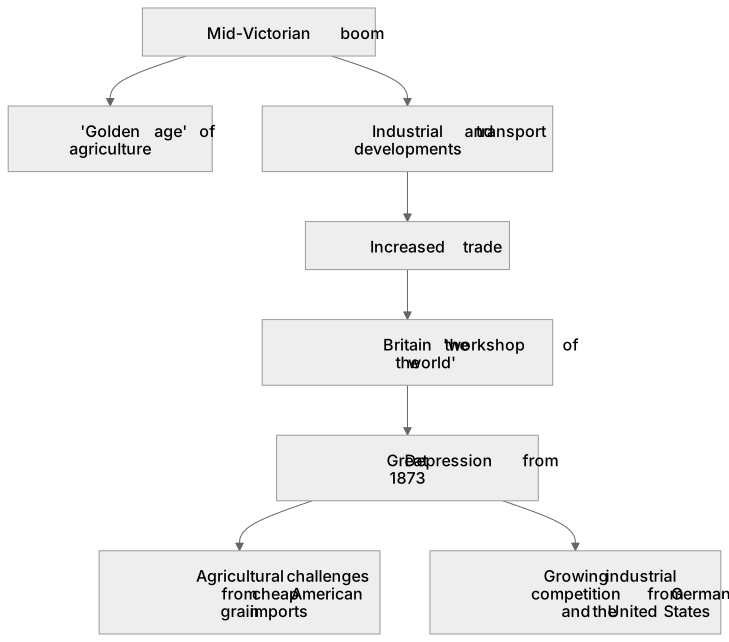
The period 1846 to 1885 witnessed profound economic shifts, beginning with the mid-Victorian boom where Britain became the 'workshop of the world'. This era featured a 'golden age' of agriculture, characterised by high yields and mixed farming, despite the repeal of the Corn Laws. Industrial and transport developments, notably the rapid expansion of the railway network and steam shipping, facilitated this growth. The impact of increased free trade further boosted exports of coal, iron, and textiles. However, from 1873, Britain entered the 'Great Depression', facing severe agricultural challenges from cheap American grain imports and growing industrial competition from a newly unified Germany and the United States.
What earns the marks
- Identify the key drivers of the mid-Victorian boom, including technological supremacy in coal, iron, and textiles.
- Explain how high farming techniques and growing urban markets created a 'golden age' of agriculture despite free trade.
- Analyse the role of industrial and transport developments, such as the railway mania and steamships, in integrating domestic and global markets.
- Evaluate the impact of increased trade following the removal of tariffs, cementing Britain's global economic dominance.
- Assess the causes and realities of the 'Great Depression' post-1873, distinguishing between agricultural collapse and industrial deceleration.
Common mistakes and how to put them right
Claiming the 'Great Depression' was a period of absolute economic decline.
Put it right: Clarify that it was a period of deflation, lower profit margins, and slower growth relative to competitors, rather than an absolute collapse in production.
Assuming the repeal of the Corn Laws immediately ruined British agriculture.
Put it right: Explain that agriculture actually entered a 'golden age' of prosperity until the 1870s due to high farming and lack of cheap transport for foreign grain.
Treating industrial and transport developments as separate phenomena.
Put it right: Emphasise their symbiotic relationship, such as railways driving demand for iron and coal while simultaneously distributing manufactured goods.
Exam tips
- Use production statistics for coal, iron, or textiles to substantiate claims about the scale of the mid-Victorian boom.
- When discussing the Great Depression, differentiate clearly between the severe impact on arable farming and the more nuanced effects on industry and consumer prices.
- Link the impact of increased trade to Britain's commitment to laissez-faire and free trade policies championed by Gladstone.
Try the lesson
The start of the 1F Industrialisation and the people: Britain, c1783–1885 – Economy, society and politics, 1846–1885 (A-level only): Economic developments: the mid-Victorian boom; the 'golden age' of agriculture; industrial and transport developments; impact of increased trade; the Great Depression lesson, made from checked teaching notes for this specification point.
Have a go first
Which of the following factors was a primary characteristic of the 'golden age' of British agriculture during the 1850s and 1860s?
Listen
The period 1846 to 1885 witnessed profound economic shifts, beginning with the mid-Victorian boom where Britain became the 'workshop of the world'. This era featured a 'golden age' of agriculture, characterised by high yields and mixed farming, despite the repeal of the Corn Laws. Industrial and transport developments, notably the rapid expansion of the railway network and steam shipping, facilitated this growth. The impact of increased free trade further boosted exports of coal, iron, and textiles. However, from 1873, Britain entered the 'Great Depression', facing severe agricultural challenges from cheap American grain imports and growing industrial competition from a newly unified Germany and the United States. A strong answer earns marks for these points. Identify the key drivers of the mid-Victorian boom, including technological supremacy in coal, iron, and textiles. Explain how high farming techniques and growing urban markets created a 'golden age' of agriculture despite free trade. Analyse the role of industrial and transport developments, such as the railway mania and steamships, in integrating domestic and global markets. Evaluate the impact of increased trade following the removal of tariffs, cementing Britain's global economic dominance. A common slip: Claiming the 'Great Depression' was a period of absolute economic decline. Instead, Clarify that it was a period of deflation, lower profit margins, and slower growth relative to competitors, rather than an absolute collapse in production. Exam tip: Use production statistics for coal, iron, or textiles to substantiate claims about the scale of the mid-Victorian boom.
See it
Key words
Say what each word means before you turn the card.
mid-Victorian boom
Try answering aloud or in your head before turning the card.
golden age of agriculture
Try answering aloud or in your head before turning the card.
Great Depression
Try answering aloud or in your head before turning the card.
free trade
Try answering aloud or in your head before turning the card.
See every definition
- mid-Victorian boom
- A period beginning in 1846 in which Britain became the 'workshop of the world', driven by technological supremacy in coal, iron and textiles.
- golden age of agriculture
- A period of high yields and mixed farming, created by high farming techniques and growing urban markets despite free trade.
- Great Depression
- A period from 1873 of deflation, lower profit margins and slower growth relative to competitors, rather than an absolute collapse in production.
- free trade
- The removal of tariffs, which increased trade and boosted exports of coal, iron and textiles, cementing Britain's global economic dominance.
Label the diagram
Some boxes have lost their names. Pick the right name for each number.
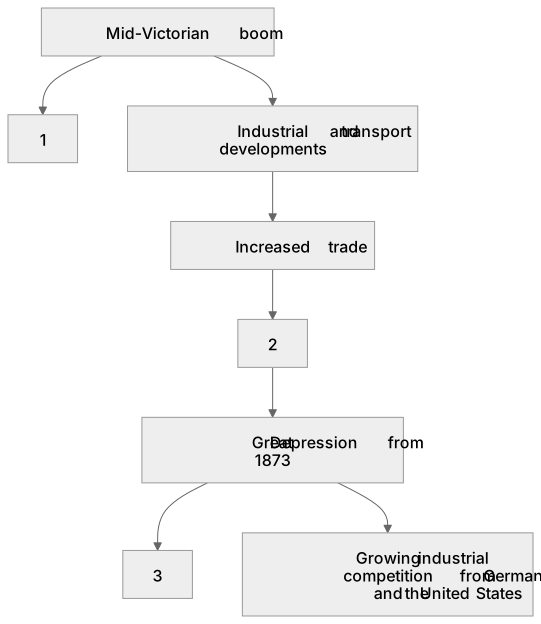
1Box 1
2Box 2
3Box 3
There is more to this lesson
The full lesson goes on to check your understanding and help you earn the marks. Create a free account to carry on, with your progress saved.
A week of Premium from your first lesson · Then the free plan continues · No card, no charge
Test your understanding of 1F Industrialisation and the people: Britain, c1783–1885 – Economy, society and politics, 1846–1885 (A-level only): Economic developments: the mid-Victorian boom; the 'golden age' of agriculture; industrial and transport developments; impact of increased trade; the Great Depression
Active recall beats re-reading. Take an instant quiz now to test what you’ve learned and lock it into long-term memory.
A week of Premium from your first lesson · Then the free plan continues · No card, no charge