AQA · A-Level · History
Course version: 7042 · Version from Sept 2017
Britain, c1783–1885 – Economy, society and politics, 1846–1885 (A-level…
Full specification wording
1F Industrialisation and the people: Britain, c1783–1885 – Economy, society and politics, 1846–1885 (A-level only): The political, economic and social condition of Britain by 1885; the extent of democracy and Britain’s industrial position
By 1885, Britain was a nation in transition.
Checked against the AQA 7042 specification (opens in a new tab) on .
- Point 6 of 6
- 3 key terms
Study notes
From the checked teaching notes for this specification point.
The idea
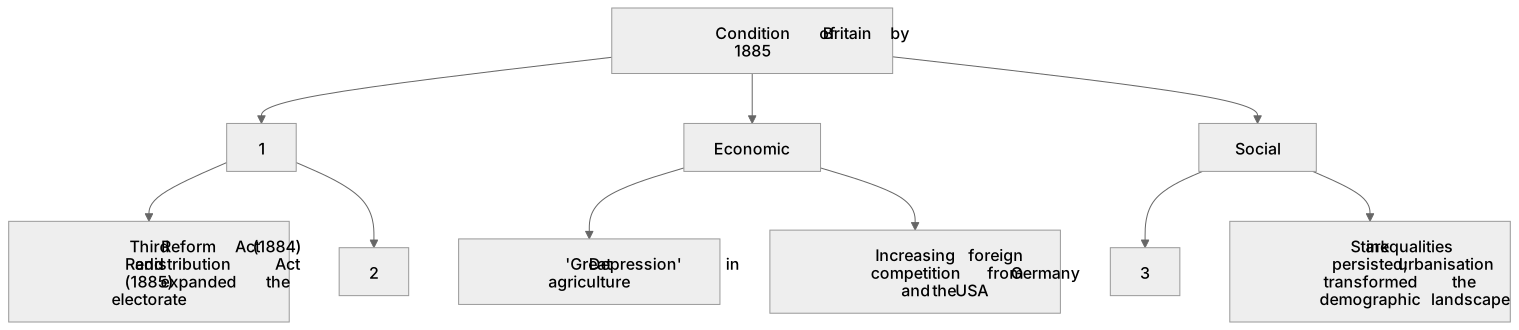
By 1885, Britain was a nation in transition. Politically, the Third Reform Act (1884) and Redistribution Act (1885) significantly expanded the electorate, enfranchising many rural workers and reshaping constituencies, though full democracy remained elusive as women and many unpropertied men were still excluded. Economically, Britain faced the 'Great Depression' in agriculture and increasing foreign competition from Germany and the USA, challenging its previously dominant industrial position. Socially, despite rising overall living standards and better public health, stark inequalities persisted. Urbanisation had transformed the demographic landscape, creating a complex society where a growing middle class contrasted sharply with the urban poor.
What earns the marks
- Evaluate the political landscape by 1885, focusing on the impact of the 1884-1885 reforms on the franchise and party organisation.
- Assess the limitations of democracy by 1885, noting the continued exclusion of women, plural voting, and the property qualifications that disenfranchised many working men.
- Analyse Britain's economic condition, specifically the challenges to its industrial supremacy from emerging powers like Germany and the United States.
- Examine the effects of the agricultural depression from the 1870s on the economic and social fabric of rural Britain.
- Discuss the social condition of Britain, highlighting the paradox of rising average real wages alongside entrenched urban poverty and class stratification.
Common mistakes and how to put them right
Claiming Britain was a full democracy by 1885.
Put it right: Specify that the 1884 Act only enfranchised around 60 percent of adult males, and women remained entirely excluded from parliamentary elections.
Stating that British industry collapsed in the 1880s.
Put it right: Explain that while growth slowed and foreign competition increased, Britain remained a major global industrial and financial power.
Ignoring the Redistribution Act of 1885.
Put it right: Pair the 1884 Franchise Act with the 1885 Redistribution Act, as the latter fundamentally altered the political map by creating equal electoral districts.
Exam tips
- Use statistical evidence, such as the increase in the electorate from roughly 3 million to 5 million, to demonstrate the extent of political change in 1884.
- When evaluating Britain's industrial position, contrast the continued dominance in shipbuilding and finance with the relative decline in steel and chemical production compared to Germany.
- Synthesise political, economic, and social factors to provide a holistic assessment of Britain's condition at the end of the period.
Try the lesson
The start of the 1F Industrialisation and the people: Britain, c1783–1885 – Economy, society and politics, 1846–1885 (A-level only): The political, economic and social condition of Britain by 1885; the extent of democracy and Britain’s industrial position lesson, made from checked teaching notes for this specification point.
Have a go first
Following the Third Reform Act of 1884, which group remained entirely excluded from the parliamentary franchise in Britain?
Listen
By 1885, Britain was a nation in transition. Politically, the Third Reform Act (1884) and Redistribution Act (1885) significantly expanded the electorate, enfranchising many rural workers and reshaping constituencies, though full democracy remained elusive as women and many unpropertied men were still excluded. Economically, Britain faced the 'Great Depression' in agriculture and increasing foreign competition from Germany and the USA, challenging its previously dominant industrial position. Socially, despite rising overall living standards and better public health, stark inequalities persisted. Urbanisation had transformed the demographic landscape, creating a complex society where a growing middle class contrasted sharply with the urban poor. A strong answer earns marks for these points. Evaluate the political landscape by 1885, focusing on the impact of the 1884-1885 reforms on the franchise and party organisation. Assess the limitations of democracy by 1885, noting the continued exclusion of women, plural voting, and the property qualifications that disenfranchised many working men. Analyse Britain's economic condition, specifically the challenges to its industrial supremacy from emerging powers like Germany and the United States. Examine the effects of the agricultural depression from the 1870s on the economic and social fabric of rural Britain. A common slip: Claiming Britain was a full democracy by 1885. Instead, specify that the 1884 Act only enfranchised around 60 percent of adult males, and women remained entirely excluded from parliamentary elections. Exam tip: Use statistical evidence, such as the increase in the electorate from roughly 3 million to 5 million, to demonstrate the extent of political change in 1884.
See it

Key words
Say what each word means before you turn the card.
Democratisation and franchise reform
Try answering aloud or in your head before turning the card.
Economic relative decline
Try answering aloud or in your head before turning the card.
Social inequality and urbanisation
Try answering aloud or in your head before turning the card.
See every definition
- Democratisation and franchise reform
- The Third Reform Act (1884) and Redistribution Act (1885) significantly expanded the electorate, enfranchising many rural workers and reshaping constituencies, though full democracy remained elusive.
- Economic relative decline
- Britain faced the 'Great Depression' in agriculture and increasing foreign competition from Germany and the USA, challenging its previously dominant industrial position.
- Social inequality and urbanisation
- Despite rising overall living standards and better public health, stark inequalities persisted, and urbanisation had transformed the demographic landscape, creating a complex society.
Label the diagram
Some boxes have lost their names. Pick the right name for each number.
1Box 1
2Box 2
3Box 3
There is more to this lesson
The full lesson goes on to check your understanding and help you earn the marks. Create a free account to carry on, with your progress saved.
A week of Premium from your first lesson · Then the free plan continues · No card, no charge
Test your understanding of 1F Industrialisation and the people: Britain, c1783–1885 – Economy, society and politics, 1846–1885 (A-level only): The political, economic and social condition of Britain by 1885; the extent of democracy and Britain’s industrial position
Active recall beats re-reading. Take an instant quiz now to test what you’ve learned and lock it into long-term memory.
A week of Premium from your first lesson · Then the free plan continues · No card, no charge