AQA · A-Level · History
Course version: 7042 · Version from Sept 2017
Britain, c1783–1885 – Economy, society and politics, 1846–1885 (A-level…
Full specification wording
1F Industrialisation and the people: Britain, c1783–1885 – Economy, society and politics, 1846–1885 (A-level only): Social developments: prosperity and poverty in towns and countryside; regional divisions; influences including Evangelicalism; 'self-help'; trade unions and education
Between 1846 and 1885, Britain experienced uneven social developments.
Checked against the AQA 7042 specification (opens in a new tab) on .
- Point 5 of 6
- 4 key terms
Study notes
From the checked teaching notes for this specification point.
The idea
Between 1846 and 1885, Britain experienced uneven social developments. While the mid-Victorian boom brought prosperity to skilled urban workers and capitalist farmers, severe poverty persisted in overcrowded towns and among agricultural labourers, exacerbating regional divisions between the industrial North and agrarian South. Social values were profoundly shaped by Evangelicalism, which emphasised moral duty and philanthropy, and Samuel Smiles' concept of 'self-help', encouraging individual thrift and hard work. Working-class organisation advanced through New Model Trade Unions, securing better conditions for skilled artisans. Meanwhile, the 1870 Forster's Education Act laid the foundations for state-supported elementary education.
What earns the marks
- Assess the contrast between rising real wages for skilled urban workers and the enduring poverty of unskilled labourers and rural workers.
- Evaluate the impact of regional divisions, particularly the economic disparities between the industrialising North and the agricultural South.
- Analyse how Evangelicalism drove philanthropic efforts and moral reform movements, influencing middle-class attitudes towards the poor.
- Explain the influence of 'self-help' ideology, popularised by Samuel Smiles, on working-class aspirations and the growth of friendly societies.
- Examine the role of New Model Trade Unions in securing legal recognition and improving conditions for the 'aristocracy of labour'.
- Discuss the significance of the 1870 Education Act in expanding elementary education and its limitations regarding compulsory attendance.
Common mistakes and how to put them right
Assuming the mid-Victorian boom eradicated poverty.
Put it right: Recognise that while skilled workers prospered, casual urban labourers and rural workers remained in severe poverty.
Confusing 'self-help' with state welfare.
Put it right: Understand that 'self-help' emphasised individual responsibility, thrift, and voluntary mutual aid, explicitly rejecting state intervention.
Overstating the reach of trade unions.
Put it right: Specify that New Model Trade Unions primarily represented skilled artisans, leaving the vast majority of unskilled workers unorganised until the late 1880s.
Exam tips
- Use Samuel Smiles' 1859 book 'Self-Help' as a concrete example of mid-Victorian middle-class ideology and its influence on working-class respectability.
- When discussing regional divisions, contrast the high wages in northern textile and engineering towns with the low wages in southern agricultural counties like Dorset.
- Link the 1870 Education Act to economic needs, demonstrating how industrial competition prompted the state to intervene in social development.
Try the lesson
The start of the 1F Industrialisation and the people: Britain, c1783–1885 – Economy, society and politics, 1846–1885 (A-level only): Social developments: prosperity and poverty in towns and countryside; regional divisions; influences including Evangelicalism; 'self-help'; trade unions and education lesson, made from checked teaching notes for this specification point.
Have a go first
What was the core principle of Samuel Smiles' concept of 'self-help', as popularised in his 1859 book of the same name?
Listen
Between 1846 and 1885, Britain experienced uneven social developments. While the mid-Victorian boom brought prosperity to skilled urban workers and capitalist farmers, severe poverty persisted in overcrowded towns and among agricultural labourers, exacerbating regional divisions between the industrial North and agrarian South. Social values were profoundly shaped by Evangelicalism, which emphasised moral duty and philanthropy, and Samuel Smiles' concept of 'self-help', encouraging individual thrift and hard work. Working-class organisation advanced through New Model Trade Unions, securing better conditions for skilled artisans. Meanwhile, the 1870 Forster's Education Act laid the foundations for state-supported elementary education. A strong answer earns marks for these points. Assess the contrast between rising real wages for skilled urban workers and the enduring poverty of unskilled labourers and rural workers. Evaluate the impact of regional divisions, particularly the economic disparities between the industrialising North and the agricultural South. Analyse how Evangelicalism drove philanthropic efforts and moral reform movements, influencing middle-class attitudes towards the poor. Explain the influence of 'self-help' ideology, popularised by Samuel Smiles, on working-class aspirations and the growth of friendly societies. A common slip: Assuming the mid-Victorian boom eradicated poverty. Instead, recognise that while skilled workers prospered, casual urban labourers and rural workers remained in severe poverty. Exam tip: Use Samuel Smiles' 1859 book 'Self-Help' as a concrete example of mid-Victorian middle-class ideology and its influence on working-class respectability.
See it

Key words
Say what each word means before you turn the card.
Evangelicalism
Try answering aloud or in your head before turning the card.
'self-help'
Try answering aloud or in your head before turning the card.
New Model Trade Unions
Try answering aloud or in your head before turning the card.
regional divisions
Try answering aloud or in your head before turning the card.
See every definition
- Evangelicalism
- A religious influence that emphasised moral duty and philanthropy and profoundly shaped social values.
- 'self-help'
- Samuel Smiles' concept encouraging individual thrift and hard work, emphasising individual responsibility and voluntary mutual aid.
- New Model Trade Unions
- Working-class organisation that advanced by securing better conditions for skilled artisans and improving conditions for the 'aristocracy of labour'.
- regional divisions
- Economic disparities between the industrialising North and the agricultural South, exacerbated by uneven social developments.
Label the diagram
Some boxes have lost their names. Pick the right name for each number.
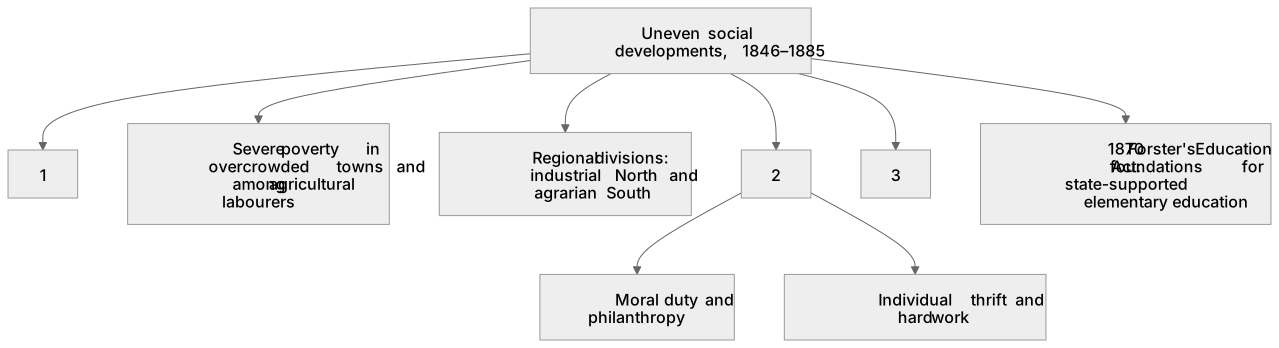
1Box 1
2Box 2
3Box 3
There is more to this lesson
The full lesson goes on to check your understanding and help you earn the marks. Create a free account to carry on, with your progress saved.
A week of Premium from your first lesson · Then the free plan continues · No card, no charge
Test your understanding of 1F Industrialisation and the people: Britain, c1783–1885 – Economy, society and politics, 1846–1885 (A-level only): Social developments: prosperity and poverty in towns and countryside; regional divisions; influences including Evangelicalism; 'self-help'; trade unions and education
Active recall beats re-reading. Take an instant quiz now to test what you’ve learned and lock it into long-term memory.
A week of Premium from your first lesson · Then the free plan continues · No card, no charge