AQA · A-Level · History
Course version: 7042 · Version from Sept 2017
Britain, c1783–1885 – Government and a changing society, 1812–1832:…
Full specification wording
1F Industrialisation and the people: Britain, c1783–1885 – Government and a changing society, 1812–1832: Economic developments: continuing industrialisation and developments in key industries; agricultural change; economic policies and free trade
Between 1812 and 1832, Britain experienced continuing industrialisation, driven by rapid developments in key industries like coal, iron, and textiles.
Checked against the AQA 7042 specification (opens in a new tab) on .
- Point 3 of 6
- 4 key terms
Study notes
From the checked teaching notes for this specification point.
The idea
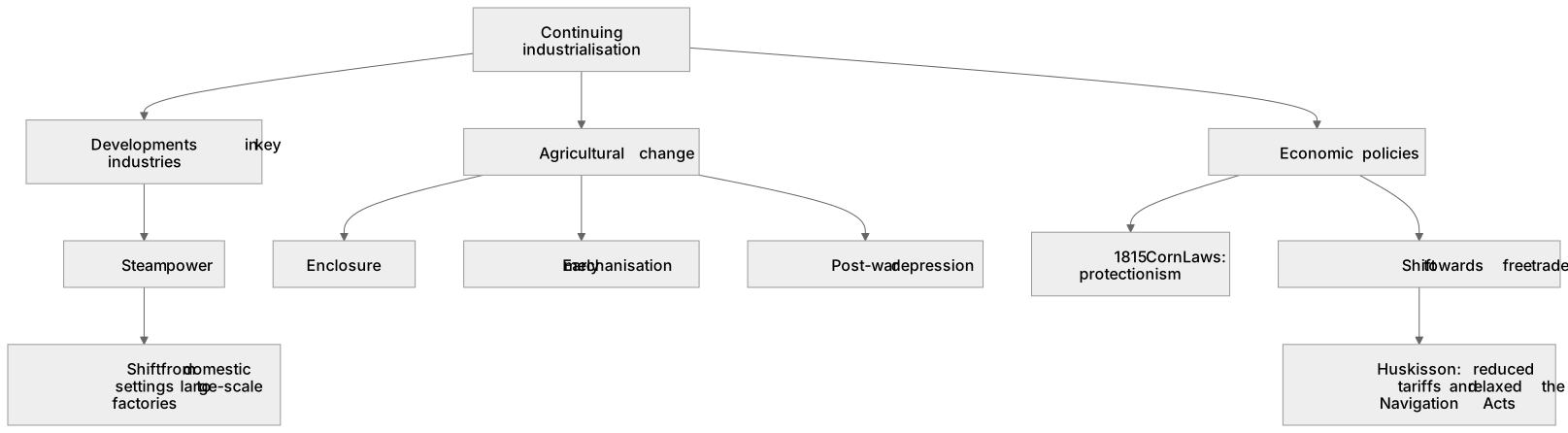
Between 1812 and 1832, Britain experienced continuing industrialisation, driven by rapid developments in key industries like coal, iron, and textiles. The adoption of steam power transformed manufacturing, shifting production from domestic settings to large-scale factories. Simultaneously, agricultural change accelerated through ongoing enclosure and early mechanisation, though the sector faced post-war depression and the controversial protectionism of the 1815 Corn Laws. In response to economic pressures, government economic policies gradually shifted towards free trade. William Huskisson, as President of the Board of Trade, reduced tariffs on imports and relaxed the Navigation Acts, laying the groundwork for a more liberalised, export-driven British economy.
What earns the marks
- Identify specific technological advancements in key industries, such as the expansion of steam-powered looms in textiles.
- Explain the impact of agricultural change, including the effects of the enclosure movement on rural employment and efficiency.
- Analyse the significance of the 1815 Corn Laws as a protectionist economic policy and its impact on domestic prices.
- Evaluate the shift towards free trade under Liverpool's government, specifically Huskisson's tariff reductions and modification of the Navigation Acts.
Common mistakes and how to put them right
Claiming free trade was fully established by 1832.
Put it right: State that Huskisson introduced early free trade measures, but full free trade was not achieved until the repeal of the Corn Laws in 1846.
Assuming agricultural change only brought prosperity.
Put it right: Acknowledge that while enclosure increased overall yields, it caused significant hardship and displacement for agricultural labourers.
Treating industrialisation as a sudden event in this period.
Put it right: Describe industrialisation as a continuing, cumulative process building on late 18th-century foundations.
Exam tips
- Link economic policies directly to political stability, showing how Huskisson's free trade measures aimed to stimulate trade and reduce unrest.
- Use specific statistics or examples, such as the growth in coal output or raw cotton imports, to demonstrate developments in key industries.
- Contrast the protectionist nature of the 1815 Corn Laws with the later liberalising economic policies of the 1820s to show change over time.
Try the lesson
The start of the 1F Industrialisation and the people: Britain, c1783–1885 – Government and a changing society, 1812–1832: Economic developments: continuing industrialisation and developments in key industries; agricultural change; economic policies and free trade lesson, made from checked teaching notes for this specification point.
Have a go first
Which economic policy was introduced by William Huskisson as President of the Board of Trade in the 1820s to promote free trade?
Listen
Between 1812 and 1832, Britain experienced continuing industrialisation, driven by rapid developments in key industries like coal, iron, and textiles. The adoption of steam power transformed manufacturing, shifting production from domestic settings to large-scale factories. Simultaneously, agricultural change accelerated through ongoing enclosure and early mechanisation, though the sector faced post-war depression and the controversial protectionism of the 1815 Corn Laws. In response to economic pressures, government economic policies gradually shifted towards free trade. William Huskisson, as President of the Board of Trade, reduced tariffs on imports and relaxed the Navigation Acts, laying the groundwork for a more liberalised, export-driven British economy. A strong answer earns marks for these points. Identify specific technological advancements in key industries, such as the expansion of steam-powered looms in textiles. Explain the impact of agricultural change, including the effects of the enclosure movement on rural employment and efficiency. Analyse the significance of the 1815 Corn Laws as a protectionist economic policy and its impact on domestic prices. Evaluate the shift towards free trade under Liverpool's government, specifically Huskisson's tariff reductions and modification of the Navigation Acts. A common slip: Claiming free trade was fully established by 1832. Instead, State that Huskisson introduced early free trade measures, but full free trade was not achieved until the repeal of the Corn Laws in 1846. Exam tip: Link economic policies directly to political stability, showing how Huskisson's free trade measures aimed to stimulate trade and reduce unrest.
See it
Key words
Say what each word means before you turn the card.
Industrialisation and technological change
Try answering aloud or in your head before turning the card.
Laissez-faire versus protectionism
Try answering aloud or in your head before turning the card.
Agricultural transformation
Try answering aloud or in your head before turning the card.
Government economic policy
Try answering aloud or in your head before turning the card.
See every definition
- Industrialisation and technological change
- A continuing process in which rapid developments in key industries and the adoption of steam power shifted production from domestic settings to large-scale factories.
- Laissez-faire versus protectionism
- The contrast between the controversial protectionism of the 1815 Corn Laws and government economic policies that gradually shifted towards free trade.
- Agricultural transformation
- Accelerated change through ongoing enclosure and early mechanisation, though the sector faced post-war depression and hardship and displacement for agricultural labourers.
- Government economic policy
- Measures that gradually shifted towards free trade, with Huskisson reducing tariffs on imports and relaxing the Navigation Acts as President of the Board of Trade.
Label the diagram
Some boxes have lost their names. Pick the right name for each number.
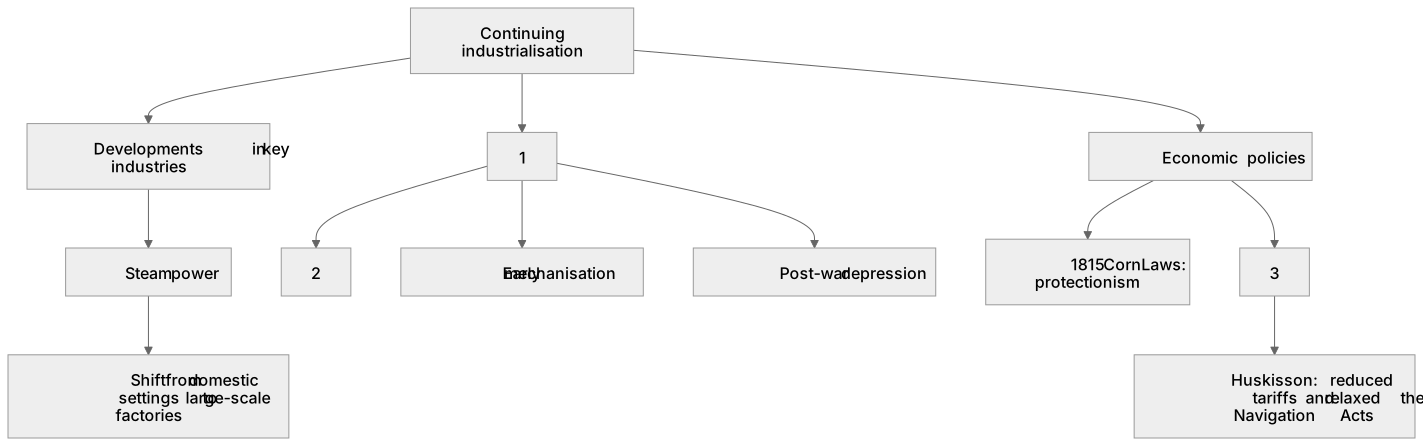
1Box 1
2Box 2
3Box 3
There is more to this lesson
The full lesson goes on to check your understanding and help you earn the marks. Create a free account to carry on, with your progress saved.
A week of Premium from your first lesson · Then the free plan continues · No card, no charge
Test your understanding of 1F Industrialisation and the people: Britain, c1783–1885 – Government and a changing society, 1812–1832: Economic developments: continuing industrialisation and developments in key industries; agricultural change; economic policies and free trade
Active recall beats re-reading. Take an instant quiz now to test what you’ve learned and lock it into long-term memory.
A week of Premium from your first lesson · Then the free plan continues · No card, no charge