AQA · A-Level · History
Course version: 7042 · Version from Sept 2017
Britain, c1783–1885 – Government and a changing society, 1812–1832: Social…
Full specification wording
1F Industrialisation and the people: Britain, c1783–1885 – Government and a changing society, 1812–1832: Social developments: the effects of industrialisation; standards of living and working class discontent
The period 1812 to 1832 witnessed profound social developments as the effects of industrialisation reshaped British society.
Checked against the AQA 7042 specification (opens in a new tab) on .
- Point 4 of 6
- 4 key terms
Study notes
From the checked teaching notes for this specification point.
The idea
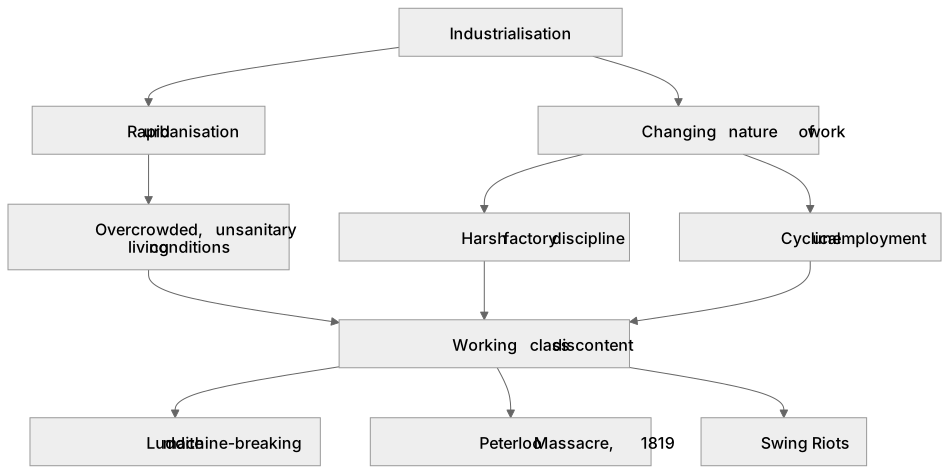
The period 1812 to 1832 witnessed profound social developments as the effects of industrialisation reshaped British society. Rapid urbanisation led to overcrowded, unsanitary living conditions in expanding northern towns, fundamentally altering daily life. The debate over standards of living remains complex; while some skilled workers saw wage increases, many faced cyclical unemployment, high bread prices, and harsh factory discipline. This precarious existence fuelled widespread working class discontent. Protests erupted against mechanisation and economic hardship, manifesting in Luddite machine-breaking, the tragic Peterloo Massacre of 1819, and the rural Swing Riots, highlighting the deep social fractures caused by rapid economic transformation.
What earns the marks
- Assess the effects of industrialisation on urbanisation, focusing on public health, housing, and the changing nature of work.
- Evaluate the historical debate surrounding working-class standards of living, contrasting wage data with the reality of living conditions and inflation.
- Explain the causes of working-class discontent, linking economic hardship and high food prices to political radicalism.
- Analyse specific manifestations of discontent, such as Luddism, the Blanketeers, the Peterloo Massacre, and the Swing Riots.
Common mistakes and how to put them right
Stating that standards of living universally declined or improved.
Put it right: Recognise the nuance in the standard of living debate, noting regional variations and differences between skilled and unskilled workers.
Confusing the aims of different protest movements.
Put it right: Distinguish between economic protests (like Luddism against wage reductions and mechanisation) and political protests (like Peterloo demanding parliamentary reform).
Attributing working-class discontent solely to political radicalism.
Put it right: Emphasise that economic distress, such as post-war unemployment and the impact of the Corn Laws, was the primary driver of discontent.
Exam tips
- When discussing standards of living, explicitly reference the 'optimist' and 'pessimist' historical interpretations to demonstrate historiographical awareness.
- Connect social developments to government actions, showing how working-class discontent was often met with repressive legislation like the Six Acts.
- Use specific examples of regional unrest, such as the Swing Riots in the agricultural south, to show that discontent was not limited to industrial towns.
Try the lesson
The start of the 1F Industrialisation and the people: Britain, c1783–1885 – Government and a changing society, 1812–1832: Social developments: the effects of industrialisation; standards of living and working class discontent lesson, made from checked teaching notes for this specification point.
Have a go first
Which of the following best describes the primary cause of the Swing Riots that erupted in rural England in 1830?
Listen
The period 1812 to 1832 witnessed profound social developments as the effects of industrialisation reshaped British society. Rapid urbanisation led to overcrowded, unsanitary living conditions in expanding northern towns, fundamentally altering daily life. The debate over standards of living remains complex; while some skilled workers saw wage increases, many faced cyclical unemployment, high bread prices, and harsh factory discipline. This precarious existence fuelled widespread working class discontent. Protests erupted against mechanisation and economic hardship, manifesting in Luddite machine-breaking, the tragic Peterloo Massacre of 1819, and the rural Swing Riots, highlighting the deep social fractures caused by rapid economic transformation. A strong answer earns marks for these points. Assess the effects of industrialisation on urbanisation, focusing on public health, housing, and the changing nature of work. Evaluate the historical debate surrounding working-class standards of living, contrasting wage data with the reality of living conditions and inflation. Explain the causes of working-class discontent, linking economic hardship and high food prices to political radicalism. Analyse specific manifestations of discontent, such as Luddism, the Blanketeers, the Peterloo Massacre, and the Swing Riots. A common slip: Stating that standards of living universally declined or improved. Instead, Recognise the nuance in the standard of living debate, noting regional variations and differences between skilled and unskilled workers. Exam tip: When discussing standards of living, explicitly reference the 'optimist' and 'pessimist' historical interpretations to demonstrate historiographical awareness.
See it
Key words
Say what each word means before you turn the card.
Urbanisation and public health
Try answering aloud or in your head before turning the card.
Standard of living debate
Try answering aloud or in your head before turning the card.
Class consciousness and conflict
Try answering aloud or in your head before turning the card.
Popular protest and radicalism
Try answering aloud or in your head before turning the card.
See every definition
- Urbanisation and public health
- Rapid urbanisation led to overcrowded, unsanitary living conditions in expanding northern towns, fundamentally altering daily life.
- Standard of living debate
- The debate over standards of living remains complex; while some skilled workers saw wage increases, many faced cyclical unemployment, high bread prices, and harsh factory discipline.
- Class consciousness and conflict
- Widespread working class discontent fuelled protests against mechanisation and economic hardship, highlighting the deep social fractures caused by rapid economic transformation.
- Popular protest and radicalism
- Protests erupted against mechanisation and economic hardship, manifesting in Luddite machine-breaking, the Peterloo Massacre of 1819, and the rural Swing Riots.
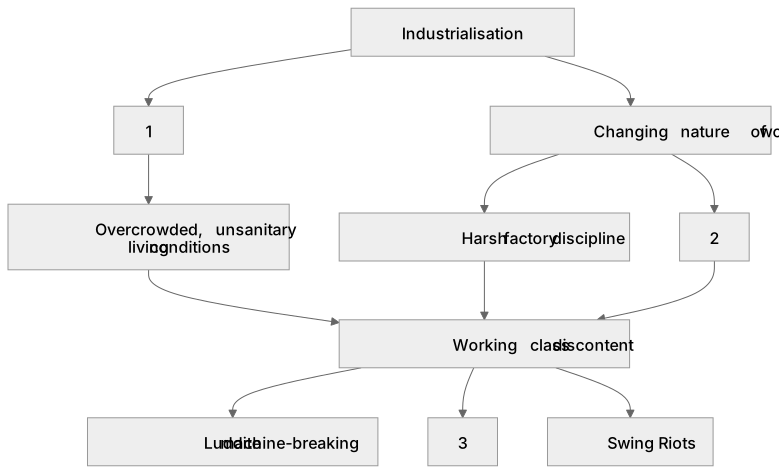
Label the diagram
Some boxes have lost their names. Pick the right name for each number.
1Box 1
2Box 2
3Box 3
There is more to this lesson
The full lesson goes on to check your understanding and help you earn the marks. Create a free account to carry on, with your progress saved.
A week of Premium from your first lesson · Then the free plan continues · No card, no charge
Test your understanding of 1F Industrialisation and the people: Britain, c1783–1885 – Government and a changing society, 1812–1832: Social developments: the effects of industrialisation; standards of living and working class discontent
Active recall beats re-reading. Take an instant quiz now to test what you’ve learned and lock it into long-term memory.
A week of Premium from your first lesson · Then the free plan continues · No card, no charge