AQA · A-Level · History
Course version: 7042 · Version from Sept 2017
Britain, c1783–1885 – Government and a changing society, 1812–1832:…
Full specification wording
1F Industrialisation and the people: Britain, c1783–1885 – Government and a changing society, 1812–1832: Greater democracy: the election of the Whigs; pressure for parliamentary reform; the Great Reform Act and its impact; the state of Britain politically, economically and socially by 1832
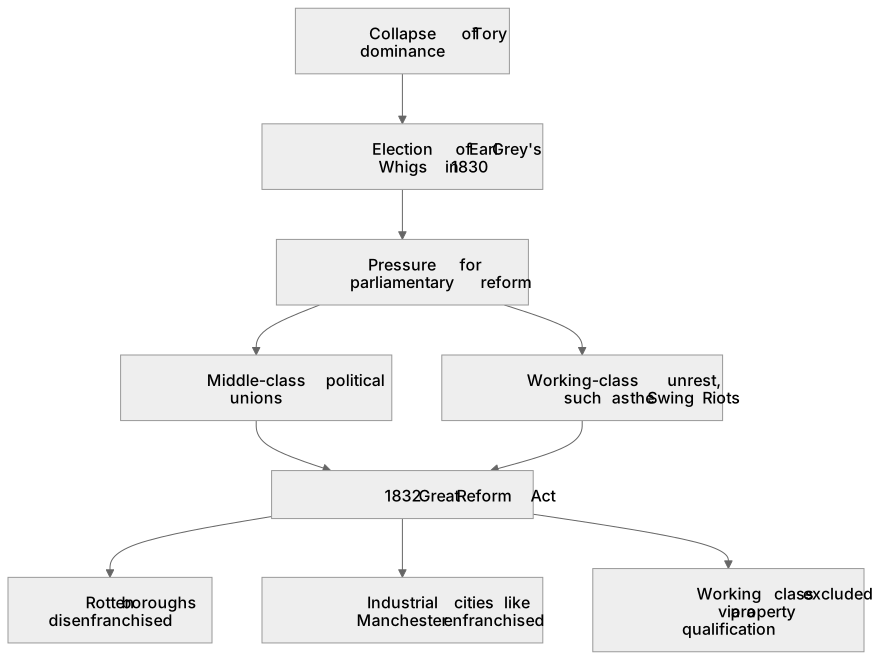
The collapse of Tory dominance led to the election of Earl Grey’s Whigs in 1830, catalysing the push for greater democracy.
Checked against the AQA 7042 specification (opens in a new tab) on .
- Point 6 of 6
- 4 key terms
Study notes
From the checked teaching notes for this specification point.
The idea
The collapse of Tory dominance led to the election of Earl Grey’s Whigs in 1830, catalysing the push for greater democracy. Intense pressure for parliamentary reform arose from middle-class political unions and working-class unrest, such as the Swing Riots. This culminated in the 1832 Great Reform Act, which disenfranchised rotten boroughs and enfranchised industrial cities like Manchester, though it deliberately excluded the working class via a property qualification. By 1832, Britain was politically transformed yet still aristocratic. Economically, it was an industrial powerhouse experiencing rapid urbanisation. Socially, deep class divisions persisted, setting the stage for Chartist agitation as workers realised the Act ignored their grievances.
What earns the marks
- Explain the political circumstances that led to the collapse of the Tory government and the election of the Whigs in 1830.
- Analyse the sources of pressure for reform, including the Birmingham Political Union and the threat of popular revolution.
- Detail the specific terms of the 1832 Great Reform Act, including the redistribution of seats and the uniform borough franchise.
- Evaluate the immediate impact of the Act, noting the enfranchisement of the middle classes and the deliberate exclusion of the working classes.
- Assess the political, economic, and social state of Britain by 1832, highlighting the ongoing dominance of the landed elite despite industrialisation.
Common mistakes and how to put them right
Claiming the Great Reform Act introduced universal democracy.
Put it right: It only increased the electorate to roughly 18 percent of adult males and explicitly excluded women.
Assuming the Whigs passed the Reform Act out of radical democratic ideals.
Put it right: They actually intended it to be a final, conservative measure to prevent revolution and preserve aristocratic power.
Treating the state of Britain in 1832 as entirely modernised.
Put it right: Politically and socially, the landed aristocracy still held disproportionate power over the industrial bourgeoisie.
Exam tips
- Distinguish between the extra-parliamentary pressure (riots, political unions) and the parliamentary manoeuvring (Days of May, creation of peers) that secured the Act.
- When assessing the impact of the 1832 Act, explicitly contrast the satisfaction of the middle classes with the profound disappointment of the working classes.
- Synthesise political, economic, and social factors when evaluating the state of Britain in 1832 to provide a comprehensive conclusion to the period.
Try the lesson
The start of the 1F Industrialisation and the people: Britain, c1783–1885 – Government and a changing society, 1812–1832: Greater democracy: the election of the Whigs; pressure for parliamentary reform; the Great Reform Act and its impact; the state of Britain politically, economically and socially by 1832 lesson, made from checked teaching notes for this specification point.
Have a go first
Which of the following was a direct political impact of the Great Reform Act of 1832?
Listen
The collapse of Tory dominance led to the election of Earl Grey’s Whigs in 1830, catalysing the push for greater democracy. Intense pressure for parliamentary reform arose from middle-class political unions and working-class unrest, such as the Swing Riots. This culminated in the 1832 Great Reform Act, which disenfranchised rotten boroughs and enfranchised industrial cities like Manchester, though it deliberately excluded the working class via a property qualification. By 1832, Britain was politically transformed yet still aristocratic. Economically, it was an industrial powerhouse experiencing rapid urbanisation. Socially, deep class divisions persisted, setting the stage for Chartist agitation as workers realised the Act ignored their grievances. A strong answer earns marks for these points. Explain the political circumstances that led to the collapse of the Tory government and the election of the Whigs in 1830. Analyse the sources of pressure for reform, including the Birmingham Political Union and the threat of popular revolution. Detail the specific terms of the 1832 Great Reform Act, including the redistribution of seats and the uniform borough franchise. Evaluate the immediate impact of the Act, noting the enfranchisement of the middle classes and the deliberate exclusion of the working classes. Exam tip: Distinguish between the extra-parliamentary pressure (riots, political unions) and the parliamentary manoeuvring (Days of May, creation of peers) that secured the Act.
See it
Key words
Say what each word means before you turn the card.
Parliamentary reform and democracy
Try answering aloud or in your head before turning the card.
Class conflict and alignment
Try answering aloud or in your head before turning the card.
Continuity and change in government
Try answering aloud or in your head before turning the card.
Industrial and urban transformation
Try answering aloud or in your head before turning the card.
See every definition
- Parliamentary reform and democracy
- Pressure for parliamentary reform culminated in the 1832 Great Reform Act, which disenfranchised rotten boroughs and enfranchised industrial cities like Manchester.
- Class conflict and alignment
- Deep class divisions persisted, as the Act deliberately excluded the working class via a property qualification, setting the stage for Chartist agitation.
- Continuity and change in government
- By 1832 Britain was politically transformed yet still aristocratic, with the landed elite retaining ongoing dominance despite industrialisation.
- Industrial and urban transformation
- Economically, Britain was an industrial powerhouse experiencing rapid urbanisation by 1832.
Label the diagram
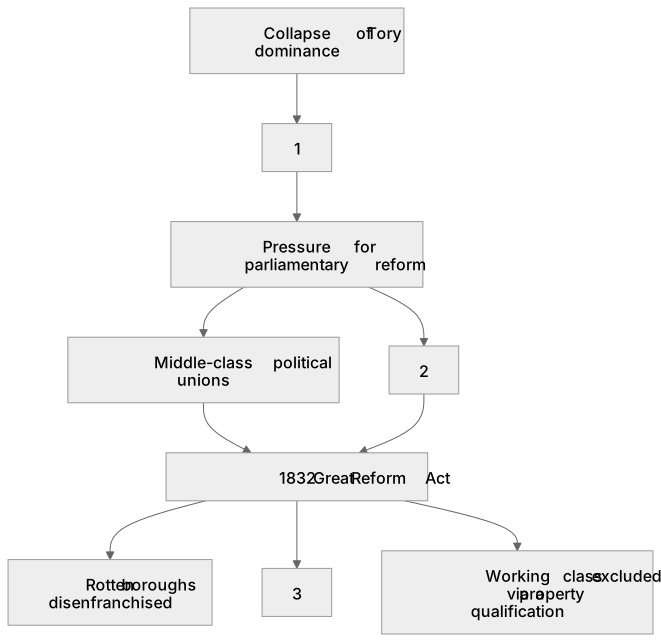
Some boxes have lost their names. Pick the right name for each number.
1Box 1
2Box 2
3Box 3
There is more to this lesson
The full lesson goes on to check your understanding and help you earn the marks. Create a free account to carry on, with your progress saved.
A week of Premium from your first lesson · Then the free plan continues · No card, no charge
Test your understanding of 1F Industrialisation and the people: Britain, c1783–1885 – Government and a changing society, 1812–1832: Greater democracy: the election of the Whigs; pressure for parliamentary reform; the Great Reform Act and its impact; the state of Britain politically, economically and socially by 1832
Active recall beats re-reading. Take an instant quiz now to test what you’ve learned and lock it into long-term memory.
A week of Premium from your first lesson · Then the free plan continues · No card, no charge