AQA · A-Level · History
Course version: 7042 · Version from Sept 2017
Britain, c1783–1885 – Government and a changing society, 1812–1832:…
Full specification wording
1F Industrialisation and the people: Britain, c1783–1885 – Government and a changing society, 1812–1832: Pressures for change: Luddism and radical agitation; the anti-slavery movement; Methodism; early socialism and the ideas of Robert Owen
Between 1812 and 1832, Britain faced immense pressures for change.
Checked against the AQA 7042 specification (opens in a new tab) on .
- Point 5 of 6
- 4 key terms
Study notes
From the checked teaching notes for this specification point.
The idea
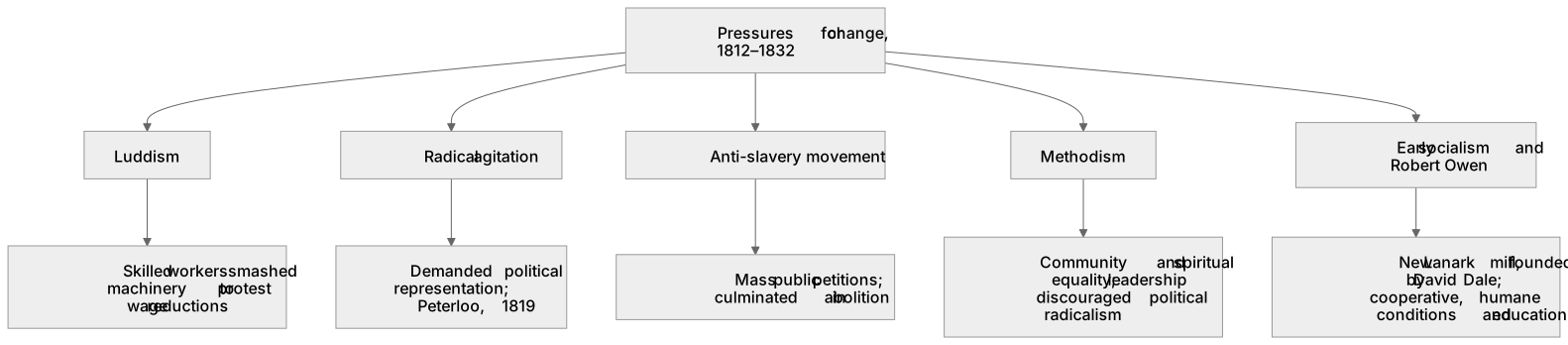
Between 1812 and 1832, Britain faced immense pressures for change. Luddism emerged as skilled workers smashed machinery to protest wage reductions, while radical agitation, seen at Peterloo (1819), demanded political representation. The anti-slavery movement gained momentum through mass public petitions, culminating in abolition. Methodism expanded rapidly, offering the working classes community and spiritual equality, though its leadership discouraged political radicalism. Concurrently, early socialism developed through the ideas of Robert Owen. At the New Lanark mill, founded by David Dale, Owen demonstrated that cooperative, humane conditions and education could improve both industrial productivity and workers' moral character.
What earns the marks
- Explain the economic motivations behind Luddism, distinguishing it from mindless vandalism against technology.
- Analyse the methods and impact of radical agitation, such as the Spa Fields riots and the Peterloo Massacre.
- Evaluate the role of grassroots campaigning and parliamentary pressure in the success of the anti-slavery movement.
- Assess the dual role of Methodism in providing working-class respectability while acting as a conservative force against revolution.
- Describe Robert Owen's utopian socialist experiments at New Lanark and their influence on the cooperative movement.
Common mistakes and how to put them right
Assuming Luddites were simply anti-technology.
Put it right: They were actually protesting the use of machines to bypass standard labour practices and reduce wages.
Conflating Methodism with political radicalism.
Put it right: While it empowered workers socially, its leadership, like Jabez Bunting, actively discouraged political rebellion.
Crediting the abolition of slavery solely to William Wilberforce.
Put it right: This ignores the massive grassroots petitioning and the agency of enslaved people in revolts.
Stating that Robert Owen founded New Lanark.
Put it right: It was established by David Dale, and Owen later managed and transformed it.
Exam tips
- Link these disparate movements to the broader context of industrialisation and the socio-economic distress following the Napoleonic Wars.
- Contrast the methods of pressure used by different groups, such as the violent direct action of Luddites versus the moral persuasion of the anti-slavery movement.
- Use Robert Owen's management of New Lanark as a specific case study to illustrate early socialist alternatives to unrestrained capitalism.
Try the lesson
The start of the 1F Industrialisation and the people: Britain, c1783–1885 – Government and a changing society, 1812–1832: Pressures for change: Luddism and radical agitation; the anti-slavery movement; Methodism; early socialism and the ideas of Robert Owen lesson, made from checked teaching notes for this specification point.
Have a go first
What was a central feature of the early socialist ideas promoted by Robert Owen in the early 19th century?
Listen
Between 1812 and 1832, Britain faced immense pressures for change. Luddism emerged as skilled workers smashed machinery to protest wage reductions, while radical agitation, seen at Peterloo (1819), demanded political representation. The anti-slavery movement gained momentum through mass public petitions, culminating in abolition. Methodism expanded rapidly, offering the working classes community and spiritual equality, though its leadership discouraged political radicalism. Concurrently, early socialism developed through the ideas of Robert Owen. At the New Lanark mill, founded by David Dale, Owen demonstrated that cooperative, humane conditions and education could improve both industrial productivity and workers' moral character. A strong answer earns marks for these points. Explain the economic motivations behind Luddism, distinguishing it from mindless vandalism against technology. Analyse the methods and impact of radical agitation, such as the Spa Fields riots and the Peterloo Massacre. Evaluate the role of grassroots campaigning and parliamentary pressure in the success of the anti-slavery movement. Assess the dual role of Methodism in providing working-class respectability while acting as a conservative force against revolution. Exam tip: Link these disparate movements to the broader context of industrialisation and the socio-economic distress following the Napoleonic Wars.
See it
Key words
Say what each word means before you turn the card.
Luddism
Try answering aloud or in your head before turning the card.
Radical agitation
Try answering aloud or in your head before turning the card.
Methodism
Try answering aloud or in your head before turning the card.
Early socialism
Try answering aloud or in your head before turning the card.
See every definition
- Luddism
- Skilled workers smashed machinery to protest wage reductions.
- Radical agitation
- Demanded political representation, as seen at Peterloo in 1819.
- Methodism
- Expanded rapidly, offering the working classes community and spiritual equality, though its leadership discouraged political radicalism.
- Early socialism
- Developed through the ideas of Robert Owen, demonstrated at the New Lanark mill.
Label the diagram
Some boxes have lost their names. Pick the right name for each number.
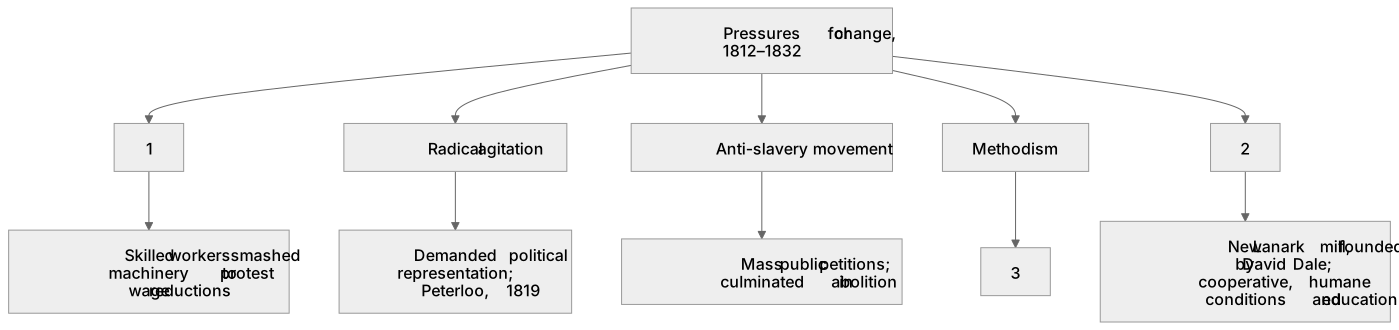
1Box 1
2Box 2
3Box 3
There is more to this lesson
The full lesson goes on to check your understanding and help you earn the marks. Create a free account to carry on, with your progress saved.
A week of Premium from your first lesson · Then the free plan continues · No card, no charge
Test your understanding of 1F Industrialisation and the people: Britain, c1783–1885 – Government and a changing society, 1812–1832: Pressures for change: Luddism and radical agitation; the anti-slavery movement; Methodism; early socialism and the ideas of Robert Owen
Active recall beats re-reading. Take an instant quiz now to test what you’ve learned and lock it into long-term memory.
A week of Premium from your first lesson · Then the free plan continues · No card, no charge