AQA · A-Level · History
Course version: 7042 · Version from Sept 2017
Britain, c1783–1885 – Political change and social reform, 1832-1846…
Full specification wording
1F Industrialisation and the people: Britain, c1783–1885 – Political change and social reform, 1832-1846 (A-level only): Economic developments: the railway 'revolution' and associated economic growth; agriculture and Corn Law repeal
The period witnessed profound economic shifts, notably the railway 'revolution' of the 1840s.
Checked against the AQA 7042 specification (opens in a new tab) on .
- Point 5 of 6
- 3 key terms
Study notes
From the checked teaching notes for this specification point.
The idea
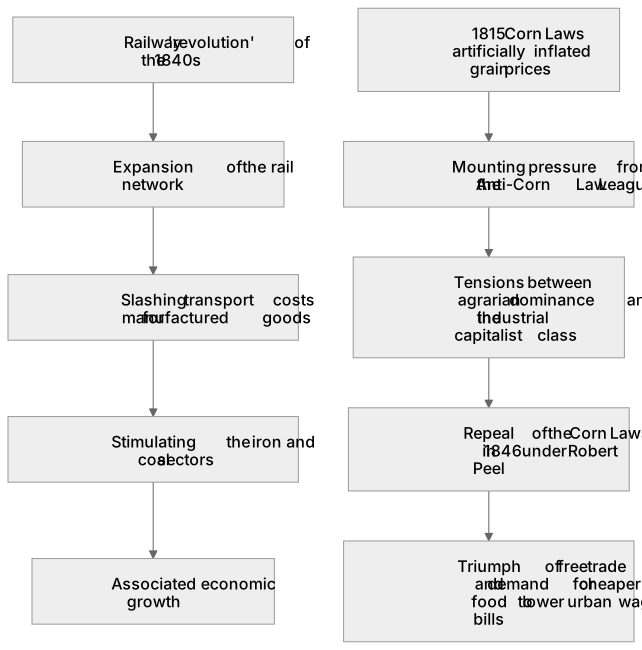
The period witnessed profound economic shifts, notably the railway 'revolution' of the 1840s. The expansion of the rail network catalysed associated economic growth by slashing transport costs for manufactured goods, directly stimulating the iron and coal sectors. Concurrently, agriculture faced significant transformation. To protect domestic farming, the 1815 Corn Laws had artificially inflated grain prices, but mounting pressure from the Anti-Corn Law League highlighted tensions between traditional agrarian dominance and the industrial capitalist class. This culminated in the momentous repeal of the Corn Laws in 1846 under Robert Peel, reflecting the triumph of free trade and the demand for cheaper food to lower urban wage bills.
What earns the marks
- Explain how the railway 'revolution' of the 1840s stimulated demand for coal and iron, driving broader industrial growth.
- Analyse the economic impact of agricultural protectionism and the subsequent effects of the Corn Law repeal in 1846.
- Evaluate the shift from canal to rail transport and its effect on the speed and cost of moving raw materials and finished goods.
- Assess the growing economic influence of the industrial middle classes who successfully campaigned for the repeal of the Corn Laws.
Common mistakes and how to put them right
Claiming the Corn Laws were repealed earlier in the century.
Put it right: Note that while opposition grew significantly earlier, actual repeal occurred under Peel in 1846.
Understating the scale of the railway network expansion.
Put it right: Specify that the major 'Railway Mania' occurred in the 1840s, fundamentally transforming the national economy.
Treating agriculture as entirely stagnant before 1846.
Put it right: Acknowledge that while protected by the Corn Laws, agriculture was still adapting to price fluctuations and early mechanisation.
Exam tips
- Use the 'Railway Mania' of the 1840s as a concrete example of how transport innovation directly facilitated industrial expansion and capital investment.
- When discussing the Corn Law repeal, explicitly link agricultural protectionism to the economic grievances of the industrial working and middle classes.
- Contrast the economic interests of the landed aristocracy with those of the emerging manufacturing elites to explain the political tensions leading to 1846.
Try the lesson
The start of the 1F Industrialisation and the people: Britain, c1783–1885 – Political change and social reform, 1832-1846 (A-level only): Economic developments: the railway 'revolution' and associated economic growth; agriculture and Corn Law repeal lesson, made from checked teaching notes for this specification point.
Have a go first
Which transport innovation of the 1820s–1840s most directly reduced the cost of moving heavy goods such as coal and raw cotton across Britain?
Listen
The period witnessed profound economic shifts, notably the railway 'revolution' of the 1840s. The expansion of the rail network catalysed associated economic growth by slashing transport costs for manufactured goods, directly stimulating the iron and coal sectors. Concurrently, agriculture faced significant transformation. To protect domestic farming, the 1815 Corn Laws had artificially inflated grain prices, but mounting pressure from the Anti-Corn Law League highlighted tensions between traditional agrarian dominance and the industrial capitalist class. This culminated in the momentous repeal of the Corn Laws in 1846 under Robert Peel, reflecting the triumph of free trade and the demand for cheaper food to lower urban wage bills. A strong answer earns marks for these points. Explain how the railway 'revolution' of the 1840s stimulated demand for coal and iron, driving broader industrial growth. Analyse the economic impact of agricultural protectionism and the subsequent effects of the Corn Law repeal in 1846. Evaluate the shift from canal to rail transport and its effect on the speed and cost of moving raw materials and finished goods. Assess the growing economic influence of the industrial middle classes who successfully campaigned for the repeal of the Corn Laws. A common slip: Claiming the Corn Laws were repealed earlier in the century. Instead, Note that while opposition grew significantly earlier, actual repeal occurred under Peel in 1846. Exam tip: Use the 'Railway Mania' of the 1840s as a concrete example of how transport innovation directly facilitated industrial expansion and capital investment.
See it
Key words
Say what each word means before you turn the card.
Agricultural Protectionism and Free Trade
Try answering aloud or in your head before turning the card.
Transport Revolution
Try answering aloud or in your head before turning the card.
Class Conflict
Try answering aloud or in your head before turning the card.
See every definition
- Agricultural Protectionism and Free Trade
- Protection of domestic farming through the 1815 Corn Laws, which artificially inflated grain prices, set against the triumph of free trade in the 1846 repeal.
- Transport Revolution
- The railway 'revolution' of the 1840s, whose expansion slashed transport costs for manufactured goods and drove broader industrial growth.
- Class Conflict
- Mounting tensions between traditional agrarian dominance and the industrial capitalist class, highlighted by pressure from the Anti-Corn Law League.
Label the diagram
Some boxes have lost their names. Pick the right name for each number.
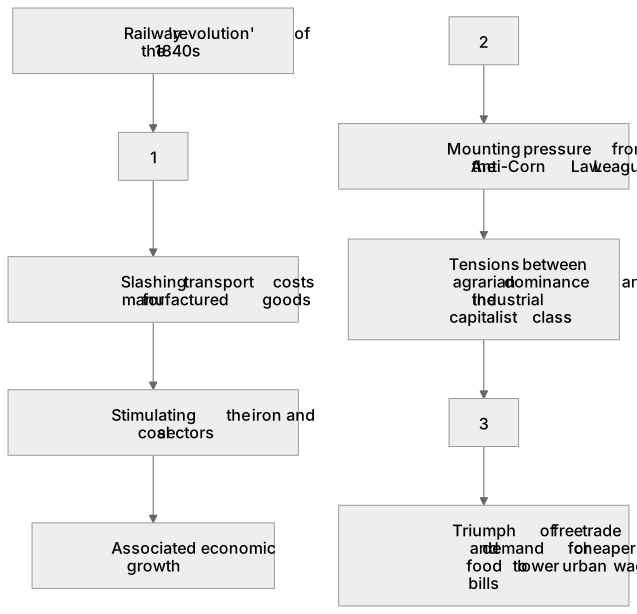
1Box 1
2Box 2
3Box 3
There is more to this lesson
The full lesson goes on to check your understanding and help you earn the marks. Create a free account to carry on, with your progress saved.
A week of Premium from your first lesson · Then the free plan continues · No card, no charge
Test your understanding of 1F Industrialisation and the people: Britain, c1783–1885 – Political change and social reform, 1832-1846 (A-level only): Economic developments: the railway 'revolution' and associated economic growth; agriculture and Corn Law repeal
Active recall beats re-reading. Take an instant quiz now to test what you’ve learned and lock it into long-term memory.
A week of Premium from your first lesson · Then the free plan continues · No card, no charge